I am… what, exactly? Prada's new campaign refuses to tell you
Star-studded cast and surreal visuals turn a fashion ad into a question
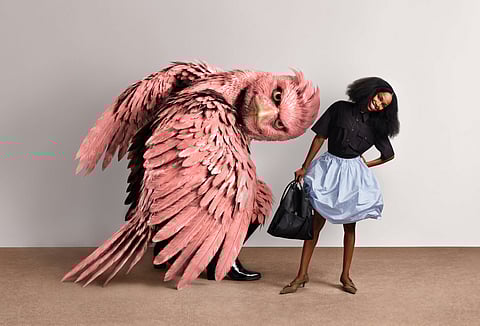
There's a moment in Prada's new Spring/Summer 2026 campaign where the cast - Nicholas Hoult, Carey Mulligan, Damson Idris, Hunter Schafer, among others - chant a mantra together. "I, I, I, I am…" And then: nothing. The sentence doesn't finish. It just hangs there, unresolved, slightly unsettling, daring you to complete it yourself.
That's the whole campaign. And somehow, it's enough.
Get updated faster and for FREE: Download the Gulf News app now - simply click here.
Miuccia Prada and Raf Simons have never been particularly interested in selling you things in the conventional sense. They're more interested in making you think about why you want them. This campaign - technically a "second act" of their SS26 advertising push, with creative direction by Ferdinando Verderi and photography by Oliver Hadlee Pearch - doubles down on that instinct so hard it almost collapses in on itself. Same cast. Same collection. Completely reimagined. The point being, apparently, that nothing is fixed, least of all identity - and least of all Prada.
To pull this off they enlisted Jordan Wolfson, an American artist whose career has been built on making people deeply, productively uncomfortable. Working across animatronics, robotics, virtual reality, holography, digital animation and wall-based pieces, his work has a habit of forcing audiences to confront how technology shapes the way we understand ourselves and each other. He hasn't made a video work since Riverboat Song in 2017-18, a sixteen-channel installation that combined computer animation, found internet footage, pop soundtracks and a deadpan monologue voiced by Wolfson himself into something best described as a fever dream about contemporary media culture. This campaign is his return to the medium. That's not nothing.
Wolfson's contribution here is the creation of what the campaign calls "unnamed, unreal, and dreamlike creatures" - synthetic beings generated through complex visual imaging that interact with the human cast throughout both stills and film. Real people, fake entities, the line between them deliberately blurred.
Now, nowhere in Prada's campaign is "artificial intelligence" mentioned. Not once. And yet it's impossible to watch this take shape in 2026 - with its themes of synthetic identity, human-machine interaction, and the question of what constitutes a "real" self - and not feel the cultural undertow of that conversation pulling at everything. We live in a moment where AI-generated images are indistinguishable from photographs, where deepfakes of celebrities circulate freely, and where the question of "what is real?" has moved from philosophy seminar to group chat. Prada is wading directly into that water.
But here's where it gets interesting: by choosing Wolfson - who has been interrogating exactly these themes since long before the AI boom made them fashionable - Prada sidesteps any accusation of trend-chasing. This isn't a brand slapping "AI" on a campaign to seem relevant. It's something more thought through. Wolfson's discomfort with technology predates the current moment; his synthetic creatures feel less like a generative AI output and more like something that crawled out of a fever dream about what technology does to human consciousness. The difference matters.
The cast itself is doing real work here too. Mulligan, freshly appointed CBE for services to drama, about to appear as a grieving mother in Greta Gerwig's Narnia: The Magician's Nephew. Idris, who just co-starred in F1. Schafer, whose forthcoming Blade Runner 2099 on Amazon Prime Video - due later this year - makes her an almost too-perfect choice for a campaign about synthetic reality. Levon Hawke - son of Ethan Hawke and Uma Thurman, just finding his footing in cinema - alongside John Glacier, the Hackney rapper-poet whose debut album Like A Ribbon, released this past February to universal critical acclaim, announced her as one of the more genuinely singular voices in British music. And then there's Liu Wen - the Chinese model who in 2017 became only the second Chinese model ever to appear on the cover of American Vogue, and whose presence here is a reminder that Prada's idea of plurality has always extended to who gets to be in the room. It's a cast assembled not for fame alone but for the ideas they represent: genre-crossing, boundary-blurring, hard to categorise.
Which is, of course, the point.
"I, I, I, I am…" The stutter at the beginning is worth pausing on. It's not just "I am." The repetition of the first-person pronoun, four times before the verb even arrives, feels almost glitchy. Like a system trying to boot up. Like something - or someone - asserting its existence before it's entirely sure what that existence consists of.
In the context of a fashion campaign, that's a provocative place to plant a flag. Fashion has always been in the identity business, but usually it offers answers: wear this, be this. Prada SS26 is doing the opposite. It's offering the question instead, and leaving you alone with it.
Whether that translates to someone buying a bag is, presumably, Miuccia and Raf's problem. As an artistic proposition, though, it's one of the more genuinely interesting things a luxury house has done in recent memory - a campaign that treats its audience as intelligent enough to sit with ambiguity, and trusts that the unfinished sentence is more compelling than any answer could be.
I am…
Yeah. Exactly.
Jordan Wolfson's collaboration with Prada for Spring/Summer 2026, with campaign creative direction by Ferdinando Verderi and photography by Oliver Hadlee Pearch, is out now.


