Look: Kung Fu robots make jawdropping dance moves, Jackie Chan sings 'We Are the World' with Lionel Ritchie
Festival highlights 'We Are the World': From gala robot dances to unfiltered viral magic
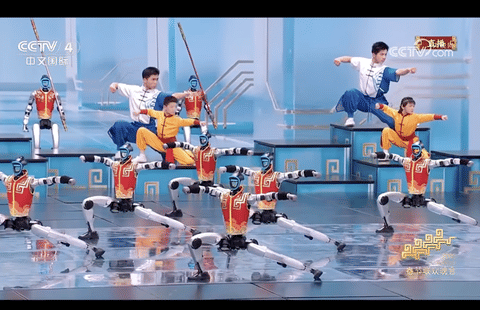
Humanoid robotics is transforming from science fiction to reality at an unprecedented speed, with China leading the charge not just in tech, but in soft power, led no less by Jackie Chan.
The 2026 Spring Festival Gala amplified its viral magic when the Hong Kong legend belted out We Are the World with American icon Lionel Ritchie.
The event was showcased at the Yiwu, one of China's biggest cultural spectacles.
Penned by Richie and Michael Jackson in 1985 for famine relief, the anthem's cross-cultural revival stirred tears across billions of viewers, symbolising unity amid global divides.
"OMG! Everyone in China cries, crazy!" a tweep exclaims.
With 13.5 billion new media views, this performance underscores the gala's soft power, blending East-West harmony.
It's a wholesome antidote to online noise — pure, feel-good vibes that prove music still heals.
Humanoids steal the show
Still, the dancing robots show something fundamental: the mainland is outpacing the West in humanoid robot deployment while exporting "robot economies."
Example: What began as basic Yangko dances in 2025 by Unitree's robots escalated in 2026 to jaw-dropping feats: high-speed parkour vaults, Drunken Fist martial arts, nunchaku spins, 3-metre aerial flips, and airflare rotations.
These are powered by self-developed dexterous hands, force feedback, and cluster coordination reaching 4 m/s.


Global Times reports that this leap reflects “broader advances”.
Chinese firms now command nearly 90% of the global market, shipping 13,000–18,000 units in 2025 alone — up from negligible volumes.
Government backing for robot makers
Top players like Unitree (5,500 units sold) and AgiBot (over 5,000) outpace Western rivals like Tesla's Optimus, which sold just ~150.
Government backing is pivotal.
Under the 14th Five-Year Plan and "Made in China 2025," over 140 companies receive subsidies, fostering a mature supply chain “cluster” in motors, sensors, and AI.
Robots like UBTECH's Walker S2 are in mass production (with aggressive targets in 2026), deployed in factories for assembly and quality checks, elder care for a shrinking workforce (23% over 60), logistics, and even border patrols.
Innovations abound
Unitree's G1 endures -47°C treks (130,000 autonomous steps), builds its own kind in smart factories, and integrates embodied AI for human-like dexterity.
Fourier's GR-3 emphasizes care, while X-Humanoid's platforms push tactile interaction.
China's supply chain "cluster" strategy concentrates interconnected manufacturers, suppliers, and R&D in specific geographic hubs to achieve cost efficiencies, rapid iteration, and reduced external dependencies in high-tech sectors.
Clustering strategy
Clusters integrate the full value chain — from raw materials to final assembly — within one relatively contiguous area, minimising logistics delays and enabling quick prototyping or customisation.
Government policies like Made in China 2025 provide subsidies, tax breaks, and infrastructure to scale these “hubs”.
This helps foster “innovation spillovers” among firms.
More practically, this setup lowers risks from disruptions and supports "self-reliance" by localising critical tech.
The robotics industry in China is highly concentrated in several key regions, with the Yangtze River Delta, Pearl River Delta, and Beijing-Tianjin-Hebei areas serving as the primary hubs. These clusters benefit from strong policy support, mature supply chains, and a high concentration of research institutions.
“Robot Valley”
For example, Shenzhen (known as the “Robot Valley” on the Pearl River Delta), is a major hub for robotics, particularly in AI and humanoid robots, with literally thousands of robotics firms.
The Nanshan District also hosts a “Robot Valley” with companies like UBTECH, Dobot, and Unitree. The city is aggressively building a 100-billion-yuan humanoid robot sector.
Shanghai (Yangtze River Delta) is a key hub for industrial automation and robotics, featuring the first robot-themed industrial park in the Lingang Special Area. It has a high concentration of foreign and local robotics giants.
Beijing (Jing-Jin-Ji) focuses on "embodied intelligence" and high-end robotics, particularly in the Beijing Economic-Technological Development Area (Yizhuang), which hosts over 300 robotics companies.
Others are found in Hangzhou (Zhejiang Province), an emerging tech hub for humanoid and quadruped robots (with over 200 robot-related companies), and Wuhu (Anhui Province), which has a rapidly-growing hub, with hundreds of robotics companies, including Efort Intelligent Equipment.
Shenyang in northeast China is another robotics manufacturing base, anchored by Siasun Robot & Automation.
Challenges
Challenges persist — battery endurance, cost, and full autonomy — but intense internal competition, IPOs (Unitree, AgiBot) and scaling signal a multi-billion-dollar future.
By addressing labour shortages, these companies are not just catching up; they are redefining robotics.
In a LinkedIn post, venture capitalist Arshad Chowdhury highlighted the mainland's geo-strategic advantage.
"China’s robotics ecosystem is faster and cheaper to build in. Western teams struggle to match it, and this really starts to show when competition heats up," Chowdhury stated.
"Capabilities and go-to-market still matter, but the long-term moat increasingly lives in supply-chain control, manufacturing partnerships, and the ability to iterate hardware at speed."


