China launches world's first offshore wind-powered underwater data centre
China’s undersea hub taps 95% green power to tackle data centres’ cooling crisis
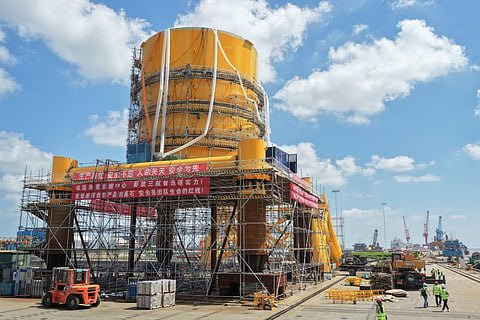
Dubai: China has become the first country in the world to operate an underwater data centre powered by offshore wind, a milestone that could reshape how the global technology industry approaches one of its most pressing problems - cooling its servers without consuming vast amounts of energy and fresh water.
The Shanghai Lingang undersea data centre sits roughly 30 feet below the surface of the ocean, about 10 kilometers off Shanghai's southern coast in the city's Lingang Special Economic Zone. Built at a cost of approximately $226 million, the facility is a joint venture between HiCloud Technology, a private subsea infrastructure firm, and China Communications Construction, a state-owned enterprise.
Get updated faster and for FREE: Download the Gulf News app now - simply click here.
How does it work?
Running a data centre is expensive, not just because servers need power, but because keeping those servers from overheating requires enormous amounts of energy.
According to Wired, in a typical land-based facility, cooling systems account for 40 to 50 percent of total electricity use. In some designs, that means pumping chilled water continuously around racks of servers around the clock.
The Lingang centre sidesteps much of this by being submerged. The surrounding ocean provides natural cooling, dramatically reducing the need for energy-hungry air conditioning systems. And rather than drawing power from the grid, the facility connects directly to a nearby offshore wind farm, meaning more than 95 percent of its electricity comes from renewable sources.
According to the Chinese government, compared to traditional onshore data centres, the project:
Uses more than 95 per cent green electricity
Reduces energy consumption by 22.8 per cent
Eliminates water use entirely (100 per cent reduction)
Cuts land use by more than 90 per cent
Why does this matter?
Data centres are often described as the physical backbone of Artificial Intelligence (AI) and their resource demands are growing fast.
As The Guardian reports, in a traditional land-based data centre, anywhere between 25 per cent and 40 per cent of total electricity demand comes from the need to pipe chilled water around servers to prevent overheating. They also consume significant amounts of fresh water.
The United Nations University Institute for Water, Environment and Health warned on June 3 that water consumption by data centres could rise to 9.3 trillion liters a year by 2030 as AI demand increases. Moving data centres underwater eliminates the need for freshwater supplies entirely.
China is not the first to attempt this. Microsoft ran a similar experiment, Project Natick, submerging a data centres pod off the coast of Scotland. The results were technically promising, but Microsoft shelved the project in 2024, citing economics and the difficulty of servicing submerged equipment.
China turned the same concept into a working commercial facility. HiCloud had already opened the world's first commercial underwater data centre in 2023 in Hainan, southern China but that facility was not wind-powered. The Lingang complex is the first to combine offshore wind with subsea infrastructure at commercial scale.
For an industry under pressure to reduce its energy and water use, underwater data centres offer a promising alternative.
But real questions remain, including long-term maintenance costs, scalability across different environments, and whether the economics work outside of a state-backed model. The technology has proven it can work. Whether it can work for everyone is still unclear.


