SpaceX's biggest Starship win yet brings Moon missions one step closer
SpaceX nails historic ocean splashdown, deploys satellites, and clears biggest hurdle yet
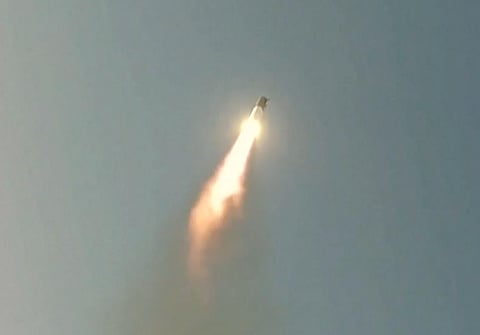
SpaceX's 13th Starship test flight on July 24 marked the company's most successful Starship mission to date.
While not every objective was perfect, the flight achieved several milestones.
The new milestones had never been completed together before, giving engineers critical data for future Moon and Mars missions.
The biggest headline wasn't simply that Starship, the world's biggest rocket, launched — it was that it:
survived reentry
completed its mission
splashed down intact in the Indian Ocean,
continued transmitting telemetry afterward.
For a vehicle designed to eventually be fully reusable, that's a huge leap forward.
Launch: Latest Starship rocket lifted off at 5:51 pm CDT on July 24, 2026 (2:51 AM GST on July 25, 2026)
What was achieved?
1. Rocket intact following reentry: Starship survived reentry intact
Earlier Starship flights often ended with explosions or loss of the spacecraft during reentry.
This time, the vehicle:
Reentered Earth's atmosphere
Maintained control
Protected itself with its upgraded heat shield
Landed in the Indian Ocean largely intact
SpaceX engineers celebrated because it was the first time an intact Starship had been recovered in the water.
As SpaceX spokesperson Dan Huot put it: "This is the first time we've put an intact Starship in the water."
2. Data gathering: Starship kept transmitting data after splashdown
Perhaps even more valuable than the landing itself, Starship continued sending telemetry after touching down.
That means engineers can study:
Heat shield performance
Structural loads
Landing dynamics
Vehicle temperatures
Hardware health
Instead of guessing what happened during reentry, SpaceX now has real-world engineering data.
Starship Version V3: A 124-metre stainless-steel giant (2x more powerful as NASA’s 98-metre Space Launch System (SLS), the next-largest operational rocket .
3. Payload milestone: 20 Starlink V3 satellites were successfully deployed
The mission also tested Starship's ability to function as a next-generation Version 3 internet and direct-to-cell satellite launcher.
The upper stage released:
20 Starlink Version 3 satellites
These deployment tests are important because Starship is expected to become SpaceX's primary launcher for its next-generation Starlink constellation.
The deployment involves next-gen Starlink V3 internet satellites via a payload dispenser while in a suborbital trajectory.
4. Thermal Protection: The new heat shield passed another major test
One of the biggest goals was evaluating improvements made after May's flight.
SpaceX had redesigned parts of:
heat shield tiles
hardware
onboard software
The spacecraft survived atmospheric heating, providing engineers with valuable information for future flights.
Dan Huot described the result as a "dream scenario" for collecting heat shield data.
This allows the test team to evaluate upgraded heat shield tiles and new aft skirt attachment mechanisms under real aerodynamic and re-entry conditions.
Liftoff Thrust: Starship V3 generates over 18 million pounds (approx. 80 meganewtons) of thrust using 33 Raptor 3 engines, whereas SLS produces about 8.8 million pounds of thrust. Payload Capacity: Starship V3 is designed to lift over 100 to 150+ metric tons to low Earth orbit (LEO) in reusable configurations (and even more if expendable).
5. Landing result, so far: The booster mostly succeeded — though it wasn't perfect
The Super Heavy booster also completed its return, although not flawlessly.
According to SpaceX:
Not all planned landing engines ignited.
The landing burn was harder than intended.
The booster hit the ocean faster than expected.
While this means more work remains on booster recovery, SpaceX still collected valuable data.
Why this matters
This wasn't simply another test launch.
It demonstrated that SpaceX is steadily solving the hardest engineering problems needed to make Starship reusable.
Those include:
surviving orbital reentry
protecting the heat shield
maintaining vehicle control
deploying payloads
recovering usable flight data
Each successful test reduces technical risk for future missions.
Why NASA is watching closely
NASA has selected Starship as the lunar lander for future Artemis Moon missions.
To carry astronauts safely to the Moon, Starship must repeatedly prove it can:
survive spaceflight
operate reliably
land safely
be reused
Following the flight, NASA Administrator Jared Isaacman shared an image of Starship passing the Moon, writing:
"Pretty clear from this shot that SpaceX knows where we are going!"
Why investors care
This was also Starship's first test flight since SpaceX's public market debut in June.
A successful mission boosts confidence in several long-term business plans, including:
expanding the Starlink satellite network
dramatically lowering launch costs
supporting NASA lunar missions
enabling future Mars exploration
developing large-scale space infrastructure
The July 24 flight wasn't a perfect landing — but it may have been Starship's most important success yet.
In short
For the first time, SpaceX launched its newest-generation Starship, deployed satellites, survived atmospheric reentry, splashed down intact in the ocean, and continued transmitting engineering data afterward.
While the booster's landing burn still needs refinement, the mission cleared one of the biggest remaining hurdles toward making Starship a fully reusable spacecraft.
For SpaceX, that's a major step toward supporting future Moon missions, expanding Starlink, and ultimately pursuing its long-term goal of sending humans to Mars.


