Inside Trionda, Adidas’ most tested ball ever
Adidas football innovation lead Schaefke breaks down innovation behind 2026 World Cup ball
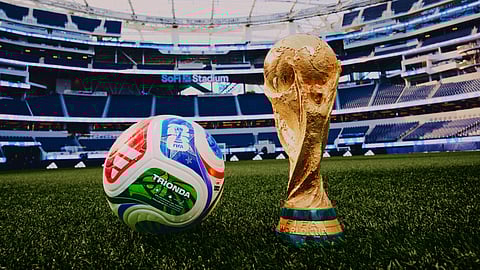
Dubai: Have you ever wondered how different football history might look if today’s technology had existed in past World Cups? Diego Maradona’s “Hand of God”, Frank Lampard’s disallowed goal against Germany in 2010 or Carlos Tevez’s offside strike for Argentina against Mexico that same year would almost certainly have been judged differently.
These moments highlight how thin the margins can be, and they form the backdrop to Trionda, adidas’ Official Match Ball for the Fifa World Cup 2026. The tournament will span the United States, Canada and Mexico across 16 cities with different climates, altitudes and atmospheres unlike any edition before it.
Trionda blends “Tri” and “onda”, or three waves. Its colours reflect the three host nations, while gold references the trophy. Stars, eagles and maple leaves appear as graphics and embossed textures designed to improve grip. Behind that look sits one of the most complex engineering projects adidas has attempted.
When Adidas football innovation lead Hannes Schaefke spoke to Gulf News, the first question came naturally: would a World Cup played across so many environments force adidas to rethink how a ball is engineered?
“Yeah, I would say the answer to that is yes, it does,” Schaefke explained. “From the moment the host nations were public and we basically knew where and at which altitudes, temperature conditions, just environmental conditions as a whole the game would be played at the World Cup in 2026. That is a consideration that influences a World Cup specific product like the World Cup ball.”
The core challenge was physics
“We will not be able to change the laws of physics,” he said. “Altitude and temperature have an impact on the ball. When it comes to, pressure changes are just realities for us to consider. But also in terms of flight behaviours in terms of the density of the air. That is something to consider.”
To prepare, Trionda had to be tested in the exact environments it will face. “You want to make sure that your product is validated in those exact environmental conditions as well,” Schaefke said. “When it comes to making sure the ball performs at Mexico City altitude as much as at Vancouver altitude for instance, that is something that we wanted to cater for both from a simulation standpoint with our university partners, and from research and field-testing standpoint.”
The travel required was significant
“The team has been to six of the host cities to test locally with clubs,” he said. “Normally we hardly go that far to retest in so many cities across the globe, but for a World Cup ball the magnitude of exposure makes it absolutely worth going to those extras.”
The extremes mattered most
“You want to make sure that you test in those extreme conditions,” he added. “From the low to the high, mild to the extreme. We also tested in the United States. It is not just altitude. Climate conditions vary across the three host nations and we wanted to reflect that.”
Player feedback shaped the development just as much. While Adidas does not disclose names, Schaefke outlined the process.
“For these types of products, particularly when it comes to the ball, what we want to make sure of is we make use of that big portfolio of clubs and players,” he said. “We focus on players who are into set pieces, like those who take free kicks. We test with goalkeepers for obvious reasons.”
He continued with another layer of detail. “And with strikers who have a strong point of view on how the ball behaves and reacts to shots. It even comes down to how it sounds. These are things we want to cover so it is not throwing anybody off.”
Neutral feedback
Adidas also looked for neutral feedback, bringing in players not affiliated with the brand.
“We test other clubs and with competitor players as well,” he said. “They do not carry any bias from us as a brand and give us their honest perspective. We appreciate that.”
But the moment that carried the most risk was hidden inside the ball.
Trionda is only the second connected World Cup ball after Qatar 2022. The chip, however, has shifted from a suspended centre mount to a new position on the side of the bladder. That change could have altered balance or feel, so the stakes were high.
“We were very curious about how players would react to a chip placed in that specific location,” Schaefke admitted. “I can tell you that from the first test we did, it was surprisingly positive. With a technology like that, our goal is to make it undetectable by a player so players would not be able to distinguish a ball with that chip inside from a ball that does not have our regular inline product that we sell.”
He added that Adidas had been preparing for years. Qatar 2022, the Women’s World Cup, Euro 2024 and the 2025 Club World Cup in the US were all used to refine the system.
“Throughout all these stages it was about making sure players couldn’t detect it,” he said.
The construction change triggered the most extensive testing programme Adidas has ever run.
“With that switch, that slight change of technology in terms of the construction, we went the extra mile for that,” Schaefke said. “It is the by far most tested Adidas ball ever.”
The first phase centred on psychology
“We started with blind tests, not telling players anything and just throwing it into the club’s training,” he explained. “Later we told them there were two versions and asked if they could detect which one was which. You have a row of five balls, some with the chip, some without, and you listen to their feedback.”
He described how the tests escalated. “Step by step you give out more information to see if players can distinguish them. There is some psychology behind that.”
The outcome was exactly what Adidas needed.
“The conclusion was for us that no player would ever be able to detect it or distinguish it, which is great,” he confirmed.
Laboratory work followed
“A large battery of lab tests that we carry out,” he said. “Starting from things like sphericity. Balance is a big topic, especially if you place a chip on the side wall of the bladder. Intuitively you would think, is the ball still round, does it wobble. Kudos to our engineering team who basically did the trick to balance it out with counterweights catering for a perfectly balanced bladder and connected ball.”
The internal standards were unforgiving.
“We have far tighter margins of error versus Fifa has,” he said. “It is really, really tight margin expectations.”
Then came the robot
“We have our kicking robot there where we put 100 balls on that robot and make sure the flight path is super accurate,” he explained. “All these things combined basically make a large portfolio of tests that we then look at and say, all right, is it ready or not. Throughout those stages, honestly speaking, Trionda came out solid.”
Before the Maradona question arrived, Schaefke shifted to the role Trionda plays in fairness. The modern game relies heavily on VAR, and he felt the connected ball has already changed key moments.
“The modern game has some implications and VAR is something that the modern game cooperates with,” he observed. “Some of the disruptions you see when the referee is running off the pitch and is looking at the screen, particularly in those aspects when it comes to handball detection.”
He cited Euro 2024. “Speaking as a German, we had the Euros and we had that technology played at the Euros last year and we benefited from it. There was a referee who basically oversaw, I think it was quarterfinals or so against Denmark. Referee did not detect a handball from a Danish player in the box and that was only detected by that technology.”
Those moments illustrated the impact. “Those are black or white instances where that technology and no other technology can provide more fairness because it detects things like head or not,” he said. “We are never going to take out the full potential for errors because eventually we are not taking away any decision. There is no automatic decision taken by the technology. It is always going to be the referee. What we can do is provide them with more and better information to make better and faster decisions.”
Offsides benefit too
“In the Premier League we have seen the referee scrolling back and forth between frames trying to detect when exactly a pass is being played,” he explained. “The ball provides a signal at 500 times per second. You can exactly calibrate that line.”
Then came the Maradona question. How fast would today’s chip detect a handball?
“On the spot,” he answered. “The ball reacts to anything. You can tick on the ball, you can tickle the ball a bit, and the accelerometer gives you a signal immediately.”
He referenced a 2022 World Cup incident. “Ronaldo was claiming a goal for himself,” he said. “But there was actually no signal, so the ball provided the info that he did not touch the ball with his head.”
“The stakes are high when it comes to major decisions like handball penalty or not, offside or not,” Schaefke added. “At a semi-final or even a final of a World Cup it has major implications.”
Trionda’s appearance also reflects function. The ball uses only four panels, compared to 20 in 2022 World Cup.
“Panel shape carries functional implications,” he said. “Those grooves between individual panels play a role to make balls stable in flight. In the past times there was a belief that you need the ultimate sphere without grooves. We learned that this makes the ball behave unpredictably. Modern balls feature those grooves.”
The design blends engineering with aesthetics
“It is a mix between a design effort looking at the fluidity of the game, the idea of waves,” he said. “At the start of every creation process we test a bunch of generated panel shapes to really optimise that effort and put them through aerodynamics tests.”
Simulation came first
“We are partnering with teams at universities that normally look at rockets and how they fly,” he explained. “The level of in-depth simulation ahead of any materialisation or prototype is huge. A selection of those then go into actual physical testing. The robot repeats the shot one to one and we look at stability, flight curve and assess what the best option is.”
Players will feel differences in texture, debossing and panel shape but performance should only improve.
“Players would detect differences because of texture, debossing and panel shape,” Schaefke said. “Functionally we try to continue to improve performance. Things like stability, accuracy and speed are enhanced. The sensation you want to generate is confidence.”
After three nations, 16 cities, altitude modelling, blind trials, competitor testing, laboratory analysis and 100 robot strikes, the goal is simple: players should feel nothing unusual and referees should see everything clearly.
And whatever unfolds next summer, one truth remains.
In 2026, the ball will know exactly what happened.


