The 15-minute city: Dubai’s next urban shift explained
On Earth Day, greener living means smart planning, not just more trees
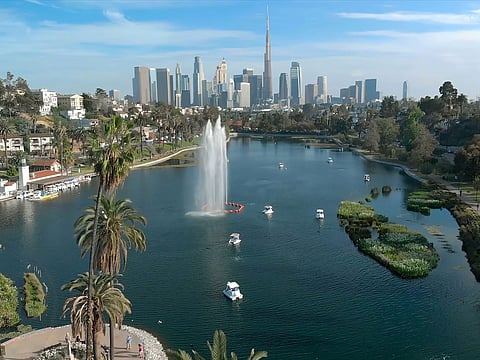
The “15-minute city” has gone from urban-planning buzzword to a rather sensible idea: if people can get to work, school, shops and parks without embarking on a daily expedition, cities become healthier, happier and less exhausting places to live.
Before cities were carved up by zoning codes and long commutes, urban life in many places was organised around proximity. Homes near shops, work near markets, and daily necessities within walking distance. Be it London or Dubai, clusters of homes, and local businesses formed neighbourhoods where life unfolded on foot.
What is new now is the scale and intentionality with which cities are trying to bring that logic back.
Dubai’s Blue and Green Spaces Roadmap 2030 is committed to making nature an active part of urban life. The plan includes 1.5 million trees, 120 new parks, 200 sports and recreational spaces, three new beach destinations each year, and a nearly three-fold expansion in beachfront walking, jogging and cycling tracks by 2030.
Mixed-use districts
This is a shift in how neighbourhoods are conceived. Less of the old model in which residents sleep in one place, work in another and spend half their lives in traffic between the two. And more of mixed-use districts where daily life is neatly stitched together.
The 2040 Plan’s targets on transit access, green space and compact hubs give developers and investors something valuable: clarity.

The case for proximity is not hard to grasp. A growing body of research suggests long commutes are associated with lower life satisfaction, poorer mental health and rising fatigue.
Meanwhile, access to parks, trees and waterfronts tends to improve wellbeing, strengthen social ties and reduce stress. Even a short daily dose of urban nature, some studies suggest, can do a person a surprising amount of good.
Shorter journeys and nearby greenery are thus, not just nice-to-haves, but an integral part of a functional city.
Environmental case
The environmental case is just as persuasive. Cities consume more than two-thirds of the world’s energy and produce over 70 percent of carbon-dioxide emissions. Transport is one of the biggest offenders, accounting for roughly 15-20 percent of global greenhouse-gas emissions, most of it from road vehicles. If urban life is built around long car journeys, emissions are effectively designed in. If more people can live, work and unwind within a short distance, the carbon bill begins to shrink.
That is one reason investors are paying attention. Communities that make daily life easier tend to enjoy stronger occupancy, firmer pricing and better rental performance.
Life becomes less cumbersome when offices, schools, amenities and community spaces are embedded into a neighbourhood. The school run is shorter. A doctor’s appointment doesn’t require military-grade planning. Even the commute begins to look less like a test of character.
Dubai enjoys an advantage here that many older cities do not. Much of the city it will become by 2040 is yet to be built, which makes it easier to plan for proximity from the outset rather than retrofit it later at great cost and with much complaining. The 2040 Plan’s targets on transit access, green space and compact hubs give developers and investors something valuable: clarity.
None of this means the work is easy. Dubai, like many modern cities, has inherited car-first layouts that are easier to drive through than walk around. And in a hot climate, “walkable” must mean more than technically possible. It requires serious attention to shade, trees, arcades, pocket parks, microclimates and street-level design that puts human comfort first.
Practical framework
The 15-minute city, in other words, will not be delivered by slogan. It will be delivered by specification.
That is perhaps the most useful way to think about it in Dubai: not as a fashionable urban theory, but as a practical framework. Distance to transit, density of services, access to green and blue space, and the extent to which all of this shows up in lived experience and financial performance; these are the metrics that will matter.
For residents, the prize is straightforward: less time spent getting through the day, and more time actually enjoying it. For investors, “location” is starting to mean something more nuanced than a pin on a map. The question is no longer simply where a property sits, but how much of life can happen around it with minimal friction. In the communities that get that equation right, the future of urban value may already be taking shape.
Mohammed Tahaineh is Chief Project Officer, DAMAC Properties

