Nature doesn’t have to be green to help us unwind
The Gulf’s native landscapes invite us to slow down and connect with where we live
Most of us assume that if you sat someone down in total quiet, with nothing to do and nowhere to be, they would eventually relax. A 2014 study led by psychologist Timothy Wilson at the University of Virginia, published in Science, found something quite different. Participants left alone with their thoughts for as little as six minutes found it so uncomfortable that some chose to give themselves a mild electric shock rather than keep sitting there.
I’ll admit I’m not sure I would have lasted the six minutes either. Stillness, it turns out, isn’t something we naturally default to. It often needs a reason, and somewhere to happen.
I love Dubai’s pace. It’s a city shaped by ambition, innovation and constant reinvention. But it also raises a question I come back to often in my work: in a climate this intense, and a city moving this fast, how do people actually connect with nature?
Grown here, not imported
When we talk about how nature supports our wellbeing, it’s tempting to picture a certain kind of landscape: dense forests, rolling countryside or cool green parks.
But nature does not have to look temperate to be restorative.
A 2022 study in the Journal of Environmental Psychology offers a fascinating counterpoint. Researchers showed 95 desert residents a virtual desert, green or office environments after a stressful experience. Those who saw the desert landscape had lower cortisol and blood pressure than the office group. The researchers suggested that our lived experience of a landscape, and how familiar it feels, may shape how we respond to nature.
Which raises a question for us in the Gulf: have we become too used to thinking that restorative nature must be green?
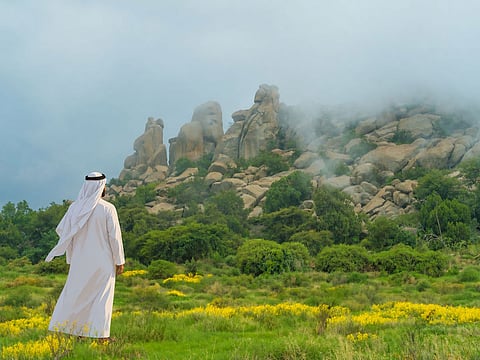
The Gulf has its own ecological language. Ghaf and sidr trees, desert grasses, mangroves, seasonal flowers and the insects and birds they support are all part of landscapes adapted to heat, scarcity and extremes. They may not offer the instant lushness we associate with the word “green”, but they invite a different kind of attention.
A native plant flowering after months of heat is easy to miss. So is the bee visiting it, the bird sheltering in it or the small changes each season brings. But once you start noticing these relationships, a landscape stops being scenery and becomes something alive.
For many of the people who call Dubai home, there’s another layer to this. They didn’t grow up in the UAE, so meeting its native plants isn’t a nostalgic return to something familiar. It’s a first introduction to the ecology of the place they now call home.
Here, the desert isn’t necessarily a memory. It can be an introduction, open to anyone willing to look closely.
From stress relief to attention
Researchers have spent decades exploring why natural spaces seem to affect us differently from built ones.
We have actually known about this for a long time. In 1984, biologist Edward O. Wilson popularised the term “biophilia” in his book Biophilia (Harvard University Press), describing our innate tendency to seek connection with nature and other living things. That same year, Roger Ulrich published a landmark study in Science showing that hospital patients whose window looked out onto trees recovered faster after surgery, needed fewer strong painkillers and went home sooner than patients facing a brick wall.
Also Read: Why every child should grow a plant
One explanation is that nature holds our attention without demanding it. Attention Restoration Theory, developed by Rachel and Stephen Kaplan, suggests that natural environments help replenish the focused attention that everyday life constantly draws on.
Roger Ulrich’s Stress Reduction Theory adds another dimension, looking at how time in natural environments can help us recover from stress.
More recent research backs this up. A 2019 study in Scientific Reports, involving nearly 20,000 people in England, found that spending at least 120 minutes a week in nature was linked to better self-reported health and wellbeing. What I love about this one is that it didn’t seem to matter whether those two hours happened all at once or across shorter visits during the week.
To be clear, access to nature isn’t a substitute for professional care. But it does tell us something useful about how we design cities. The places we move through every day can either add to our mental load or give us small moments of relief from it.
In the Gulf, designing for that relief takes more than adding greenery. A landscape that needs excessive water, struggles in the climate or is too uncomfortable to use for much of the year may look appealing, but it won’t necessarily build a real relationship between people and place.
For me, the more interesting question is how landscapes can work with local conditions, using shade, native and climate-adapted planting, biodiversity and careful use of water to create places where people actually want to slow down and spend time.
A little nature, often
Urban planner Tim Beatley, founder of the Biophilic Cities Network, offers a helpful way to think about this: the Nature Pyramid. Much like a food pyramid, it suggests we need a broad base of everyday nature (the trees on our street, birdsong, a shaded courtyard), topped up by weekly visits to parks, monthly trips further afield and, every now and then, time in real wilderness.
The message is simple. The small, frequent doses matter most.
This sits beautifully with positive psychology, which focuses not only on treating illness but on helping people feel well and flourish day to day. Regular time in nature is part of how we maintain our wellbeing, in the same way that sleep, movement and good relationships are.
Nature also has a growing place in healthcare itself. Doctors in countries such as the UK and Canada now prescribe time outdoors through green social prescribing programmes, alongside other forms of care rather than instead of them.
It isn’t a question of prevention or treatment. Nature supports both, which is why everyday contact with it needs to be possible for everyone. Heat, mobility, safety, accessibility and cultural expectations all shape whether an outdoor space feels restorative, so how we design these spaces really matters.
A shaded route between buildings. Somewhere to sit beneath a tree. A school garden buzzing with insects. Native planting outside an office. A neighbourhood space where birds, butterflies and people can all find somewhere to pause.
None of these ideas are dramatic. But together they form the base of the pyramid, and their value comes from being part of everyday life.
Nature as part of the city
Dubai is a city of ambition and momentum, and I don’t believe stillness has to be at odds with that.
The opportunity, I think, is to see nature not as an escape from city life, but as part of the infrastructure that makes city life more liveable.
That means creating landscapes that belong here rather than imitating somewhere else, recognising biodiversity as something people can encounter every day, and leaving room in the city for experiences that ask nothing of us.
Nature doesn’t have to compete with the city’s speed, growth or appetite for what’s next. It can be part of that story: woven into the places where we live, work and gather, and felt in small, everyday moments of connection.

Sheena Khan is Head of Environmental Programmes, Terra, Expo City Dubai


