Family first, ideology last: The real glue of Indian politics
From Mumbai’s civic polls to Delhi’s dynasties, bloodlines trump beliefs
Death by breath continued to haunt us in Delhi even as the civic elections in Mumbai served as a pointer to what politicians really care about — and it is certainly not ideology or the people in whose name they seek votes.
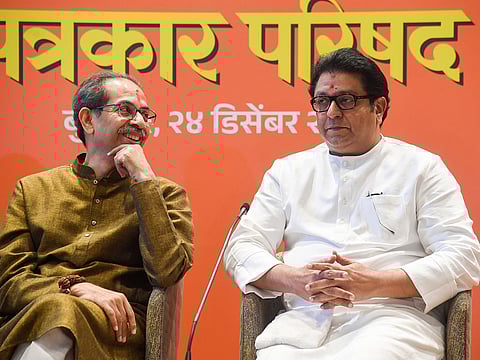
As predicted for my beloved readers of SWAT ANALYSIS, the grand reunion of Maharashtra’s political dynasties and families continued apace. After estranged cousins Uddhav and Raj Thackeray joined hands — a development predicted here first — ostensibly to save Maharashtrians from the depredations of two “Gujaratis”, the real objective was to defend the final lucrative turf: the BMC, the richest municipality in Asia, with a budget of Rs680 billion.
This also underlines the reality that the Shiv Sena (UBT) is essentially a party of urban Mumbai, and even that turf is now under severe attack. Raj Thackeray has turned to his cousin whom he once spurned because, after flirting with every possible ideology, he has drawn a blank. He has finally returned to the family-first formula, once again attacking hapless “prarpranti” (outsiders).
Family first
It was family first as well for Sharad Pawar, arguably Maharashtra’s tallest leader, who appeared to repudiate his lifelong secular ideology to tie up with nephew Ajit Pawar. Ajit Pawar broke the party and jumped into the arms of the BJP to fulfil his lifelong dream of becoming chief minister of Maharashtra. He did not get the job, but managed to ensure that investigative agencies stayed away from his and his family’s doors — one of the unofficial perks of office and of being a BJP ally. This is now knowingly referred to as the “washing machine” effect in Indian politics.
So while the two factions of the NCP are currently tied up for the Pune civic polls, expect this bonhomie to extend across the state. Interestingly, the BJP has welcomed the development. Astute political leaders know how to connect the dots.
Also Read: Uddhav, Raj Thackeray reunite for BMC polls
What compelled Pawar, who had once magicked up the unlikely alliance between Uddhav Thackeray and the Congress, to perform such an ideological somersault at this stage of life? Family, of course.
Political future
The tie-up with his nephew and the BJP — whom he had sworn never to do business with in this lifetime — is meant to secure the political future of his lacklustre political heir, daughter Supriya Sule. Sule appears more comfortable socialising across party lines than doing the hard grind of grassroots politics. Pawar seems unable to accept that Maharashtra does not take his only child seriously as a leader, hence the ideological contortions to ensure she can continue the family business.
Pawar senior is reportedly expected to announce his retirement from active politics in April 2026, when his Rajya Sabha tenure ends, and hand over the reins of state politics to Ajit Pawar, with both NCP factions merging under the auspices of “Saheb”. In return, Ajit Pawar — now a BJP ally — will secure Sule a ministerial berth at the Centre, fulfilling Pawar’s lifelong dream of seeing his daughter as a Union minister. Sule will become the national face of the NCP, diminished though it may be, while Ajit Pawar will remain the power centre in Maharashtra, where the real base lies.
Eternal mystery
How any of this is ideologically kosher or benefits the people of Maharashtra remains one of the eternal mysteries of Indian politics.
Family first is clearly the only ideology that truly animates Indian politics across the spectrum — from the country’s oldest political party, the Congress, which once fought for India’s freedom but is now hopelessly in thrall to the Gandhi family; to the Trinamool Congress, where Mamata Banerjee’s heir is her nephew; to the Samajwadi Party, which functions as a wholesale family enterprise involving Akhilesh Yadav, his wife Dimple Yadav, uncles, and nephews.
The pattern is repeated in the South, where the DMK is first a family business in Tamil Nadu and only then a party under Chief Minister Stalin, himself a dynast. Even Mayawati, despite her shrinking political turf, appears set to bequeath the BSP to her nephew Akash Anand.
The BJP, too, now has its own flourishing mini political dynasties.
India’s political ecosystem, much like its environment, continues to grow ever more toxic.


