UAE women on fighting breast cancer and reclaiming their lives: ‘I'm not going anywhere'
The women urge others not to fear mammograms, stressing the importance of early detection
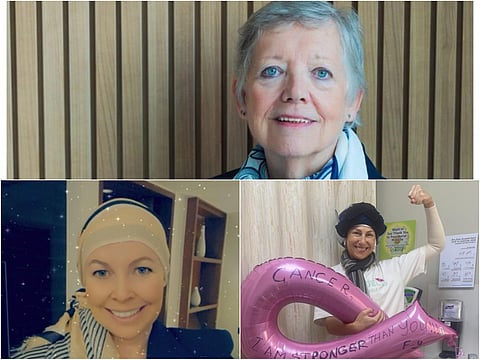
It was meant to be her 60th birthday dinner with her husband and it turned quiet.
Catherine Vander Cammen, a social educator, was a very busy woman living in the UK. One day, after a shower, she noticed that her right nipple was inverted. She went straight to her GP and pressed for a mammogram. “They told me to stay longer,” she recalls. “They took me for a biopsy, and we waited several days for the results.”
The call arrived on her birthday. “I just put the phone down, and I said, ‘I think I’ve got cancer,’” she remembers. She still went to the dinner, just the two of them. They were numb, she says. “I cried and cried for hours. My whole life was collapsing in front of me. I could not believe this was happening,” Catherine tells us.
The word 'cancer' itself registers as a threat. The nervous system shifts into survival mode, explains Hiba Salem, a psychologist specialising in psycho-oncology and palliative psychology at Sage Clinics. “That is why so many people leave that first appointment unable to recall what was said. Feeling numb or strangely calm is common too. I see this as the mind pacing itself, letting the reality in gradually rather than all at once.”
It's a crippling state of uncertainty and the mind also rehearses the worst possible outcome. “Patients tell me it feels like preparation, but in practice it means living through bad news many times over,” says Salem.
‘I am going to fight this’
For Catherine, things moved quickly, even if acceptance didn’t. A date for surgery was set, and the doctors did not want to wait any longer. She had a mastectomy of her right breast, and 17 lymph nodes were dissected. “When they removed the bandages, I couldn’t recognise my body. The doctor said it was normal, but I just felt a new anxiety,” adds Catherine.
She was discharged the following day, along with instructions about a prosthesis, a specialist bra and follow-up treatment. “I knew I had to have chemotherapy and went to Macmillan [Cancer Support], where we attended a session to demystify chemo,” she says.
She had a PICC (peripherally inserted central catheter) line fitted in her left arm and kept it for more than six months. “I knew the treatment would be tough and was prepared for it. On top of all this, my neutrophil count was too low, and I was admitted to isolation as I was at risk of infection and death.”
Amid the swings between physical pain, psychological pain and numbness, she promised herself she would regain control. “I said, ‘I am going to fight this.’”
She did, armed with a journal and therapy. There was a 'rollercoaster' of hospital trips, as she had to deal with infections too. “I was admitted on three occasions, but I kept smiling through it, even when I lost my hair. I said that I would carry on fighting. I was on a mission to survive this.”
She kept writing and researching ways to deal with the side effects of chemotherapy, such as nausea and peripheral neuropathy, as well as the psychological toll of losing her self-esteem. “It was a very difficult learning curve, with many ups and downs. That was the time when I decided to apply for a voluntary position at Macmillan. Unfortunately, 15 months later, I had to undergo another surgery, on my left breast, but this time it was caught early and the chemotherapy was not so hard to manage.”
Today, Catherine lives in the UAE and is part of a support group for women who are going through breast cancer or have been through it. The group is led by Lamya Gabr, who introduced us to the women, sharing their stories.
For other women living in the UAE, the journey has unfolded differently, but the questions and uncertainties that come with a breast cancer diagnosis can feel familiar. Maria Sirotinina and Maelisa Hall share their experiences, from confronting the news to finding ways to move forward.
‘I want to live my best life’
In June 2022, Maria Sirotinina, a MedTech leader and biomedical engineer, was grappling with a breast cancer diagnosis. “I was 36 years old and thought, obviously, it could not happen to me. There was no history of breast cancer in my family,” she says. A full-body check-up and ultrasound revealed a suspicious mass. “This is where it was becoming obvious,” she says. A biopsy confirmed the news.
She was assailed by the fears that would hit anyone with such a diagnosis: “I thought, am I going to survive?”
Still, she remained focused, planning when and how she would be treated. “My chemotherapy started in July 2022, and by the end of the year, I was out of treatment,” she says. But, as she remembers, there was a sense of loss of control during chemotherapy, so her family advised her to go out and slowly start being active. And amid the exhaustion of treatment, one thought cemented itself firmly: she wanted to live her best life. It became the motto she followed. “I would just believe, today is the best day.”
No doubt, the entire process is a mind-numbing one. Changes to the breasts, hair, fertility or hormones can unsettle someone’s sense of who they are, explains Salem. These are genuine losses, and they deserve to be grieved. “Rebuilding comfort tends to be gradual: looking, touching, then sharing the body again at one’s own pace. Intimacy often needs redefining rather than resuming, and issues like pain or dryness are treatable.”
The journey from grief to acceptance is rarely smooth, but Maria has now found a way to be at peace with herself and her looks. The changes are difficult, of course, and yet you can still come out of it stronger, says Maria, who researched ways to avoid losing all her hair during chemotherapy and was able to use cold caps.
She still has her tattooed eyebrows. But she feels beautiful inside, and that, she says, changes how you look at yourself. “I did a photoshoot too,” she says.
There’s a warm pride in her voice as she says those words.
‘I had a lot of itchiness’
If there is one symptom not immediately associated with breast cancer, it’s itchiness. Maelisa Hall had a lot of it, she says, but didn’t give it much thought at the time. Then, in 2021, she discovered a lump. She contacted a general physician, who immediately sent her to hospital for an ultrasound and four biopsies.
A week later, it was confirmed: Stage 3 triple-negative breast cancer. The question hung over her head, just as it had for the others: what were her chances of survival? She was referred to an oncologist at Mediclinic City Hospital. “I had 16 rounds of chemotherapy, immunotherapy every three weeks, three blood transfusions, weekly injections, a lumpectomy to remove the shrunken tumour, followed by 20 rounds of radiation,” she says.
Just like the other women, she was determined to fight. “I said, ‘I’m not going anywhere.’”
Initially, she had no pain, which surprised her. The pain came as the treatment progressed. Even more frightening, as she started speaking to others, she learned that breast cancer had far more symptoms than she had ever known, beyond just a lump. Inverted nipples, severe itchiness and discharge can all be signs, she says. “Now I just say, the moment you feel something is not right, just go and get it checked. Don’t wait.”
Maelisa has also heard women express fear about mammograms because of the discomfort they can cause. “It does, but chemo hurts worse, operations hurt. Please don’t be scared,” she says, urging women not to let that fear stop them from seeking medical advice.
When it comes to cancer, there’s always a fear of recurrence, a sense of always looking over your shoulder. Nevertheless, Maelisa keeps up with regular checks and scans.
‘There is no single way to recover emotionally’
The end of treatment does not always mean the end of the emotional strain, says Salem. Patients may find themselves struggling long after hospital visits and treatment schedules have stopped, even as those around them assume life is returning to normal. “Emotional recovery often lags behind physical recovery, sometimes by months,” she explains.
She encourages patients to recognise when distress begins to interfere with daily life. Persistent low mood, panic attacks, withdrawing from others, avoiding follow-up appointments or compulsively checking for signs of recurrence can all be reasons to seek professional support. “Seeking support is part of good cancer care, not a sign of failing at it,” Salem says.
A good prognosis eases one fear, but it doesn't make treatment less grueling. Fatigue, hormonal shifts and poor sleep all affect mood directly. What I hear most often, though, is guilt: "Other people have it so much worse." Many patients feel they should simply be grateful. But gratitude and distress can sit side by side. Struggling reflects how much someone is carrying. Giving yourself permission to find it hard often eases the load....


