AI-Assisted Mammography: A game changer in breast cancer detection
Knowing risk, noticing change & screening on time give the best chance of finding it early
October is Breast Cancer Awareness Month. No two women share the same risk, symptoms or treatment path. What their stories do share is this: the earlier a change is found, the more options there are.
Breast cancer is the most diagnosed cancer in the UAE and accounts for about 39 per cent of all cancers in women. Feeling well, or having no relatives with the disease, is not a reason to delay screening.
The story that could be anyone’s
At 43, she had no lump, no pain and no family history. She had postponed her first mammogram twice; work, school runs and a busy home always came first. When she finally went, the images showed a small area that needed a closer look. Further imaging and a biopsy confirmed an early-stage cancer, found before it could be felt.
AI-assisted 3D Mammography: A second set of eyes
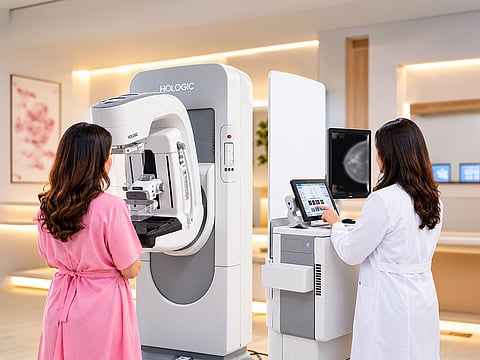
At PRIME Hospital, every mammogram is also analysed by Lunit INSIGHT, artificial intelligence software that highlights areas that may need closer attention. It does not diagnose cancer. A radiologist reviews every study in detail, weighs the findings against your history and earlier images, and decides what, if anything, should happen next. No screening test finds every cancer, so report any new change between screens.
Changes worth a check: See a doctor promptly if you notice:
Breast lump or thickening, often painless
Change in the size, shape or appearance of a breast
Dimpling, redness or pitting of the skin
Change in the nipple or the skin around it
Unusual or bloody fluid from the nipple
Most breast lumps are not cancer. Even so, any persistent change deserves a medical assessment at any age, regardless of what your last mammogram showed. Breast cancer can affect men too, though rarely.
Complete breast-health journey
Breast care is not a single test. It is a pathway that begins before any symptoms and continues long after treatment. At PRIME Hospital, breast imaging, biopsy, surgery and medical oncology are available in one place, and every breast cancer is discussed by a multidisciplinary tumour board, so each step leads clearly to the next.
1. Know: Understand your personal risk
Risk rises with age. It is higher with a family history of breast cancer, inherited gene changes such as BRCA1 and BRCA2, dense breast tissue or earlier radiotherapy to the chest. Excess weight, alcohol, tobacco and hormone therapy after menopause also play a part.
A consultation turns these factors into a personal plan: when to start screening, how often, and which test to use. Women with a strong family history may be offered a hereditary cancer risk assessment and genetic testing.
2. Screen: Find change before it can be felt
For women at average risk, Dubai Health Authority guidance recommends a mammogram every two years from age 40.
Women at higher risk may need to start earlier, screen more often or add other imaging, as their doctor advises. PRIME Hospital offers 2D and 3D mammography (tomosynthesis) on a Hologic 3D mammography system. 3D mammography images the breast in thin slices, so that overlapping tissue is less likely to hide a small change.
3. Look Closer: When a result needs a second look
Being called back after a mammogram is common, and fewer than one in ten women called back are found to have cancer. Breast ultrasound can tell a fluid-filled cyst from a solid lump. Contrast-enhanced mammography and breast MRI add detail where needed, including for women with dense breasts or at higher risk.
4. Diagnose: Get a clear answer
Only a biopsy can confirm or rule out cancer, and most biopsy results are not cancer. PRIME’s radiologists perform image-guided biopsies. The tissue is examined to identify the type of cancer and its biology. This guides every decision that follows.
5. Treat: A plan built for one person
No two breast cancers are the same, and no two treatment plans should be. When cancer is suspected, staging tests show whether it has spread beyond the breast. Depending on type and stage, care may include:
Surgery: Oncoplastic surgery that removes the tumour while preserving healthy breast tissue where possible. Where mastectomy is the best option, breast reconstruction can be planned with the Plastic Surgery team.
Medicines: Hormone therapy, chemotherapy, targeted therapy and immunotherapy. Supportive care, including pain management, runs alongside.
Radiotherapy: Arranged with partner centres, with consultation available with a radiation oncologist at PRIME Hospital.
6. Recover and Follow up: Care that continues
Treatment does not end on the day of surgery. Recovery may include physiotherapy, nutrition advice and emotional support. Regular follow-up visits and imaging check for any change and support long-term medicines where they are prescribed.
Doctors speak
“Most breast lumps turn out not to be cancer, but the only way to know is to have them checked. Please don’t wait for a lump to grow or become painful.” — Dr Verushka Mansukhani, Specialist General Surgeon, PRIME Hospital.
“Found early, breast cancer can often be removed while preserving the breast. We treat the cancer and care about how a woman feels afterwards. — Dr Sivaprakash Rathanaswamy, Consultant Surgical Oncologist, PRIME Hospital.
“No two breast cancers are alike. As a tumour board, we plan each woman’s treatment around her cancer and her life.” — Dr Arun Karanwal, Specialist Medical Oncologist, PRIME Hospital.
“Treatment has advanced remarkably. Completing the full course and keeping every follow-up appointment matter as much as starting it.” — Dr Tanvi Sood, Specialist Medical Oncologist, PRIME Hospital.
“Careful monitoring of blood counts and clotting helps women stay safe and stay on track with their treatment.” — Dr Kavya Keerthana, Specialist Clinical Haematologist, PRIME Hospital.
Book your breast check: www.primehealth.ae


