The Odyssey: Inside Christopher Nolan's groundbreaking all-IMAX filmmaking experiment
The Odyssey pushed IMAX cameras further than ever, forcing crews to invent new technology
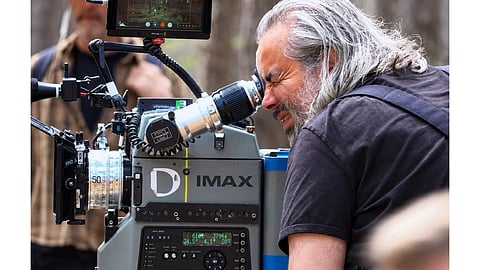
Dubai: Christopher Nolan has never made things easy on himself, and his new film, The Odyssey, might be the most extreme example yet. Landing in cinemas on July 16, it is the first feature film in history shot entirely on IMAX film cameras, a format so demanding that entire departments had to invent new equipment just to make it work.
Homer's epic follows Odysseus, played by Matt Damon, on his long journey home after the Trojan War, alongside a cast that includes Anne Hathaway, Zendaya, Tom Holland, Lupita Nyong'o in a dual role as Helen of Troy and her sister Clytemnestra, Charlize Theron and Jon Bernthal.
Nolan wrote, directed and produced it with his wife, Emma Thomas, working once again with his regular cinematographer, Hoyte van Hoytema.
The problem no one had solved before
IMAX film cameras are famously massive, and famously loud, loud enough that the sound of the camera itself could drown out an actor's dialogue on the take. That is a big part of why no one had shot a full, dialogue heavy feature on the format before Nolan. Van Hoytema first tested whether it was even possible by filming a child reading David Bowie's Sound and Vision lyrics in extreme close up on IMAX. It worked, and convinced Nolan the whole film could be built around it.
Solving the noise problem meant inventing new hardware: a soundproof camera housing nicknamed "the blimp," roughly the size of a coffin and, once fully assembled, weighing more than 136kg. Dollies had to be reinforced with steel plating just to carry it. It also took 6 people to carry and move the camera.
That solved the sound. It created a new problem entirely: an object that size, sitting between two actors, blocks their eyeline completely. Nolan's crew built a system of mirrors instead, angled so that an actor on one side of the blimp could look into a mirror reflecting a second mirror on the other side, and see their scene partner as if the camera were not there at all. Anne Hathaway has described it as "truly ingenious," insisting it never felt like acting around a machine.
From a Moroccan beach to a lab in Burbank
Shooting entirely on film also means the film itself has to go somewhere once a scene wraps. The Odyssey was shot across Morocco and locations around the Mediterranean, and every exposed reel had to be flown back to Los Angeles for processing, at FotoKem in Burbank, the last lab left in the world that still produces 70mm prints.
What happens there is close to a lost art. The film goes through a chemical bath, then dries inside a glass enclosure.
Colour timers programme different coloured lights to expose across each frame, shot by shot, to get the colour right. Once everything is signed off, the reels are literally cut and glued together by hand, reel by reel, to build the final print.
By the time the shoot wrapped, the production had gone through 2.1 million feet of film, about 640 kilometres, or roughly the length of the UAE's own coastline along the Arabian Gulf, all the way from the Saudi border down past Abu Dhabi and Dubai to Ras Al Khaimah.
Why the format itself is the point
Standard cinema film runs vertically through the projector: four perforations per frame for 35mm, five for a typical 70mm print. IMAX 70mm is a different beast entirely, 15 perforations per frame, running horizontally through the projector instead, which is what makes it the largest and highest resolution film format in the world, offering up to three times the resolution of digital around 18k. It is also why so few cinemas can even show it: fewer than 41 screens worldwide are currently capable of projecting true IMAX 70mm.
As Nolan put it: "IMAX is the best film format that was ever invented. It's the gold standard and what any other technology has to match up to, but none have."
Watching it in the UAE
For anyone catching The Odyssey at Mall of the Emirates, the IMAX screen there runs on a 4K laser projection system, built for sharper, brighter images and deeper contrast, alongside IMAX's next generation precision sound system for clearer, more evenly distributed audio. It will not be true 70mm film projection, but it remains one of the biggest, most immersive ways to see the film in the region.