Rise in oil prices and output spurs rebound in Mideast economies
IMF says region needs to resume its focus on medium-term challenges
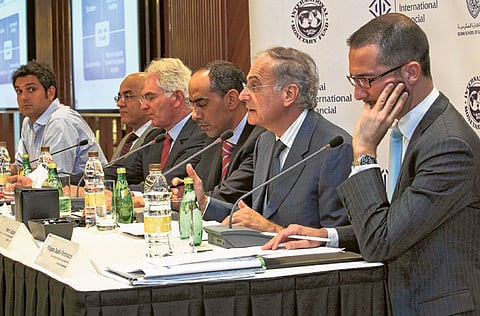
Dubai : The Middle East and North Africa region is experiencing a generally robust economic recovery, aided by rising oil prices and production levels and supportive fiscal policies, the International Monetary Fund said yesterday.
The IMF report, covering the Middle East, North Africa, Afghanistan and Pakistan (MENAP), released yesterday in Dubai, predicts the region's oil output will expand by 4.2 per cent in 2010, or nearly double the 2.3 per cent recorded in 2009. Economic growth in 2011 is projected at 4.8 per cent.
"We expect most countries in the region to grow faster in 2010 and 2011 than in 2009," Masoud Ahmad, Director of the IMF's Middle East and Central Asia Department, said.
"With the economic recovery taking hold, the region needs to resume its focus on medium-term challenges such as diversification and financial market development for the oil exporters, and tackling unemployment through faster, job-creating growth in the emerging markets," Ahmad said.
According to the IMF, the Middle East's fiscal and external balances will improve markedly in response to rising oil prices, up from $62 (Dh227.54) per barrel in 2009 to $76 in 2010 and $79 in 2011.
The combined external current account surplus of these countries is expected to increase to $120 billion in 2010 and $150 billion in 2011 from $70 billion in 2009. In the Gulf Cooperation Council (GCC) alone, the improvement is estimated at about $50 billion from 2009 to 2011.
Oil GDP growth — projected at 3.5 to 4.5 per cent in 2010 and 2011 — is likely to stay below pre-crisis levels. Moreover, while external financing conditions have improved, domestic credit is picking up only slowly, and investment demand is subdued.
As such, growth in non-oil activity remains lacklustre at 3.5 to 4.5 per cent, indicating a need for continued policy support through 2011 in most countries.
Turning to the challenges ahead, the report recommends that, given the region's recovery, governments strengthen their focus on the medium-term objective of promoting economic diversification and reducing the dependence of both the budget and the economy on hydrocarbons.
For the Gulf, the challenge is to consolidate the gains made in the past, address any remaining vulnerabilities uncovered by the crisis, and pursue regulatory and supervisory reform in line with evolving international norms, the report said.
For some oil exporters in the region, the challenge is to spur greater financial development by removing entry and exit barriers and reducing state ownership in the banking system, the IMF said.
NPLs likely to remain high
Dubai : The non-performing loans (NPLs) of the banks in the region are likely to remain high for a few more quarters, but the strong support from the governments will help to keep the bank balance sheets healthy and meet the regulatory capital requirements, the IMF said.
Participating in a discussion on the IMF report on the region, Dr Henry Azzam, chairman of Deutsche Bank, Middle East and North Africa, said the private sector confidence is yet to pick up in the region while the demand and supply for bank credit have been slow to pick up.
"There are early signs of recovery in the credit markets. Nearly $15 [Dh55.05] billion worth of debt raised by sovereign and semi sovereign debt issuers shows confidence is slowly returning to the market," said Azzam.


