Power over global institutions shifts to developing world
World bank now plays a smaller role in extending American influence as it fears losing borrowers
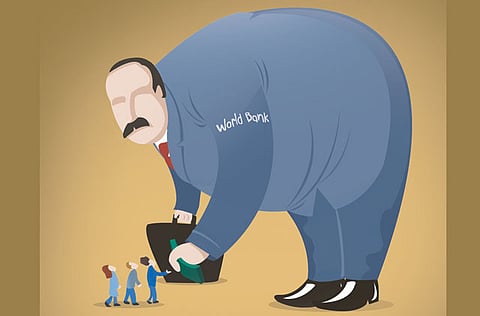
Conventional wisdom about the World Bank goes something like this: dominated by the US — which by convention nominates its president — the bank has spent decades financing huge dams and power plants in developing countries, and demanding privatisation and deregulation from their governments in return for loans. These days, that role has been challenged by the growth of private capital markets and the rising power and wealth of borrowers such as India and China, leaving the institution casting about for a strong purpose.
However true that depiction, the battle that started in earnest last week to replace Robert Zoellick as the bank's president reflects the complications of a world where power over the institutions of global governance is shifting from those developed nations that set up the bank to emerging economies. Nigeria's Ngozi Okonjo-Iweala and Colombia's Jose Antonio Ocampo are candidates much more in the old traditions of the US-dominated organisation than is Kim Jim-yong, America's nominee.
Nancy Birdsall, director of the Centre for Global Development think-tank in Washington, says: "A new president needs to corral shareholders with disparate interests to create a fresh mandate for the bank."
If that mandate fails to be defined, emerging markets will increasingly seek the funding and support they need from other institutions instead and the World Bank's relative importance will further shrink, as it has been doing for some time.
Demanding structural adjustment
Set up during the surge of multilateralist enthusiasm following the Second World War, the World Bank's original aim was to help rebuild Europe and Japan. By the 1970s, it was financing investment throughout the developing world. Its reach over borrowers' economic policy extended rapidly and controversially during the 1980s. It extended loans to cash-strapped developing nations contingent on "structural adjustment" measures such as liberalising trade, privatising industries and abolishing controls on food and fuel prices.
Much of this deregulatory drive came from the US, the largest shareholder, which — especially during the Cold War — was keen to export an American model of capitalism.
However, in the 1990s, and particularly during the 1995-2005 presidency of Australian-born investment banker James Wolfensohn, the bank moved towards becoming an all-round development agency concerned with health, education, corruption and the environment. Meanwhile, the US and other rich countries came under pressure from environmental and development non-governmental organisations to soften their uncompromising focus on deregulation and growth. "Macro-economic policy by itself isn't enough," Wolfensohn said in 1997. "We must also make sure that we give adequate weight to the human dimension, that we reach down to all corners of society."
Though his reforms aroused opposition from some economists inside and outside the bank, who said it was losing focus and rigour, attention has continued to widen beyond economic policy — and, as middle-income countries such as China and India have gained more access to private capital, greater concentration has turned to the very poorest countries. Swathes of the developing world have in any case made strides towards economic stability and growth: hyperinflationary basket cases such as Zimbabwe have become rare exceptions.
Intellectually, the inconclusive battles of the 1990s within the development economics profession over liberalisation and poverty reduction have given way to a less ideological, more eclectic approach that includes the use of small-scale trials to test the effect of changes in, say, health or education policy.
While the US has continued to provide its president, the institution plays a diminishing role in extending American influence. Last year, Congress even planned to cut its contribution to the bank before relenting.
The bank has increased its technical capacity and sought to assist in policy making — for example flinging open its vast collection of economic, health and other data to free public use. However, its ability to respond on a large scale to issues concerning cross-border "global public goods", such as health pandemics, water scarcity and climate change, has been limited.
Birdsall says: "The structure of the bank's lending, oriented around single-country loans, has prevented its resources being deployed as well as they could." For some pressing challenges, such as HIV/Aids in the developing world, the lead has been taken by institutions such as the Geneva-based Global Fund to Fight Aids, Tuberculosis and Malaria. For other cross-border issues, such as equipping poor countries to manage the effects of climate change, no international agency is in effective charge.
Battle for presidency
The gradual shift in the bank, and in the US' view of its purpose, is underlined by a peculiar feature of the battle for the presidency. While US nominees have generally been bankers or politicians, Dr Kim has a background in public health, having run the HIV/Aids programme at the World Health Organisation, and in 2000 co-edited a book taking a sceptical approach to the traditional World Bank model for growth.
Meanwhile, Okonjo-Iweala and Ocampo are current or former finance ministers who graduated in economics from US universities, and in Okonjo-Iweala's case spent more than two decades working at the bank. In Nigeria, she has been closely associated with a politically contentious plan to cut public fuel subsidies and shift spending to more targeted services, a move straight out of the bank's traditional policy handbook.
The US is confident of installing Dr Kim as president this month, with the Europe's big voting bloc — about a third of the total — likely to reciprocate for the White House's backing for former French finance minister Christine Lagarde's successful bid to become IMF managing director last year.
— Financial Times


