Wall Street still bets big on SpaceX, but IPO investors aren’t so sure anymore
SpaceX gives up IPO gains despite Nasdaq-100 boost as market weighs vision vs. valuation
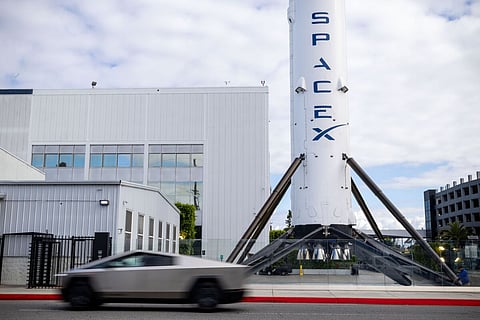
Dubai: SpaceX has surrendered nearly all the gains made after one of the biggest stock market debuts in recent years, raising a fundamental question for investors: has the recent sell-off created a buying opportunity, or is the market beginning to question whether even one of the world’s most ambitious companies can justify its multi-trillion-dollar valuation?
Get updated faster and for FREE: Download the Gulf News app now - simply click here.
The shares have slipped back to around their opening trading price despite what would normally be viewed as a major positive catalyst—its inclusion in the Nasdaq-100 index.
Instead of attracting sustained buying from exchange-traded funds (ETFs) and passive investors that track the benchmark, the stock has come under renewed selling pressure as markets focus on lofty valuations, execution risks and an increasingly uncertain macroeconomic backdrop.
Nasdaq boost fails
SpaceX fell more than 6% after joining the Nasdaq-100, an unexpected move given that inclusion in a major stock index typically generates buying from index funds required to mirror the benchmark.
The shares touched an intraday low of $149 before recovering to around $150.72, leaving the stock trading close to its debut price of $150 and roughly 50% below the post-listing high of $226. Even after the decline, the shares remain above their IPO price of $135.
The weakness also reflected broader pressures across technology stocks. Investors were grappling with rising US Treasury yields, elevated oil prices, continued heavy investment in artificial intelligence infrastructure and renewed geopolitical tensions in the Middle East. Semiconductor companies including Micron Technology and Advanced Micro Devices also fell sharply during the session.
“There’s nervousness about expectations being too high,” Mark Hackett, chief market strategist at Nationwide, said in comments reported by Reuters. “I expect that to continue until we get some earnings out.”
For many investors, the decline represents a familiar pattern. Initial excitement surrounding a blockbuster IPO often gives way to a closer examination of whether the company’s financial performance can support its valuation.
Wall Street backs SpaceX
Despite the sell-off, analyst sentiment has barely shifted. Following the expiry of the IPO research blackout period, 18 of the 19 firms covering SpaceX assigned Buy ratings, with most price targets comfortably above $200 a share.
JPMorgan initiated coverage with an Overweight rating and a $225 price target, saying: “SpaceX’s ambitions — and potential impact on humanity — are bigger than any company’s we’ve ever seen.”
The bank added: “While SpaceX has already reached a $2T+ market cap post its IPO, we believe significant upside potential remains as the company quite literally builds out the next frontier.”
Morgan Stanley was even more optimistic, assigning a $300 target. “SpaceX combines near-monopoly launch economics, the world’s largest LEO satellite network, and a fast-scaling AI infrastructure business,” its analysts wrote.
“We see the company as one of the few platforms that can link real estate in orbit, global connectivity, and compute capacity into one infrastructure stack.”
Goldman Sachs also began coverage with a Buy rating, saying SpaceX is “well positioned to scale its differentiated advantages” across launch services, satellite communications and AI, markets it believes each have the potential to become multi-trillion-dollar opportunities over the next five years and beyond.
Valuation debate stays
Not everyone is convinced the stock has become attractive after its pullback.
MoffettNathanson was the lone major brokerage to break from Wall Street’s consensus, assigning a Neutral rating and a $131 price target. Analyst Julie Zhu questioned assumptions surrounding SpaceX’s addressable markets, Starlink’s satellite-to-phone opportunity and Elon Musk’s plans to build large-scale AI computing infrastructure in space.
The firm nevertheless acknowledged that SpaceX enjoys an effective monopoly in commercial launches and described the launch business as the “flywheel that makes SpaceX work”, highlighting how lower launch costs strengthen the economics of its Starlink broadband network.
Independent research firms have also urged caution. David Jagielski of The Motley Fool noted that SpaceX remains unprofitable despite its enormous ambitions.
“This is, after all, an unprofitable company,” he wrote, adding that its plans for Mars exploration and space-based data centres “may take many years to become reality.”
He also argued that “SpaceX is the only stock that has a $2 trillion valuation or more, and that doesn’t have a highly profitable and successful business,” warning investors that the shares could face further downside if expectations are not met.
Research firm Zacks struck a similar tone, saying investors continue paying “a steep price for future growth” and suggesting prospective buyers may benefit from waiting for a more attractive entry point.
Analysts stay positive
The sharp difference in opinion reflects how difficult SpaceX is to value.
Unlike mature companies, much of its projected worth lies in businesses that are still evolving, forcing analysts to rely on long-term assumptions rather than current earnings.
Morgan Stanley projects SpaceX could generate $3.3 trillion in annual sales and $2.7 trillion in EBITDA by 2040. Deutsche Bank values the company’s AI, Starlink and launch businesses at a combined $3.3 trillion, while RBC Capital Markets estimates a valuation of about $2.9 trillion. Raymond James is even more optimistic, assigning an $800 share price target that values the company at more than $10 trillion.
Make—or break—case
Those valuations depend on SpaceX delivering on an ambitious roadmap.
Analysts expect the company to make Starship fully reusable, increase launch payloads, expand AI capabilities, develop solar-powered data centres in space and raise vast amounts of capital to finance those plans. Morgan Stanley estimates SpaceX may need to raise about $84 billion annually between 2027 and 2034, while Goldman Sachs estimates debt financing requirements of about $270 billion between 2026 and 2030.
Forecasts also vary widely. JPMorgan expects around 5,000 Starship launches by 2031, while RBC projects about 2,440 launches by 2030, illustrating how differing assumptions can produce dramatically different valuations.
Vision versus valuation
The debate surrounding SpaceX has moved beyond short-term share price movements.
Few analysts dispute the company’s leadership in commercial space launches or the growth potential of Starlink. Instead, investors are trying to determine whether today’s valuation should reflect the business SpaceX has already built or the one it hopes to create over the next decade through reusable rockets, artificial intelligence infrastructure and a vastly expanded commercial space economy.
For now, Wall Street continues to back the latter. Despite the recent pullback, analysts’ average price target of about $236.45 still implies roughly 58% upside from recent trading levels, suggesting the market’s biggest believers remain convinced that SpaceX’s most valuable chapters have yet to be written.