IMF to fast-track extended rescue package for Ireland
Repayments will start after four and-a-half years to restore bank system
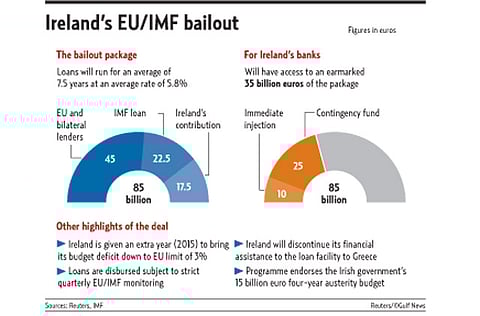
Dubai: The International Monetary Fund (IMF) has reached an agreement with Ireland on a 22.5 billion euro (Dh109.4 billion) bailout in the form of an ‘Extended Fund Facility Arrangement', said an IMF statement, obtained by Gulf News.
"The Irish authorities have today proposed a clear and realistic package of policies to restore Ireland's banking system to health and put its public finances on a sound footing. Immediate actions to tackle vulnerabilities in the banks and continued strong fiscal adjustment are set in a multi-year policy framework for sustained growth and job creation," Dominique Strauss-Kahn, IMF Managing Director, said following the deal yesterday.
A financing package of 85 billion euros will support Ireland's effort to get its economy back on track. Of this, the European Union and bilateral European lenders have pledged a total of 45.0 billion euros. The Irish authorities have decided to contribute 17.5 billion euros to this effort from the nation's cash reserves and other liquid assets.
The IMF has activated its fast-track procedures for consideration of Ireland's funding request, Strauss-Kahn said. "I expect the EFF will go to the IMF Executive Board for approval in December."
Policy decisions praised
Lauding Ireland's policies in a very challenging environment, he said: "I have confidence in its ability to implement this new programme. Supported by substantial financing, this programme can underpin market confidence and bring Ireland's economy back on track," he said. "The strategy for the financial system rests on twin pillars: deleveraging and reorganisation; and ample capitalisation. A fundamental downsizing and reorganisation to restore the viability of the system will commence immediately."
Olli Rehn, European Union Commissioner, said, "It is a forceful response to vulnerabilities in the banking system imposing a heavy cost on the budget and, in turn, hurting the prospects for growth that Ireland needs for an enduring solution to the crisis. This programme articulates a clear strategy for tackling today's problems and for harnessing the enormous growth potential of this open and dynamic economy."
At the end of this process, a smaller, more robust, and better capitalised banking system will emerge to effectively serve the needs of the Irish economy, Kahn said. "The transition to this goal will be buttressed by substantial recapitalisation based on higher capital standards and stringent stress tests and asset valuation to accurately determine the quality of banks' loan portfolios. In addition, structural measures — a special resolution scheme for deposit-taking institutions and a further strengthening of the supervisory system — will impart greater stability," he said.
On the fiscal side, the programme incorporates a comprehensive National Recovery Plan that covers a period of four years. The plan will form the basis for the 2011 budget and also details fiscal consolidation measures through 2014. The process of budget formation will be reformed to safeguard these gains and bring greater sustainability to public finances, he said.
Social safety net
"The fiscal plan strikes an appropriate balance between revenue and spending measures, and maintains Ireland's due regard to a social safety net," Kahn assured.
"To restore strong sustainable growth the programme includes a strategy to remove potential structural impediments to enhancing competitiveness and creating new employment opportunities. It also details appropriate sectoral policies to encourage exports and a recovery of domestic demand, thereby supporting growth and reducing long-term unemployment.
Floating interest rate
The choice of an EFF offers Ireland a facility with a longer repayment period, with repayments to the Fund starting after four and a half years and ending after 10 years. The IMF charges member countries a uniform interest rate on nonconcessional loans, which is a floating rate based on the Special Drawing Rights (SDR) interest rate, which is updated weekly. (The SDR interest rate is a weighted average of yields on three-month Treasury bills for the United States, Japan, and the United Kingdom, and the three-month Europe rate.)
At the current SDR interest rate, the average lending interest rate at the peak level of access under the arrangement would be 3.12 per cent during the first three years, and just under 4 per cent after three years.
Rehn said, "On the financial side, the programme shows the authorities' determination to reorganise the banking sector while deleveraging the banks and injecting fresh capital into them. The programme will also strengthen regulation and supervision to prevent a repeat of the costly mistakes of the past. On the fiscal side, the programme spells out both spending and revenue efforts over several years to repair the budget position, with due regard for Ireland's system of strong social protection," he said.


