Hormuz Strait 'toll': Oil prices drift back to $100/barrel mark — what it will take to get things going again
Many shipping firms wait for explicit, safety guarantees from Iran, clear guidance
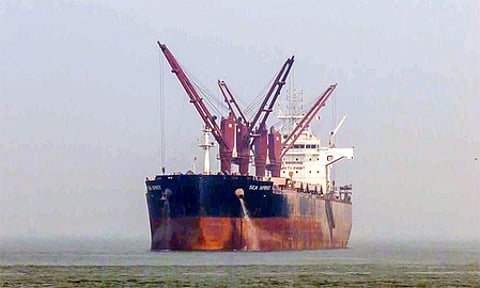
The Hormuz Strait may be officially “open.”
But for the moment, it is still operating more like a high‑risk exclusion zone than a normal shipping lane.
News of a two‑week ceasefire briefly sent oil prices plunging and stock markets rallying.
But that optimism quickly faded: only a handful of vessels actually attempted crossing the waterway after the agreement.
Fragile ceasefire
So far, the fragile ceasefire that has mostly quieted the skies over the region has yet to convince shippers to risk the narrow strait, the critical chokepoint that carries about 20% of the world’s oil supply.
Get updated faster and for FREE: Download the Gulf News app now - simply click here.
With many tankers still queueing in the Gulf and alternatives limited, crude prices have begun drifting back toward the $100‑per‑barrel mark.
This reflects how much the world’s economy depends on fluid traffic through Hormuz.
As of 5.07 AM GMT (9.07 Am Gulf Standard Time), Murban crude stood at $99.62, up 2.03%, while the US benchmark West Texas Intermediate (WTI) inched higher to $98.25, or +0.27%.
Brent rose 0.60% at $96.50.
Uncertainty
Shipping company executives say that uncertainty surrounding the ceasefire makes transit too risky, even as Donald Trump and Iran exchange mutual assurances that the waterway should be safe for passage.
Many firms are waiting for explicit, written safety guarantees from Iranian authorities, clear guidance on which routes and schedules are allowed, and some long‑term clarity about the strait’s future security.
Right now, that framework is missing.
Hapag‑Lloyd, the world’s fifth‑largest container‑shipping line, has six ships effectively trapped inside the Gulf, choosing to keep them anchored rather than run the gauntlet.
“Our top priority is the safety of our employees on land and at sea,” spokesman Nils Haupt told CNN. “Based on our current risk assessment, we are refraining from transiting the strait.”
Trickle traffic
Market analysts at Allianz Economic Research warn that it could take six months or more before traffic recovers to pre‑war levels.
Before the conflict, more than 100 cargo and oil‑carrying ships passed through the 33-km wide (21‑mile) strait every day, according to data from shipping‑intelligence firm Lloyd’s List.
Now, traffic is a trickle: the maritime‑data platform Kpler counts only two oil or gas tankers having transited since the ceasefire announcement, while marine‑tracking site MarineTraffic shows over 400 tankers, 34 LPG carriers, and 19 LNG vessels still clustered in the region.


