Emirates tops global airlines in international capacity in August
Dubai carrier offers more than 31 billion available seat kilometres, OAG data shows
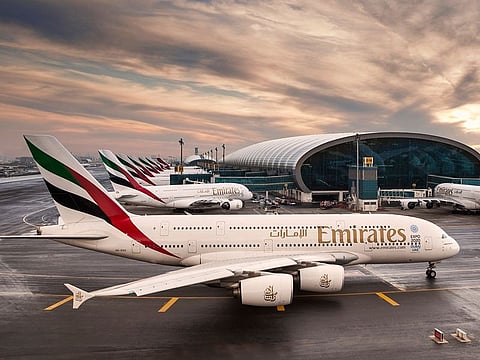
Dubai: Emirates has ranked first among global airlines for international capacity in August, offering more than 31 billion available seat kilometres (ASKs), according to data from aviation analytics OAG.
The Dubai-based carrier’s international capacity was about 21 per cent higher than second-ranked Ryanair, which recorded around 25.7 billion ASKs during the month.
Get updated faster and for FREE: Download the Gulf News app now - simply click here.
Available seat kilometres, a widely used measure of airline capacity, are calculated by multiplying the number of seats available for sale by the distance flown.
United Airlines ranked third globally with around 22.8 billion ASKs, followed by Turkish Airlines with about 21.5 billion. Qatar Airways placed fifth with around 21 billion ASKs, while Delta Air Lines ranked sixth at about 17 billion.
British Airways was seventh with 15.9 billion ASKs, followed by American Airlines with around 15.7 billion. Air France ranked ninth with a similar level of capacity, while Lufthansa completed the top 10 with about 15.3 billion ASKs.
The figures put Emirates, which operates an extensive long-haul network through its Dubai hub, significantly ahead of other international carriers by capacity deployed during August.
The ASK measure particularly reflects the scale of long-haul operations because it takes both the number of available seats and the distance flown into account.
The ranking comes as Dubai’s aviation sector continues to rebuild following the disruption caused by the US-Iran war. UAE airlines have been restoring international capacity as passenger demand gradually recovers across key markets.
Emirates has also resumed flights between Dubai and Kuwait after an extended suspension owing to the resumption of the US-Iran conflict. However, services are yet to be completely restored.
Despite the disruption, the emirate has maintained its focus on international connectivity, while airlines and airports across the Gulf have worked to restore schedules and adapt operations to a changed post-war environment.