UAE NRIs hope for lower taxes on India investments: What you could save
What you pay when selling shares, how the rules work and what a repeal could change
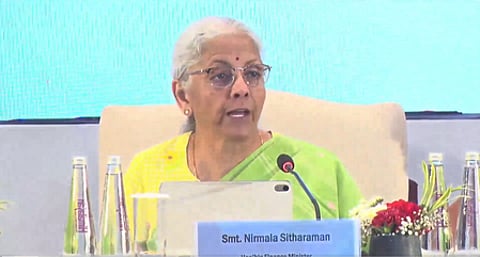
Dubai: UAE-based Indians investing in Indian shares could keep more of their profits if New Delhi reduces investment taxes, after Finance Minister Nirmala Sitharaman signalled willingness to hear investors’ concerns.
Get updated faster and for FREE: Download the Gulf News app now - simply click here.
Her remarks raised hopes of a tax review ahead of the February Budget. Indian shares rallied on Tuesday, with the Nifty 50 closing 1.6% higher, its biggest advance in more than two months, according to Bloomberg.
“It’s healthy to have this debate, and I will be keenly hearing them,” Sitharaman said at the Bloomberg New Economy Forum in New Delhi.
Even though she did not promise to cut or scrap either securities transaction tax or long-term capital gains tax, for NRIs, the difference between them matters.
One tax applies when you buy or sell certain investments. The other applies to taxable profits when you sell. Removing either could reduce your bill, but in different ways.
Why investors cheered
Investors welcomed the possibility that the government could reconsider taxes affecting their returns. Sitharaman kept that discussion open while remaining cautious about announcing changes before the Budget.
The rally reflected hopes of relief. It did not mean a tax cut had been agreed, and other developments, including gains in technology shares, also supported the market.
SBI Research has separately proposed scrapping tax on long-term equity profits while requiring investors to hold their investments for two or three years. That remains a recommendation, rather than government policy.
What you pay when trading
Securities transaction tax, commonly called STT, applies to specified purchases and sales. For ordinary purchases of listed Indian shares that enter your demat account, the rate is currently 0.1% of the purchase value. You also pay 0.1% when selling.
Buy shares worth Rs1,000,000 and the purchase tax is Rs1,000. Sell them later for Rs1,500,000 and the sale tax is Rs1,500. Together, that is Rs2,500, separate from brokerage and other charges.
You pay this tax even if the investment loses money. If those shares instead sell for Rs800,000, the sale still attracts Rs800 in STT.
Tax on investment profits works differently. It applies to the taxable gain when you sell or redeem an investment. Simply holding shares that have risen in value does not trigger this tax.
How profits are taxed
For qualifying listed shares and equity-oriented mutual funds, holding an investment for more than 12 months generally makes the profit long-term. Sell after holding for 12 months or less and the profit is generally short-term.
Qualifying short-term profits currently attract a 20% base tax rate. Long-term profits attract 12.5% on the amount exceeding Rs125,000 in a tax year.
That Rs125,000 allowance covers your combined eligible long-term profits. You do not get a separate allowance for each share, fund or sale. A 4% health and education cess—a charge on the tax itself—and any applicable surcharge increase the final bill.
Consider someone who buys shares for Rs1,000,000 and sells them for Rs1,500,000 after more than 12 months. Assume the Rs500,000 profit is their only eligible long-term gain that year, with no losses or other adjustments.
After the Rs125,000 allowance, Rs375,000 is taxable. The base tax is Rs46,875. Including the 4% cess and assuming no surcharge, the bill becomes Rs48,750.
That comes on top of the Rs2,500 STT paid across the purchase and sale. This example excludes brokerage and other transaction costs.
Why investors want relief
Investors object to paying a tax on the transaction alongside a tax on the profit. Nilesh Shah, managing director of Kotak Mahindra Asset Management Co., described the combination as a burden in the Bloomberg report.
“This dual taxation has been a concern for investors, and we need to find the right balance,” he said.
The two levies do not tax the same amount. STT applies to the value traded, while capital gains tax applies to taxable profit. Both reduce what an investor retains after a profitable sale.
SBI Research argues that removing long-term profit tax, alongside a longer holding requirement, could help attract investment. For an NRI, that could mean a lower bill in exchange for keeping money invested for longer.
Someone who needs to sell earlier might not qualify. The outcome would depend on the rules eventually adopted.
Effects on older investments
India introduced STT in 2004. Before the 2018 change, qualifying long-term equity profits covered by the relevant exemption escaped capital gains tax, although STT applied.
In 2018, India began taxing those profits at 10% above an annual Rs100,000 allowance. For sales from July 23, 2024, the rate rose to 12.5% and the allowance increased to Rs125,000. The qualifying short-term rate rose from 15% to 20%.
Buying shares before a tax increase does not automatically let you keep the earlier rate. The rules applicable when you sell determine the treatment, subject to specific protections.
Qualifying investments bought before February 1, 2018 have protection for eligible earlier gains. The calculation uses the January 31, 2018 market value when determining the purchase cost for tax purposes.
This does not make every later profit tax-free. It means investors with older holdings need their purchase records and the relevant historical value to calculate the taxable amount correctly.
What scrapping taxes saves you
Using the earlier example, removing STT before a future sale could save the investor Rs1,500 on that sale. Capital gains tax would remain unless the government changed it separately.
If long-term capital gains tax disappeared for the same qualifying sale, the illustrated Rs48,750 profit-tax bill would go. STT would remain unless that levy also changed.
For an investment already bought, a future STT repeal would not automatically refund the purchase tax. Nor would removing capital gains tax automatically return tax paid on shares already sold.
Shares you still own could benefit if new rules cover their eventual sale. But the government would need to specify when relief begins, which investments qualify and whether a longer holding period applies.
There is no announced retrospective relief. Until legislation changes, the existing rules continue to apply.
Mutual funds work differently
Equity-oriented mutual fund purchases do not attract the same 0.1% STT charged on ordinary delivery-based share purchases. The transaction tax on selling or redeeming these fund units is generally 0.001%.
On a Rs1,500,000 redemption, that is Rs15. For someone selling at a substantial long-term profit, the tax on gains can therefore be much larger than STT.
Monthly investments also have separate purchase dates. Investing through a systematic investment plan does not give every instalment the same holding period, so one withdrawal can include both short-term and long-term gains.
Any reform would need to say whether mutual funds qualify alongside direct shares. Investors cannot assume that a proposal covering “equities” will include every fund.
What UAE NRIs need to know
Living in the UAE does not automatically exempt profits from Indian investments from Indian tax. Your Indian tax residency and the rules applying to the investment determine the position.
Non-residents can also use the Rs125,000 allowance for eligible long-term equity gains. But they cannot claim the additional adjustment against an unused basic income-tax exemption that qualifying resident individuals can use under these provisions.
NRI mutual fund withdrawals can also involve tax being deducted before the money reaches the investor. This withholding is a payment towards the tax bill, rather than another tax on top of STT and capital gains tax.
For UAE investors, any reduction could leave more money after a sale. Share prices and the rupee-to-dirham exchange rate would still affect the amount available to spend or reinvest.
The Budget debate now raises a practical question for your existing holdings: will relief cover their future sale, and how long must you hold them to qualify? Sitharaman has kept the discussion open, but those details remain undecided.