Roots of a new trend
Health and spiritual concerns help vegetarianism gain popularity in Mongolia
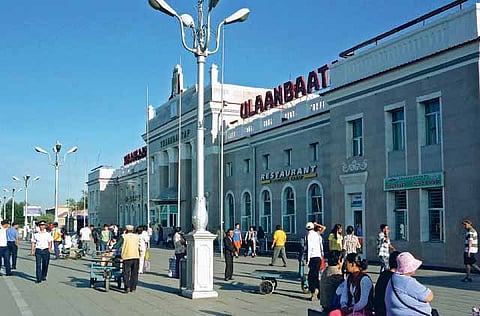
An unlikely vegetarian movement is beginning to take root in Mongolia, where livestock outnumbers people 14 to 1 and meat consumption tops 200 pounds per person a year.
The first vegetarian restaurant in Mongolia, Ananda's Café, opened in 2006. Today more than 20 vegetarian and vegan restaurants pepper the capital, Ulan Bator, and a handful of others are scattered throughout the country. Ananda's has launched a catering service and another popular restaurant, Luna Blanca, now sells frozen faux-mutton dumplings in supermarkets.
The restaurateurs, mostly Mongolians, belong to Christian and Buddhist-influenced spiritual movements that promote vegetarianism. Mongolians are turning to vegetarianism mostly because of health. "Also because of meditation — they're following this trend," says Solongo, a former assistant doctor for the United Nations, who like most Mongolians uses only one name. She estimates that vegetarians number around 30,000 or 40,000, just over one per cent of the population.
Increased trade with Russia and China and expanding internet access are providing more information about food and nutrition, she adds. "When things go to extremes, such as extreme meat consumption, things go to the other extreme," says Altanzaya, a sociologist and a co-owner of Luna Blanca. "Our goal is to make it available."
Mongolia's brand of Buddhism does not emphasise sparing the lives of animals for food, probably out of pragmatism. The country's dry, mountainous landscape and nomadic culture mean that people have historically ignored agriculture and depended instead on meat and dairy products.
The only real food
That high-protein diet fuelled Genghis Khan's hordes as they swept across the known world 800 years ago. Historians have noted that Mongolian soldiers could ride for days at a time, drinking blood from their horses' necks for nourishment.
Some in Mongolia consider meat the only real food. "If there's no meat, [my father] doesn't consider it a meal. You give him leaves and he says, ‘What am I, a goat?'" says Dolgor, a young mining company employee. The staples here are often bland, relying heavily on flour, rice and meat, particularly mutton. Dishes that most Mongolians refer to as the "national foods", buuz and huushuur — mutton-filled dumplings steamed or fried, respectively — and tsoivan, steamed noodles mixed with meat and root vegetables, originated in China.
Even more than meat, the traditional Mongolian diet depends on dairy products. Milk is viewed as sacred; each morning, women in countryside homesteads and urban apartment blocks throw an offering of the day's first milk tea to the sky. A few generations ago, herding families subsisted almost entirely on milk products during summer, when grazing is good. Milk comes in all forms here. According to Altanzaya, one of the challenges of starting a vegetarian restaurant in Mongolia is getting people to realise that the menu isn't just dairy. The Mongolian terms are only subtly different; the phrases for dairy products (tsagaan idée) and vegetarian food (tsagaan khool) both translate to "white food".
The menus of most vegetarian restaurants here use soya-based meat substitutes to mimic traditional Mongolian dishes. At all of them, vegetarian buuz and tsoivan are among the most popular items. Vegetable-based meals are less common, except at Ananda's Cafe, which anchors its menu on a different vegetable medley every day to lure vegetarians hungry for a broader spectrum of nutrients.
The food's originality, or lack thereof, is often beside the point. "The more we care about the environment and others and animals, the better we feel," says Altanzaya.
Mongolian vegetarians often face scepticism. "A lot of people think we're crazy," says Erdenchimeg, a chef at Loving Hut, a chain owned by the Supreme Master Ching Hai International Association, which promotes meditation and prayer. She became a vegetarian in 2008 and in recent months switched to veganism — all part of a commitment to lessening her impact on the environment, she says.
Limited choice
Javkhlan, a university teacher, also took up vegetarianism 18 months ago, after he began practising the Ching Hai meditation technique. He cooks tofu, dehydrated soya meat and what few vegetables are available in the province centre. He doesn't miss meat, he says. "I'm happy being vegetarian. My health has improved."
Still, even some of the vegetarian restaurants' employees haven't fully committed, for example, Amarmurun, a server at the Stupa Café, which is part of the international Foundation for the Preservation of the Mahayana Tradition, a Tibetan Buddhist organisation. "I like meat," she says sheepishly. "I just work here."


