Rare eagle rescued from smugglers soars free again in Serbia
Rare eastern imperial eagle released after months of negotiations and rehabilitation
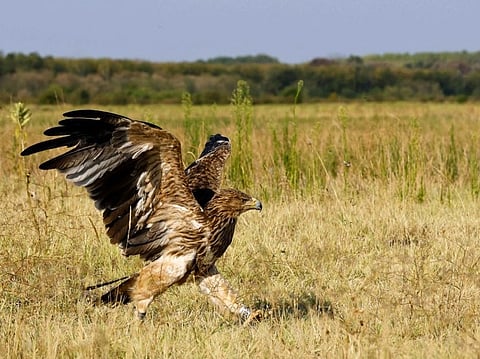
Belgrade: Feliks, a rare eastern imperial eagle, is again soaring through the skies of his Serbian homeland after being rescued from the clutches of bird smugglers during his inaugural migration, the national bird society said Friday.
Serbia's Bird Protection and Study Society, which helped return the bird from its months-long international ordeal, said he had been released back into the wild this week.
After the young raptor first flew the nest in July 2025, experts tracking the protected species' flight path became alarmed when he took an unusual route toward the Middle East.
"At that point, we started to worry because we could see that he was heading towards an extremely unsafe region," Uros Stojiljkovic of the Bird Protection and Study Society of Serbia told AFP.
In late October, Feliks's signal disappeared, with his last location recorded in Syria.
Stojiljkovic said he had originally hoped it was just a faulty tracker, but soon it became clear that he had been birdnapped.
Contacted via a partner organisation in Lebanon, the Serbian conservationist said the bird's unnamed captors had demanded a ransom.
"We categorically refused. By doing so, you are effectively supporting that smuggling chain," Stojiljkovic said.
After lengthy negotiations, the bird was handed to a wildlife centre in Beirut, where he remained for six months as plans were made for a safe return.
In June, Serbian troops returning from a peacekeeping mission in Lebanon eventually flew Feliks home on a military plane and brought him to Palic Zoo to recover.
After careful rehabilitation, he was released back to the wild this week.
"We hope he will manage to fly at least as far as the first time, when he reached the shores of Asia and Africa," zoo director Sonja Mandic said in a statement.
Eastern imperial eagles are critically endangered and strictly protected in Serbia, where their number had fallen to as little as just one breeding pair in 2017, according to Stojiljkovic.
Conservation efforts have since helped the population recover, with 29 pairs monitored in 2026.
Stojiljkovic said four chicks had also been born this year, named Jelena, Princ, Atila and Michel.
The last was named in honour of Michel Sawan, head of the Lebanese organisation that helped rescue Feliks.


