Steve Irwin died 20 years ago. His wildlife legacy never did
Children pay tribute to ‘superhero’ dad as family carries his conservation mission forward
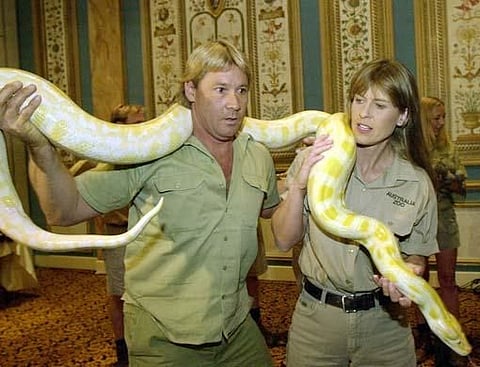
Twenty years after the sudden death of Steve Irwin stunned millions around the world, his daughter Bindi has remembered the man behind the exuberant Crocodile Hunter persona simply as her family’s “superhero”.
Irwin died on September 4, 2006, aged 44, after being struck in the chest by a stingray barb while filming underwater at the Great Barrier Reef.
Two decades later, his family and friends are marking the anniversary not simply by remembering how he died, but by celebrating what survived him: an infectious passion for wildlife that helped turn an Australian zookeeper in khaki into one of the world’s most recognisable conservationists.
Bindi, who was eight when her father died, shared an emotional tribute reflecting on the loss that has accompanied the family for 20 years.
“Our family lost our superhero,” she wrote, adding that her mother Terri had lost the love of her life while she and her brother Robert had lost “the greatest dad”.
“Grief never truly leaves us; we walk alongside it every day,” she wrote.
But Bindi, now 28, said she had come to understand that her father’s legacy extended beyond wildlife conservation.
It was also about love.
Her five-year-old daughter Grace, who never met her grandfather, watches his documentaries and knows him as “grandpa crocodile”, Bindi said.
Robert Irwin, who was just two when his father died, posted a childhood photograph of himself looking up at Steve and wrote simply: “Your legacy is forever.”
The man in khaki
Long before social media turned larger-than-life personalities into global brands, Irwin had discovered something remarkably powerful: enthusiasm could make people care.
With his trademark khaki shorts, Australian accent, cries of “Crikey!” and seemingly fearless encounters with crocodiles, snakes and other wildlife, Irwin became a television phenomenon.
The Crocodile Hunter, which he presented alongside his American-born wife Terri, took his wildlife message into homes around the world.
Yet those who worked with him say the flamboyant television personality sometimes obscured another side of Irwin — the serious and intensely curious wildlife researcher.
Mark Read, who worked alongside Irwin on crocodile research in northern Queensland, recalled a man who constantly recorded ideas and observations in a battered notebook he carried in an equally worn green backpack.
“You saw all the hallmarks of an incredibly active mind,” Read told AAP. “He was super interested in the science.”
Their work included pioneering research using satellite transmitters to track estuarine crocodiles and better understand their movements.
Read said that despite Irwin’s global fame and earning power, he remained remarkably unchanged, even arriving for remote fieldwork wearing battered boots patched with tape.
From zoo keeper to global star
Irwin’s journey to television fame began at the wildlife park established by his parents in Queensland.
Producer and director John Stainton later recalled being mesmerised after watching hours of Irwin’s home footage.
That encounter helped lead to The Crocodile Hunter, the television series that transformed Irwin into an international celebrity.
His longtime friend Wes Mannion remembers the experience of working alongside him as an extraordinary ride.
“You had to keep up with him,” Mannion told ABC Australia. “Most people couldn’t keep up with him.”
But fame did not appear to diminish Irwin’s central obsession: persuading people to care about animals, including creatures they might otherwise fear.
His formula was uncomplicated — make people fascinated by wildlife and they might want to protect it.
September 4, 2006
Irwin was filming the documentary Ocean’s Deadliest off northern Queensland when he encountered a stingray at Batt Reef near Port Douglas.
The animal’s barb struck him in the chest. Members of the film crew tried desperately to save him, but he died from his injuries.
The news travelled rapidly around the world.
For many Australians, it became one of those moments when people remembered exactly where they were when they heard.
His public memorial at Australia Zoo later that month drew an enormous global television audience.
Among those who spoke was eight-year-old Bindi.
“My daddy was my hero,” she told mourners.
She also made a promise: she did not want her father’s passion to end and wanted to continue helping endangered wildlife.
Twenty years later, that promise has proved remarkably durable.
A family carries on his work
Terri, Bindi and Robert have continued Irwin’s conservation work and remain closely associated with Australia Zoo.
The zoo attracts about 700,000 visitors a year, according to ABC Australia, while the Steve Irwin Wildlife Reserve protects about 180,000 hectares of habitat across Queensland.
The family continues field research, including work involving saltwater crocodiles.
Both children have also developed public profiles of their own.
Robert, now 22, has become a familiar television personality and conservation advocate, while Bindi has spent much of her adult life promoting wildlife protection. Both have won the US version of Dancing with the Stars — a decade apart — extending the family’s reach to audiences far beyond Australia.
For those who knew their father, however, the continuation of his work may be the more meaningful achievement.
Mannion, who helped guide Bindi and Robert after Steve’s death and taught them some of the wildlife skills their father had taught him, believes his old friend would have been immensely proud of them.
Twenty years, but hardly forgotten
Perhaps the most remarkable part of Irwin’s legacy is that a generation born after his death still knows the man in khaki.
His documentaries remain in circulation. His children speak the language of conservation to audiences their father never lived to meet. Australia Zoo continues his work, while research and wildlife protection projects carry his name.
And the style Irwin pioneered — making conservation accessible through personality, excitement and storytelling — has become commonplace in an age of social media wildlife communicators.
For Irwin, the exuberance was never really the point. It was the means of getting people’s attention long enough to make them care.
Twenty years after the Crocodile Hunter disappeared from television screens, that message has proved harder to extinguish than anyone might have imagined.
As Bindi put it in her anniversary tribute, her father’s life and legacy remain something worth celebrating.
And for five-year-old Grace, who begins her mornings watching the grandfather she never met, Steve Irwin is not simply a television icon from another era.
He is still “grandpa crocodile”.


