Shahed and LUCAS: The different drones explained
Shahed-136 and LUCAS — two drones that have become major talking points in the conflict
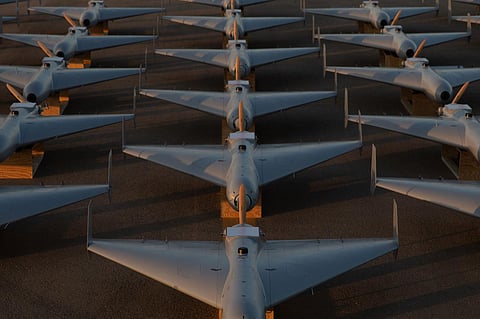
The war between the United States–Israel coalition and Iran has highlighted a new reality of modern warfare: cheap suicide drones may be more decisive than billion-dollar fighter jets.
Two nearly identical weapons now dominate the conversation — the Iranian Shahed‑136 and LUCAS (Low‑cost Uncrewed Combat Attack System), the latest gear in the US arsenal.


Ironically, the US drone was reverse-engineered directly from the Iranian design and mass produced, turning Tehran’s own innovation into a weapon used against it, Forbes reported.
Side-by-side
Below is a side-by-side look at the two loitering munitions.
| Category | Shahed-136 (Iran) | LUCAS (United States) |
|---|---|---|
| Type | One-way attack drone / loitering munition | One-way attack drone based on Shahed |
| Developer | Shahed Aviation Industries | SpektreWorks + U.S. military |
| Length | ~3.5 m | Similar triangular design |
| Wingspan | ~2.5 m | ~2.5–3 m class |
| Speed | ~185 km/h | Similar class |
| Range | Up to ~2,000 km | “Extensive range” (similar category) |
| Payload | ~50 kg warhead (some versions up to ~90 kg) | Comparable explosive payload |
| Guidance | GPS / inertial navigation | Autonomous + networking capability |
| Launch method | Rack launch / rocket assist | Catapult, mobile launcher, or ship launch |
| Unit cost | ~$10k–$50k (domestic); up to ~$193k export | ~$35,000 per drone |
| Role | Mass saturation attacks | Swarm strike and counter-swarm operations |
Sources: Public domain
Production economics: The real weapon is scale
The Shahed-136 changed warfare not because it is technologically advanced — but because it is extremely cheap and easy to mass-produce.
Estimated cost: $10k–$50k per unit in Iran.
Russia reportedly plans tens of thousands per year of its version.
The triangular design reduces structural parts, making assembly simpler and cheaper.
Instead of firing million-dollar missiles, Iran can launch hundreds of drones simultaneously, overwhelming defenses.
US response with LUCAS mirrors Shahed
It costs roughly $35,000 per unit, according to US media.
Designed for high-volume swarm attacks.
Networked drones can coordinate with each other in flight.
This reflects a major Pentagon shift toward “attritable warfare” — weapons cheap enough to lose in large numbers.
Combat performance so far: The first 6 days of war
In the opening days of the regional conflict, Iran reportedly launched hundreds of Shahed drones at targets across the Gulf.
Key observations:
Shahed-136 strengths
Massive numbers launched simultaneously
Long range (up to ~2,000 km)
Difficult for radar due to low altitude
Cheap enough for saturation attacks
But there are weaknesses.
Shahed-136 weaknesses
Slow propeller speed (~185 km/h)
Loud engine makes them detectable
High interception rates by air defense
Reports indicate most drones were intercepted by integrated systems such as Patriot and Iron Dome.
What to know about LUCAS
Meanwhile, the US LUCAS drones have only recently entered operational deployment, including launches from naval vessels in the Gulf.
Their battlefield role so far appears to include:
Targeting missile launch sites
Striking radar systems
Coordinated swarm attacks with networking
The real lesson
The bigger story today is NOT which drone is better.
It’s that both sides are converging on the same weapon concept: Cheap, mass-produced suicide drones replacing expensive missiles.
In modern warfare, the side that can produce tens of thousands of drones — not the most advanced aircraft — may ultimately control the battlefield.


