Was it a 'mission impossible' for Mideast envoy Mitchell?
Surge of uncertainty over recent events worsened the situation
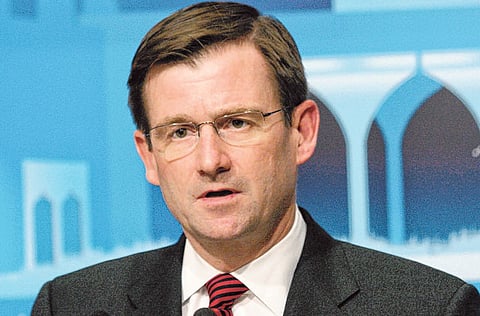
Washington: President Barack Obama's Middle East envoy, former Senator George Mitchell, is stepping down, the White House announced on Friday - a move that highlights the glaring lack of progress in what was once Obama's top foreign-policy priority, Israeli-Palestinian peace.
The Associated Press said Saturday that Obama has accepted his resignation and David Hale, Mitchell's deputy, will serve as acting envoy.
The departure of Mitchell, known for brokering a Northern Ireland peace accord under the Clinton administration, also suggests the waning of Obama's early fancy for special envoys to address key international issues.
The White House said on Friday that Mitchell is stepping down for personal reasons, but that the president remains committed to addressing one of the thorniest issues in US foreign policy.
Hard issue
"This president's commitment remains as firm as it was when he took office," spokesman Jay Carney said. "The fact that this is a hard issue, an extraordinarily hard issue, is not news to anyone in this room or anyone who's ever attempted to work on it over these many years."
But the seasoned diplomat's departure couldn't help but be linked around Washington with the fruitlessness of the more than two years Mitchell dedicated to his task.
Obama praised Mitchell as a "tireless advocate for peace" in the statement released by the White House on Friday afternoon.
In one sense the announcement seemed to come at a particularly bad time: Obama will deliver a major policy speech on the Middle East at the State Department on Thursday, and the administration insists that the president is sticking to his goal of reaching a breakthrough such as a framework peace agreement by September.
Obama is set to receive both Jordan's King Abdullah and Israeli Prime Minister Benjamin Netanyahu at the White House this week.
Inactivity
But on the other hand, Mitchell's departure merely confirmed the inactivity that characterised his office in recent months. Mitchell's once-regular forays into the Middle East had fallen off as the Arab Spring gave the region a new preoccupation — and denied Mitchell one of his key interlocutors in former Egyptian President Hosni Mubarak.
At one point earlier this year, optimism over events in Egypt and Tunisia also led to speculation that Obama's peace initiative — and Mitchell's role in it — might be revived. But more recently a surge of uncertainty over the direction of events in Egypt, plus the surprise reconciliation among Palestinians between President Mahmoud Abbas's Fatah party and Hamas, seemed to doom any imminent return to peace talks.
The special envoy model was largely based on the centrality of dialogue and negotiation with leaders who could step up and make big decisions. But many Middle East analysts cautioned from the beginning of Mitchell's brief in the first days of the Obama presidency that the successful negotiator was unlikely to find such leadership among either Israelis or Palestinians.
Criticism
Still, Mitchell exuded a characteristic optimism from the beginning. When he was named special envoy the first week of Obama's presidency, he told reporters he approached the long Israeli-Palestinian conflict as a solvable problem.
The Northern Ireland negotiations taught him that "conflicts are created, conducted, and sustained by human beings," he said. "They can be ended by human beings."
Yet Mitchell's star began falling when he was unable to deliver some form of initial agreement for Obama to announce at his first speech before the United Nations General Assembly in September 2009. Some analysts said then that Mitchell was hobbled by Obama's insistence on an Israeli colony freeze. But by 2010 some critics were calling for Mitchell to be replaced by a fresh approach, or for the idea of a special envoy for the Israeli-Palestinian conflict to be dropped altogether.
Rapport was missing
Since his appointment, Mitchell, 77, has shuttled among the Israelis, Palestinians and friendly Arab states in a bid to restart long-stalled talks that would create an independent Palestinian state. But in recent months, particularly after the upheaval in Arab countries that ousted longtime US ally and key peace partner Hosni Mubarak from power in Egypt, his activity had slowed markedly. Mitchell never established a firm presence, preferring to jet in for short visits lasting several days or even several hours.
More critically, Mitchell never established a rapport with either side. With Israelis suspicious of Obama even before he assumed office, Mitchell further unnerved them by taking a tough line against West Bank colonies, saying that any construction was unacceptable. The Palestinians, initially encouraged, became disillusioned when the US was unable to persuade Israel to freeze colony construction.
Jon Alterman, director of the Middle East programme at the Centre for Strategic and International Studies, said Mitchell's task held greater hope at the time of his appointment. "But the way the politics worked out, you have an Israeli government that is very sceptical about the ability of negotiating with the Palestinian National Authority," Alterman said. "And you have a Palestinian National Authority where the internal politics are increasingly fraught.
"So it's hard to find a political consensus either among the Israelis or the Palestinians to move forward on the kinds of negotiations that George Mitchell was appointed to facilitate." Mitchell believed his patience would serve him well in the Arab-Israeli conflict and its constant forward and backward steps.
— Christian Science Monitor & AP


