US targets IRGC weapons routes through Caspian Sea
US Central Command enforces naval blockade to curb Iran's military supply chains
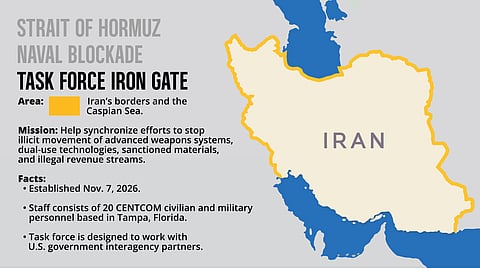
The United States is widening its campaign to choke off Iran's military supply networks, extending pressure beyond the Strait of Hormuz to the country's land borders and the Caspian Sea.
US Central Command (CENTCOM) says American forces are working "around the clock" to keep the strategic waterway open to commercial shipping while strictly enforcing what it calls an "ironclad naval blockade" against Iran.
Get it: Fast, verified news for FREE ... download the Gulf News app — simply click here
In a statement posted on X, CentCom said it was also working with other US government agencies to prevent Iran's Islamic Revolutionary Guard Corps (IRGC) from using overland routes and the Caspian Sea to move advanced weapons systems, "dual-use" technology, sanctioned materials and illicit revenue.
The announcement signals a broader US strategy: restrict not only Iran's ability to export oil and generate revenue, but also its capacity to import military equipment, obtain sensitive technology and rebuild its weapons industry.
The latest operation builds on the establishment of Task Force Iron Gate, announced on November 7.
Latest updates: What has happened so far?
NOVEMBER 7–12, 2026
November 7 — CENTCOM announces Iron Gate.
Admiral Brad Cooper orders the establishment of the approximately 20-member task force in Tampa, Florida. Its mission is to disrupt Iranian weapons and sanctioned-material supply routes.
November 8 — Trump declares it operational.
President Donald Trump says Iron Gate is in "full force and effect", claiming that, combined with the naval blockade, very little can enter or leave Iran.
November 8 — Iran dismisses the initiative.
Revolutionary Guard spokesman Hossein Mohebbi describes Iron Gate as "wordplay", arguing that Washington cannot achieve its economic objectives through the initiative.
November 9 — Details emerge about supply networks.
Reporting highlights Iran's reliance on Russian shipping, Central Asian land transport and Chinese air freight to obtain military-related equipment. Analysts question whether Washington can effectively monitor all these channels.
November 10 — White House confirms operational status.
The White House publicly describes Iron Gate as operational. However, no specific interdiction operation, border closure or agreement with neighbouring governments is announced.
November 11–12 — Enforcement details remain unclear
Available reporting has not established any publicly confirmed Iron Gate seizure, interception or physical closure of an Iranian land supply route. The announced mission remains focused on interagency coordination and disrupting prohibited movements.
The $25 billion blockade: What is at stake?
CENTCOM says the US naval blockade has prevented Iran from exporting more than $25 billion worth of crude oil in recent months.
The two components of Washington's pressure campaign:
Naval blockade: $25 billion is CentCom's claimed value of prevented Iranian crude exports
Task Force Iron Gate: Civilian and military personnel coordinating supply-route restrictions
Figures are US government statements, not independently audited estimates of total economic losses.
The combination is significant: Washington is attempting to restrict both Iran's ability to earn money from oil exports and its ability to obtain the materials needed to sustain its military.