Lebanon resumes talks on unified defence strategy
Search on for compromise over Hezbollah's military wing
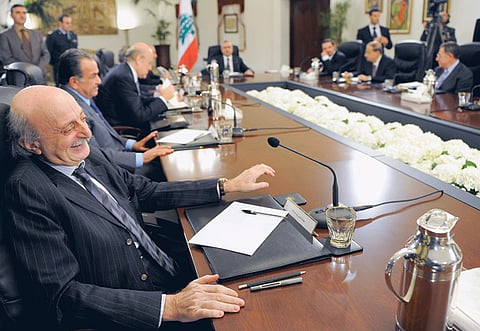
Beirut: Lebanon's top politicians have resumed a series of round-table discussions to devise a national defence strategy, at the heart of which is finding a compromise over Hezbollah's powerful military wing.
Although Lebanon is enjoying a taste of political stability and a buoyant economy after several years of internal violence and a war with Israel in 2006 its rival political factions are still divided over Hezbollah's continued armed status.
The dispute is underlined by persistent fears here that another devastating war is brewing between Hezbollah and Israel, possibly as an outcome of intensifying efforts to forge an international consensus to curb Iran's nuclear ambitions. Given the rising tensions and recent strengthening of an Iran-led alliance in the Middle East, a war between Hezbollah and Israel could expand to become a regional conflagration involving Iran and Syria, both of which support the Lebanese Shiite party.
"We have managed to put ourselves on the frontline of the main critical issue that will dominate the international agenda for the next three or four years," says Paul Salem, director of the Carnegie Endowment's Middle East Centre in Beirut.
In this strained regional atmosphere the national dialogue session, grouping Lebanon's top 18 political leaders, met on Tuesday under the auspices of President Michel Sulaiman for the first time since before the parliamentary elections last June.
Troubled waters
But the meeting only lasted two hours and mainly affirmed what was previously agreed at earlier sessions. A final statement said that a military committee formed during an earlier session in December 2008 would continue to examine proposals "in an effort to find common ground among the different parties and eventually reach a unified national defence strategy".
Will Hezbollah disarm? Sceptics of the national dialogue process say the debate over crafting a policy of national defence is simply a smokescreen to avoid having to deal with the intractable problem of Hezbollah's weapons. But, analysts say, in a country of myriad political persuasions where compromise usually is key to maintaining stability, the national dialogue does serve a purpose.
"It does seem a bit farcical," says Elias Muhanna, a political analyst and author of the influential Lebanese affairs blog Qifa Nabki, in an e-mail exchange.
"On the one hand, it's easy to deride it as little more than a glorified back-room for deal-making. On the other hand, given the problems of political representation within the Lebanese system, the talks give everyone something to take home to their constituents."
"Hezbollah's critics "get to show that they are putting pressure on Hezbollah while the latter demonstrates that it is open to a process of nationalising its [military wing]," Muhanna added.
Few expect an imminent advance in the national dialogue, which first convened in March 2006, but workable solutions could be drawn up over time, some analysts say.
"There is a team of experts working on this and that is where the credibility of the dialogue will rest," says Ousama Safa, director of the Lebanese Centre for Policy Studies. "It will become a thinking machine that could offer solutions. But we are navigating in troubled waters at this point and there is no climate for a breakthrough."
Hezbollah says it needs its weapons. It argues its mode of warfare, in coordination with the Lebanese army, is the best means of deterring future Israeli aggression against Lebanon.
Shaikh Naim Qasim, Hezbollah's deputy secretary-general, on Sunday pointed to the party's role in ending Israel's occupation of southern Lebanon in 2000 and its robust challenge to the Israeli army during the month-long war in July 2006.
But Hezbollah's opponents insist national defence is the responsibility of the Lebanese state, not a political party even if it does coordinate with the Lebanese army.


