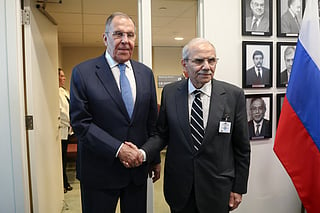
Lebanon–Israel talks: First direct meeting since 1993 — what’s next?
Rare progress in Washington overshadowed by deep divisions and uncertain next steps
Dubai: The United States has hosted the first direct talks between Lebanon and Israel since 1993 in Washington, DC, in what officials describe as a high-level diplomatic push to contain escalating violence.
Both sides agreed to hold direct negotiations after “productive discussions” between the envoys in Washington, the United States said on Tuesday.
“The participants held productive discussions on steps toward launching direct negotiations between Israel and Lebanon,” State Department spokesperson Tommy Pigott said in a statement.
“All sides agreed to launch direct negotiations at a mutually agreed time and venue,” he said.
The announcement came after Israeli and Lebanese envoys held more than two hours of talks mediated by US Secretary of State Marco Rubio.
“The United States congratulated the two countries on this historic milestone and expressed its support for further talks, and for the government of Lebanon’s plans to restore the monopoly of force and to end Iran’s overbearing influence,” Pigott said.
And it “affirmed that any agreement to cease hostilities must be reached between the two governments, brokered by the United States, and not through any separate track,” he added.
Lebanon was pulled into the region-wide Iran war on March 2 after pro-Tehran Hezbollah attacked Israel.
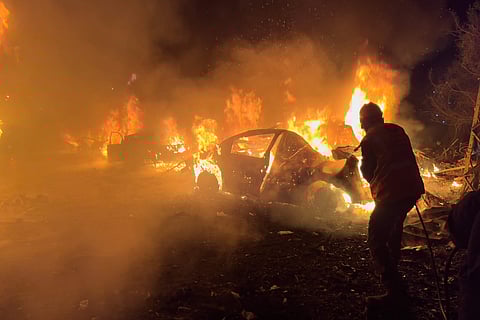
Since then, Israeli strikes have killed more than 2,000 people and displaced more than one million, despite international calls for a ceasefire, and Israeli ground forces have invaded south Lebanon.
But with both sides far apart — and Hezbollah rejecting the process outright — expectations of a breakthrough remain low.
When and where the talks were held?
The talks were held at the US State Department in Washington on Tuesday. They mark the first direct engagement between Lebanese and Israeli representatives in over three decades.
Who was involved?
The meeting brought together:
Lebanese Ambassador Nada Hamadeh
Israeli Ambassador Yechiel Leiter
US Secretary of State Marco Rubio
Senior US diplomats, including Ambassador to Lebanon Michel Issa and State Department counsellor Michael Needham, facilitated discussions.
Washington is acting as mediator, framing the talks as a necessary step to address the ongoing conflict between Israel and Hezbollah.
Why talks now?
The diplomatic push came amid a sharp escalation in violence.
Israel has intensified its military campaign in Lebanon, with over 2,000 people reported killed and more than a million displaced. Hezbollah, in turn, has fired rockets into Israel and engaged in ground fighting in southern Lebanon.
Lebanon is seeking an immediate ceasefire. Israel, however, has refused to halt operations and is instead pushing for Hezbollah’s disarmament.
The talks also follow recent US-Iran ceasefire efforts, where Lebanon emerged as a key flashpoint. Analysts say Washington is trying to prevent the conflict from being used as leverage by Tehran.
What are the core issues?
A potential ceasefire
Disarmament of Hezbollah
A broader security or peace framework
However, both sides approached these goals from sharply different positions.
What does Israel want?
Israel has made clear it is not seeking an immediate ceasefire.
Prime Minister Benjamin Netanyahu has said the goal is the dismantling of Hezbollah’s weapons and a lasting peace arrangement. Israeli media reports suggest proposals could include dividing southern Lebanon into security zones, with varying levels of Israeli and Lebanese military control.
What is Lebanon’s position?
Lebanon sees the talks as a preliminary step to halt Israeli attacks.
Officials have acknowledged limited leverage but say the priority is to secure a pause in hostilities. On Hezbollah’s disarmament, Beirut has indicated that any such process would take time and require internal consensus.
Why is Hezbollah opposing the talks?
Hezbollah has strongly rejected the negotiations.
Senior official Wafiq Safa told the Associated Press the group “will not abide” by any agreement reached in Washington, underscoring its refusal to recognise the process.
The group argues:
Talks under ongoing Israeli attacks amount to surrender
Disarmament is a domestic issue, not subject to external pressure
The government lacks national consensus for such negotiations
Hezbollah has insisted that Israeli withdrawal must come first before any discussion of its weapons.
Can the talks lead to a ceasefire?
The chances of an immediate breakthrough appear slim.
Israel remains focused on weakening Hezbollah militarily, while Lebanon is pushing for a halt to hostilities. Meanwhile, ongoing fighting on the ground — particularly in southern Lebanon — could shape the outcome more than diplomacy.
For now, the talks represent an important but uncertain step in a conflict where battlefield dynamics and political divisions continue to dominate.
-- With AP and AFP inputs