Islamic Jihad gains new traction in Gaza
Last month the group captured global headlines by firing a barrage of 100 rockets toward Israel in less than an hour
Gaza
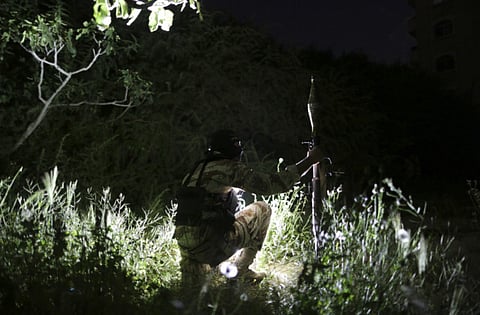
Shortly before midnight, seven black-masked young men in camouflage stood in a field of waist-high weeds, Kalashnikov rifles pointed toward the Mediterranean Sea a half-mile away.
No Israeli soldier has set foot in Gaza City in five years, but the 25-year-old commander of this band of Al Quds Brigades — the armed wing of Islamic Jihad — said his troops stand vigil nightly to “protect the Palestinian people” from any “incursion.”
Every few minutes, in what may have been a ritual or an effort to broadcast to the world their readiness to fight, the radio on the commander’s shoulder crackled with warnings: drones in the east, F-16s overhead, gunboat movement at sea.
“You are the men; you, the Al Quds Brigades, are the real men,” the voice said after reciting verses from the Quran.
Smaller and less known internationally than Hamas, that has ruled since 2007 — Islamic Jihad and its Al Quds Brigades are having something of a renaissance.
Last month the group captured global headlines by firing a barrage of 100 rockets toward Israel in less than an hour. Polls show that support for Islamic Jihad among residents of Gaza remains far below that of the leading political factions but has seen an uptick as the group has lately built health clinics, opened schools, and expanded its family-mediation services.
Though not a signatory to the reconciliation pact last month between Hamas and the Palestine Liberation Organisation, Islamic Jihad would join Hamas as part of the formal Palestinian leadership if the deal were implemented. Founded nearly a decade ahead of Hamas, Islamic Jihad has long shunned electoral politics to focus on military resistance to the Israeli occupation.
Now, analysts say that because it is backed by Iranian funds and free of any governing, Islamic Jihad has been able to assert itself as the main military expression of Palestinian nationalism, while Hamas is partly blamed by a restive population for rampant unemployment and daily shortfalls of fuel, electricity and water.
There is scant ideological space between the two movements. While some characterise Islamic Jihad as a rival Hamas struggles to control, leaders of both groups say they are coordinated and complementary.
As Hamas has suffered from severed ties with Syria, Iran and Egypt, Islamic Jihad has maintained relations with all three and increased its activity in Gaza.
“They are a very distant second to Hamas in military power, in supporters, in civil society, in every dimension of strength that you could think of, but they’re growing for sure,” said Nathan Thrall of the International Crisis Group, who wrote a report on Gaza. “They have similar visions and strategic ideas. Some of the tension comes from the fact that Islamic Jihad doesn’t govern Gaza and doesn’t really suffer the consequences. They’re ready to attack Israel all day long.”
Abu Ahmad, a spokesman for Al Quds Brigades, declined to say how many fighters it enlists, or how much they are paid. He had said the Gaza force was 8,000 strong in 2011.
A senior intelligence official with the Israel Defence Forces put the number at half that, compared with 10,000 for the Ezz Al Deen Al Qassam Brigades, Hamas’ armed wing. Together, he said, the two groups have manufactured 200 rockets capable of reaching Tel Aviv, 10 times the number they possessed two years ago, though such estimates could not be verified and could be part of an effort to emphasise the threats Israel faces.
Dangerous diplomacy
Hamas officials were clearly irked last month when Islamic Jihad announced it had worked with Egypt’s new military-backed government — which deemed Hamas a terrorist group — to restore calm with Israel.
But Islamic Jihad leaders, operating from exile in Damascus, have also tried to smooth relations between Hamas and Iran after a parting over the Syrian civil war. “They are trying to walk on a very thin line between Israel and Hamas and the Iranian pressure in the background,” the Israeli intelligence official said.
Hamas, he added, “finds itself in a very complicated situation,” concerned that Islamic Jihad’s aggression risks unwanted escalation with Israel, “but they do not want to be considered or portrayed as the government that limited the resistance, so they prefer to talk with them and to coordinate with them.”
Islamic Jihad was created in 1979 by Palestinian students at Egyptian universities who were inspired by Iran’s Islamic revolution, and disillusioned that the Muslim Brotherhood was not focused enough on Palestine. Its founder, Fat’hi Shikaki, was assassinated by Israeli agents in Malta in 1995; in some Gaza precincts, his picture is more prominent than that of the Hamas prime minister.
The US designated Islamic Jihad a terrorist organisation in 1997. The current secretary-general, Ramadan Shallah, who is on the FBI’s most wanted list, said in a 2009 interview that he would never “accept the existence of the state of Israel,” and that “our sacred duty is to fight.”
The Palestinian Centre for Policy and Survey Research found 5 per cent of Gaza residents supporting Islamic Jihad in December and 4 per cent in March, up from 1 to 3 per cent in recent years. “It’s always been an elitist group,” said the centre’s director, Khalil Shikaki, who is also its founder’s brother.
The armed wing remains Islamic Jihad’s priority, but its civic activities have been swelling. Daoud Shihab, the chief spokesman said the movement plans to build a cardiac hospital in central Gaza and four clinics. Islamic Jihad runs three private elementary schools and is planning three more, Shihab said, while the group has doubled its kindergartens to 100 in the past five years.
Above the bustling market in Shejaya, an Islamic Jihad stronghold, sits one of the movement’s 12 reconciliation centres, where middle-aged men in robes mediate disputes between families. Omar Farra, a mosque preacher and the movement’s leader, said the men resolve hundreds of cases a year, much quicker than the Hamas courts.
After a woman died in childbirth, her family demanded about $35,000 from the doctor. Mediators persuaded the family to accept $24,000, but the doctor would pay only about $21,000, so Islamic Jihad bridged the gap.
“What is more important for us is to make the reconciliation,” Farra explained, “so we paid.”
— New York Times News Service


