Cairo still arts hub of the Arab world
City offers right atmosphere for artists from region to nurture their talent
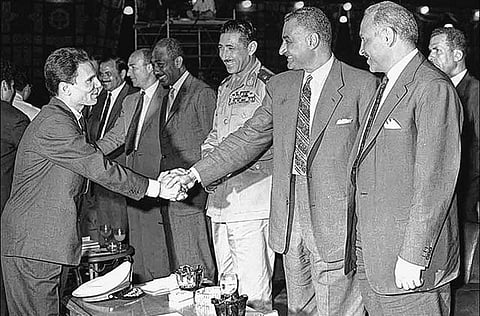
Dubai: The current events in Egypt may have brought the country into the world's political spotlight, but the 80-million-people nation had long been the Arab world's cultural hub.
Nobel Laureate novelist Najeeb Mahfouz may be the best-known Egyptian literary figure, as his works were translated to tens of languages, but he is not the only one. Men and women of letters in Egypt left their mark on Arabic literature and brought enlightenment and knowledge to all Arabs while most of the Arab nation was struggling under the Ottoman and European occupations.
Novelists Yousuf Edriss and Ehsan Abdul Quddus, Abbas Mahmoud Al Aqqad, Yousuf Al Sebai and Nawal Al Saadawi, and poets Ahmad Shawqi, Hafez Ebrahim, Ahmad Rami, Salah Jaheen, Ahmad Fuad Najm, Abdul Rahman Al Abnudi, Salah Abdul Sabour, Ahmad Abdul Mouti Hijazi, to name a few, were among the leaders in exploring the beauty of the Arabic language in the 20th century and create timeless works of prose and poetry, many of which were converted to films and songs by the equally flourishing cinema and music industries.
Movie world
In 1905, Cairo had three cinemas. The first Egyptian film was produced in 1907, and 67 were made in 1946. While Egypt currently produces between 30 and 40 films per year, production was much higher during the 1980s peak, when over 80 films were produced annually.
Names such as Anwar Wajdi, Rushdi Abaza, Fareed Shawqi, Faten Hamama, Ahmad Zaki, Nahed Sharif, Lubna Abdul Aziz and Mahmoud Al Meligi became household names in every Arab country.
Being the cinema and arts hub of the Arab world, Cairo naturally attracted Arab artists who found the right atmosphere and an opportunity to grow and develop. It was a mutually beneficial relationship between them and the Egyptian cinema and music industry. They simply made each other famous.
Among these are the world-renowned actor Omar Sharif and director Yousuf Shaheen, who hail from Lebanon along with some of the leading names in the history of Egyptian cinema, such as Najeeb Al Rihani, Abdul Salam Al Nabulsi and diva Sabah.
From Syria came the musical brother and sister duo, Farid Al Atrash and Asmahan, singers Fayeza Ahmad and Fahd Ballan, and sisters Suad Husni and Najat Al Sagheera, who became among Egypt's brightest stars, which is something they could not have accomplished in the more conservative Damascus.
From Algeria there was Warda Al Jazeri and Majida Al Sabahi, the actress best known as "Magda" along with many others who arrived from Morocco, Tunisia, Palestine and all over the Arab world looking for a chance in Egypt.
Back in the second half of the 20th century, the formula was simple. If an artist is looking for success and fame, Egypt was the place to go.
Best opportunities
Even those who did not move to Egypt cooperated with Egyptian film makers and musicians, shot movies in Egypt and performed some of their best concerts there, and almost every Arab singer until date sang Egyptian lyrics.
Egyptian composers dominated the Arabic music scene, from Zakaria Ahmad, Mohammad Al Qasabji, Riad Al Sunbati and Mohammad Al Mougi to Baleegh Hamdi, Sayyed Makkawi and Mohammad Abdul Wahab, among others, the works of these geniuses is admired and cherished by generation after generation of Arabic music lovers.
Accompanying this music, Egypt also brought to the world some of the best voices ever heard, including Umm Kulthum, Abdul Halim Hafez, Mohammad Fawzi, Karim Mahmoud, Saleh Abdul Hay, Mohammad Abdul Muttalib, and countless others.
Although many believe that current trends reduced the value of Eastern music and brought to the scene singers and composers who would not have made it earlier, there is no denying the fact that Egypt is still producing talent.


