Biden criticises crackdown on dissent in Turkey
All media must be free to “challenge orthodoxy” says US vice president
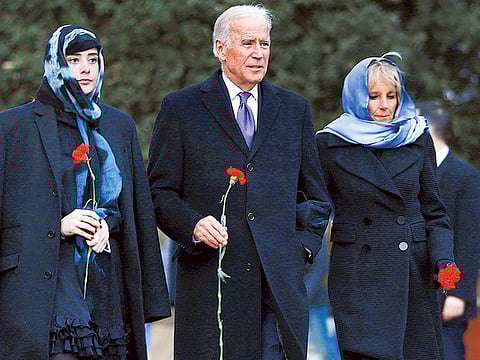
Istanbul: Vice President Biden urged “a change of attitude” by the Turkish government toward its domestic critics Friday, saying that the media and all others here must be free to “challenge orthodoxy,” including political and religious beliefs, if Turkey is to thrive.
Biden’s two-day visit is primarily to meet with top government officials on Syria and other regional crises. But he began with sharp criticism of President Recep Tayyip Erdogan’s crackdown on journalists, political opponents and academics, including the recent arrest of dozens of academics who questioned government violence in Turkey’s ethnic Kurdish region.
Speaking at the beginning of a private meeting with Turkish journalists and civil society representatives, Biden praised US-Turkish cooperation.
But “when the media are intimidated or imprisoned for critical reporting, when Internet freedom is curtailed and social media sites . . . shut down, when more than 1,000 academics are accused of treason simply by signing a petition,” he said, “that’s not the kind of example that needs to be set in the region.”
Critics at home have accused the Obama administration of downplaying human rights abuses here as it seeks Turkey’s full cooperation in the fight against Daesh. Biden also defended US Ambassador to Turkey John Bass, who has come under official fire here for speaking in support of the petitioners. “He speaks for my . . . government, he speaks for the American people,” Biden said of Bass.
During an earlier meeting with Turkish lawmakers from a range of political parties, Biden said that the United States supported Turkey’s fight against militants of the Kurdistan Workers’ Party, or PKK, but noted that the Turkish government’s policy of using force against militant-allied villages in the southeastern Kurdish region was not sustainable.
The Turkish government did not publicly respond to Biden’s remarks. Speaking separately to reporters in Istanbul, Erdogan said that the PKK - as well as Syrian Kurds who are fighting with US help against Daesh in Syria - is no different from Daesh.
In addition to complicating US relations with Turkey, the Kurdish issue is one of several obstacles that may lead to the cancellation or postponement of a Monday meeting in Geneva between Syrian opposition forces and representatives of the government of President Bashar Al Assad.
The meeting is part of a process designed by the United States and its European and regional partners supporting the opposition, as well as key Al Assad backers Russia and Iran, to end Syria’s domestic conflict and allow the parties to join forces against Daesh in both Syria and Iraq.
“There are a lot of front-burner national security” issues for which “Turkey is at the heart of our ability to get things done . . . including Iraq, Syria, Cyprus and energy in the eastern Mediterranean,” said a senior administration official, speaking on the condition of anonymity about Biden’s upcoming meetings with Erdogan and Turkish Prime Minister Ahmet Davutoglu.
Turkey charges that Syrian Kurdish fighters, known as the People’s Protection Units, or YPG, share the PKK’s goal of establishing a separate political entity in Kurdish regions of Turkey, Syria and Iraq.
To add to the complexity, Turkey has sent troops into northern Iraq near PKK havens, leading Iraqi Prime Minister Haider Al Abadi to threaten to invite Russian planes to strike in the region. Turkish-Russian relations have been strained since Turkey shot down a Russian jet that strayed into its territory from Syria in November.
To assuage Turkey’s concerns about the Syrian border, the Obama administration has pledged that the Syrian Kurdish fighters it supports will not move west beyond the Euphrates River. To secure the remaining 60 miles of border contested with Daesh in northwest Syria, Biden plans to firm up US offers of additional equipment and intelligence assistance.
He also hopes to obtain more Turkish cooperation in assembling groups of vetted Syrian opposition fighters - most of whom are currently fighting against Al Assad - to occupy the remaining border region.


