Anniversary of revolution is chance for compromise in Iran
Analysts say both sides have limited options to break deadlock
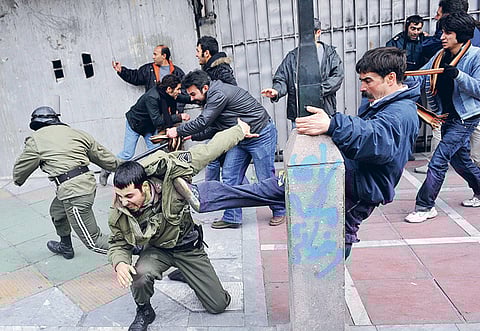
Tehran: Traditionally, Iran's Islamic republic celebrates its birthday today, February 11, with a massive rally, chants of "Death to America," the burning of US flags, and even an effigy contest.
But as Iranians celebrate the 31st anniversary of the 1979 Islamic revolution, they know that eight months of pro-democracy protest and the regime's violent reaction have transformed the relationship between rulers and ruled.
Analysts say that Iran's legitimacy crisis has now come to a head, with both sides incapable of defeating or intimidating the other — a paralysis that could continue, or yield compromise.
Opposition leaders have signalled in recent weeks that they're inching toward a face-saving way for Iran's supreme religious leader, Ayatollah Ali Khamenei, to compromise — in the interest of preserving Iran's Islamic system of government.
"I do see both Iranian society and Iranian elite structures robust enough, ... to have all the elements of a gradual process of give-and-take that will lead Iran in a different direction," says Farideh Farhi, an Iran expert at the University of Hawaii.
Yet the damage has been severe to the pillars of a revolutionary regime that for decades has measured its strength by its popular support. In recent months, that support has been challenged by Green Movement protesters, who have hijacked every key date — as they are likely to attempt again on February 11.
So far, Khamenei has taken an uncompromising line, calling Iranians who do not accept President Mahmoud Ahmadinejad as the victor of the disputed June election guilty of the "greatest of crimes." Scores of protesters, and some pro-regime militiamen, have been killed, thousands arrested, and detainees subjected to torture and rape. But that's no longer a tenable position, say observers.
"The reality is that increasingly other people are seeing that if [Khamenei] doesn't give an inch, then the whole regime will go," says Abbas Milani, a specialist at Stanford University. "So my sense is we are moving inexorably toward a transitional stage of compromise ... a much more democratic state."
During the 30th-anniversary celebrations last year, Ahmadinejad declared Iran to be a "superpower, real and true." But the political crisis has set Iranians against one another in ways not seen in decades.
A critical problem are radicals on both sides. Among them are hard-line leaders of the increasingly powerful Revolutionary Guard (IRGC), whose ideological Basij militia fought postelection street battles.
The reformist camp includes many who want to reform but preserve the current Islamic system. But an increasing number of protesters want a more dramatic change, even calling for the death of Khamenei.
Have your say
Can Iran’s current regime withstand the opposition movement? Will it be forced to
make concessions? Tell us.


