Algeria's first president dies at 95
Charismatic leader spent 23 years in prison after being overthrown by a 1965 military coup
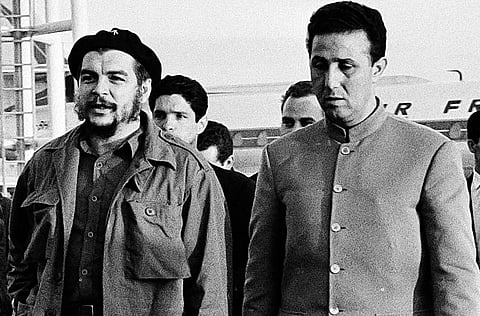
Algiers: Algeria's first president and one of six historic leaders of the bloody independence struggle from France passed away in his family home in the capital Algiers at the age of 95, his family members told the state news agency Wednesday.
The report did not give a cause for death, but twice in the last month he had been admitted to the military hospital of Ain Naadja in the past month complaining of discomfort.
The charismatic Ahmad Bin Bella, a symbol of pan-Arabist ideology as well as the global anti-colonial movement, was president of Algeria from 1963 until he was overthrown in a military coup in 1965 by the army chief of staff, Colonel Houari Boumedienne.
Bin Bella was under house arrest until 1980, and he went into self exile in Switzerland until returning to the country in 1990.
A giant of Algeria's independence struggle and first few years, he played only a symbolic role in the latter years of his life, heading the opposition Movement for the Democracy in Algeria Party, which competed in the aborted 1991 elections, winning just 2 per cent of the vote.
23 years in prison
His party was banned in 1997 but he continued to live in Algeria, often condemning government policies. He was present when current president Abdul Aziz Bouteflika was sworn in for his third term in April 2009.
Aside from Bouteflika, he was the country's sole civilian leader and was followed by a string of generals.
One of the six "historic leaders" of Algeria's revolt against French colonial rule, Bin Bella spent 23 years of his life in French and Algerian prisons. Through most of the eight-year war of independence, Bin Bella was held in a French fortress. His liberation was one of the main Algerian demands in the drawn-out peace talks that led to the 1962 Evian agreements for Algeria's independence.
Elected president of the newly-independent nation virtually without opposition, he enjoyed less than three years of an extravagant and erratic leadership before being overthrown in an army coup and imprisoned by Boumedienne, then army chief of staff.
‘Non-person'
Until Boumedienne's death 13 years later, Bin Bella became a "non person" in Algeria. No public mention of his name was allowed in Algerian media — all state-controlled. Even the official attacks on Bin Bella's allegedly "arbitrary and wasteful" regime avoided mentioning his name.
Boumedienne died in 1978. His pragmatic and moderate successor, Chadli Bendjedid, freed Bin Bella from more than a decade of detention without trial, ultimately allowing him to go abroad with his wife Zora and their two adopted daughters.
It was Bin Bella's misfortune that he was very much a product of the colonial regime that France imposed on Algeria for 130 years. He spoke better French than Arabic, and the Arabic he spoke was colloquial rather than literary.
As a result, he had difficulty conversing with the leaders of other Arab nations.
His often rousing and emotion-charged speeches as president were delivered in Algerian Arabic — which few citizens of other Arab nations fully understand — and when he wanted to stress a particular argument, he broke into French.
Part of the fight for independence
Algiers: Ahmad Bin Bella was born on Christmas Day, 1916, to a peasant family in Marnia, on Algeria's border with Morocco. He joined the French army in his late teens, rising to the rank of senior warrant officer.
He fought with distinction with the Free French Forces in Italy during the Second World War and won five French decorations including the prestigious Military Medal. But returning home following the allied victory in Europe, he quickly found that a war hero of Muslim origin had little future in an Algeria ruled by French settlers.
His application for enrolment as rural policeman was rejected, while his widowed mother was denied a licence to open a tobacco store in Marnia. Disillusioned, Bin Bella turned against France and was elected municipal councillor for the anti-colonialist "Movement for the Triumph of Democratic Liberties".
When the movement was declared illegal, Bin Bella went underground. In April, 1949, he organised a raid on the Oran central post officer to finance his revolutionary activities. The raid brought him nationwide attention and Robin-Hood-like popularity among the Muslim masses.
Arrested early in 1950, he was interned near Blida but staged a dramatic escape two years later.
Hijacked
He fled to Cairo and began planning the November 1, 1954 uprising that spelled the end for colonial rule in Algeria following a bitter, eight-year war of liberation.
On October 22, 1956, while on a flight from Rabat to Tunis with four companions, Bin Bella's Moroccan plane was hijacked by its own French crew and landed at Algiers' Maison Blanche airport.
Immediately arrested, Bin Bella was held prisoner in France until the Evian treaty ended the war nearly seven years later.


