Maps lie: Why the Philippines is not a 'small' country
It's a 300,000+ km² mineral superpower sitting on $1 trillion in untapped riches
The Philipines sits on an estimated $1 trillion in untapped mineral riches
It is increasingly recognised as a 300,000+ km² critical minerals superpower, a vital supplier of the raw materials necessary for the global energy transition
It is larger than the UK (British Isles)
Philippines laws are so crafted that its mineral wealth is subjected to elite capture
Manila: On the world map, the Philippines, an archipelago of more than 7,640 islands looks itsy-bitsy compared to the vast Pacific.
But pay closer attention: the Philippines is actually far bigger (and richer) than it looks.
Consider these (and look it up yourself):
Luzon island (where Manila is) is more than twice the land area of The Netherlands
Mindanao, the southern island, is thrice the land area of Belgium
Camarines Sur province, in Bicol, is larger than Dubai
Masbate island, also in Bicol, is five times bigger than Singapore
Palawan, the Philippines' largest province, spans 1.49 million hectares (about 14,000 sq km) across 1,780+ islands, holds significant mineral wealth,and is a major hub for oil and gas
The Philippines' total coastline length: about 36,289 km (22,549 miles), making it the fifth-longest coastline in the world
Here's why the Philippines looks small on the map...
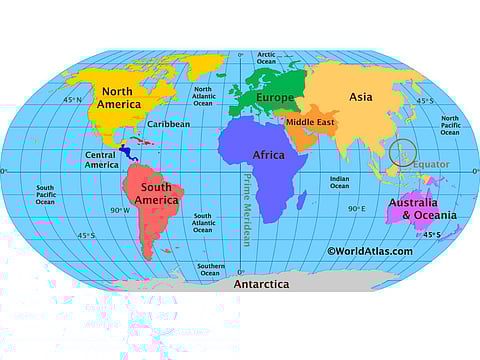
On standard world maps, the Philippines looks tiny.
But that's mostly an illusion caused by the "Mercator projection".
In a nutshell, this little-known" illusion stretches landmasses near the poles (making Greenland look massive) while shrinking equatorial nations like the Philippines.
In reality, the Philippines spans over 300,000 km² of land across more than 7,600 islands — larger than the United Kingdom (243,000 km²).
"MERCATOR PROJECTION": The Mercator projection causes an illusion of scale. While it preserves shapes and directions, it vastly inflates the size of landmasses far from the equator. This makes high-latitude regions (e.g., Greenland, Europe) appear much larger than those near the equator (e.g., the Philippines).
Sprawling archipelago
The Philippines is a sprawling mineral-rich archipelago that punches way above its visual weight.
Yes, it's small compared to the vast Pacific Ocean that surrounds it.
The country sits right in the middle of the world's largest ocean, which can make any single nation look like a speck on the map.
But size isn't just about land — it's about strategic location, maritime reach, and enormous natural wealth.
The Philippines' exclusive economic zone (EEZ) stretches across hundreds of thousands more square kilometers of ocean, and beneath its islands lies one of the planet's greatest concentrations of critical minerals.
Philippines' hidden mineral treasure trove
Far from being resource-poor, the Philippines is one of the most mineral-rich countries on Earth.
It ranks among the global top 5 for overall mineral endowment, thanks to its position along the Pacific Ring of Fire — a geologically active zone that created massive deposits over millions of years.Key highlights of its natural mineral wealth:
Nickel: The Philippines is the world's #2 producer (11% of global output in 2022) and holds some of the largest reserves in Southeast Asia — an estimated $170 billion in nickel deposits alone, vital for electric vehicle batteries and clean energy tech, as per the US Geological Surgey (USGS).
Gold and Copper: Major producer of both, with significant deposits on Luzon and Mindanao. Gold often leads in export value.
Chromite, Cobalt, Zinc, and more: The country also exports chromium, iron ore, silver, and has growing potential in critical minerals like cobalt (essential for renewables).
Untapped potential: Experts estimate the Philippines' total untapped mineral wealth at over $1 trillion (some valuations reach $1.387 trillion), yet only about 5% of reserves have been explored and just 3% are under mining contracts., according to Vantage FDI.
Elite capture of mining
Several studies/reports confirm the Philippines' untapped potential.
The US International Trade Administration (Philippines Critical Minerals, 2025), highlights the estimated $170 billion in nickel reserves. The country is believed to have 4.8 million metric tonnes of nickel deposits, in addition to copper. It also notes opportunities in "downstream" processing for EVs and semiconductors.
Most of the critical minerals, especially nickle (in raw ore form) extracted from Philippine mines go to China and Indonesia (for further processing).
A US Geological Survey report ("The Mineral Industry of the Philippines, 2022"), cited data showing the country as the second-ranked global nickel producer (11% of world production) with detailed commodity breakdowns.
EITI Philippines Country Report confirms the Philippines as a leading nickel producer and significant source of gold, copper, iron ore, chromium, zinc, and silver. Notes the extractive sector's current small GDP share but high export potential.
Vantage FDI (The Philippines' Untapped Mineral Wealth, 2025) ranks the country in the global top 5 for nickel/cobalt reserves and estimates over $1 trillion in untapped critical minerals (copper, gold, silver, rare-earth potential), with only 5% explored.
Mining currently contributes modestly to GDP (under 1%).
But with the right development, these resources could transform the economy — powering global supply chains for EVs, electronics, and green tech while creating jobs and revenue at home.
And that's to say nothing about the country's oil and gas resources.
Wealth inequality
But official data shows 15.5% of Filipinos are poor (2023 data), as per the Philippine Information Agency. However, self-rated poverty remains high, with 63% of Filipino families (approx. 17.4 million) considering themselves poor as of December 2024, a 21-year high.
While the rate is falling, the Philippines still faces a high Gini coefficient, suggesting that economic gains are not evenly distributed, as per the Borgen Project.
Illusion: Why real size matters
This illusion from the so-called "Mercator Projection" is a reminder: maps can deceive.
The deeper truth?
The Philippines isn't small — it's strategically vast and sitting on a fortune that could define its future.
The real challenge: turning that potential into prosperity, through better governance and sustainable development.


