Manama GCC summit to focus on Gulf defence and regional stability; Italy’s Meloni to join talks
Leaders prepare joint defence plan as Italy joins talks amid Gaza, Syria and Sudan crises
Manama: The leaders of the Gulf Cooperation Council (GCC) are convening in Bahrain on Wednesday at what observers are calling a “pivotal” moment — one in which Gulf states are shifting from crisis response to reshaping “security balances” in the region.
Analysts told Asharq Al Awsat that traditional approaches are no longer viable amid overlapping security, political and economic changes from Gaza and Syria to the Red Sea and Sudan. Discussions on joint Gulf defence will dominate the agenda, with renewed urgency after the Iran-Israel confrontation spilled directly into the Gulf, including an Israeli strike on Qatar in September.
“Traditional deterrence is no longer enough,” said Dr. Hesham Alghannam, nonresident scholar at the Malcolm H. Kerr Carnegie Middle East Center. He argued that GCC states must build an effective integrated defence system with early-warning mechanisms, unified planning and coordinated roles. He also urged leaders to tackle emerging threats to Red Sea shipping lanes and instability emanating from Sudan.
A second major file will centre on post-crisis political settlements in Gaza, Syria and Sudan, with analysts stressing that Gulf countries — led by Saudi Arabia — must move beyond writing cheques to playing active political roles, Asharq Al Awsat said.
“The Gulf can no longer simply be a financier,” Alghannam said, calling on leaders to push back against widening Israeli attacks in Gaza, Syria and Lebanon, support new political engagement on Syria, and confront militia-driven “war economies” in Sudan.
Dr. Abdulaziz Sager, Chairman of the Gulf Research Center, said the summit takes place amid unstable conditions across Yemen, Lebanon, Syria and Sudan, and with the Iranian-Israeli confrontation unresolved. He expects approval of a joint framework for security dialogue with Iran and concrete steps to protect international maritime navigation, a growing strategic priority in light of recurrent attacks in key waterways.
The third file on the table is economic and logistical integration, regarded as central in a rapidly shifting international environment.
Italy’s Meloni attends in rare external invite
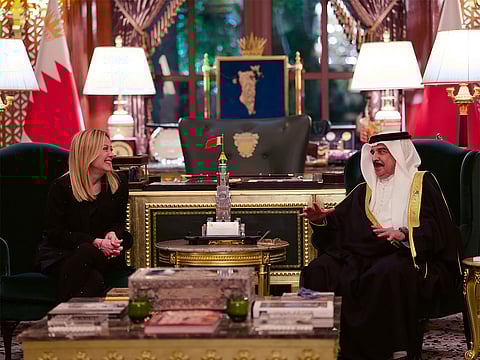
Adding a major diplomatic dimension, Italy’s Prime Minister Giorgia Meloni arrived in Manama to attend the 46th GCC Summit — an exceptionally rare invitation extended by Bahrain’s King Hamad bin Eisa Al Khalifa.
External leaders are almost never present at GCC deliberations. In recent years, only Xi Jinping, Recep Tayyip Erdogan and Theresa May have been invited.
Italian officials called Meloni’s attendance “exceptional,” reflecting a significant upgrade in Italy’s standing across the Arabian Peninsula. The visit caps three years of intensive outreach to Gulf capitals, and comes ahead of a proposed Italy–GCC cooperation agreement to be signed in Rome.
Analysts say the GCC’s decision signals that Italy is being considered not just as a bilateral partner with individual Gulf states, but as a potential regional interlocutor — especially as security dynamics stretch from the Mediterranean to the Red Sea and Indian Ocean.
Palestine to remain a core message
Gulf leaders are expected to underline a united stance on the Palestinian cause and mobilise regional and international efforts to revive the peace process.
In parallel, observers anticipate language on maritime security, Red Sea stability and the need for a strategic Gulf position on post-war Gaza governance, as well as political transitions in Syria and Sudan.


