After UK bans Israeli settlement goods, what happens to £6b UK-Israel trade?
New measures target goods, services, financing as diplomatic tensions with Israel deepens
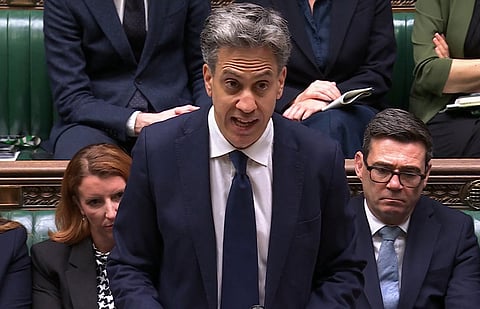
London: Britain has announced a sweeping ban on trade with Israeli settlements in the occupied West Bank, but the headline numbers reveal something important: This is likely to hurt Israel politically more than economically.
The UK and Israel traded about £6 billion ($8.1 billion) in goods and services in 2025, according to British government figures. Of that, UK exports to Israel were worth £3.5 billion and imports £2.5 billion. Israel accounted for only about 0.3 per cent of total UK trade.
But Tuesday’s measures do not ban that £6 billion trading relationship.
Foreign Secretary Ed Miliband stressed that the sanctions target settlements and settlement expansion, rather than Israel itself, and said Britain would continue trade with Israel within its internationally recognised pre-1967 borders.
So what exactly is Britain banning — and why has the move provoked such an angry response from Israel?
What is an israeli settlement?
Israeli settlements are communities built by Israel in the West Bank and East Jerusalem, territories captured in the 1967 Middle East war.
Most of the international community considers the settlements illegal under international law. Israel disputes that position and cites historical, religious and security claims to the territory.
The UK distinguishes between Israel itself and settlements in occupied territory — an important distinction because its new trade ban targets the settlements, not Israel as a whole.
How much settlement trade is involved?
This is where the difference between the political and economic impact becomes clear.
Britain estimates that trade with the occupied Palestinian territories was worth only about £38 million in 2025, compared with roughly £6 billion with Israel.
Even that £38 million cannot all be described as settlement trade. The House of Commons Library says it is difficult to calculate trade specifically with Israeli settlements because Israel and the occupied Palestinian territories operate within a customs union.
What the ban covers
Goods from Israeli settlements in the West Bank
Construction and infrastructure services supporting settlements
Financing and real-estate services linked to settlement expansion
Advertising in the UK for settlement properties
New export licences for items materially contributing to the occupation
Exception: Products and services originating from Israel itself are not covered by the settlement ban.
How Israel hit back
British consulate in Jerusalem to be closed
UK representatives removed from the Gaza ceasefire monitoring centre
British training of Palestinian Authority security forces in the West Bank to end
12 British lawmakers and other UK citizens barred from entering Israel
Foreign Minister Gideon Saar accused Britain of interfering ahead of Israel’s October election
President Isaac Herzog called the ban a “grave miscalculation”
The figures therefore suggest settlement-related trade represents well below 1 per cent of Britain’s overall trade relationship with Israel.
That means consumers should not expect Israeli products generally to disappear from British shops.
What exactly will be banned?
Britain plans to prohibit imports of all goods originating from Israeli settlements in the West Bank.
The measures go significantly further than supermarket products.
Companies will also be barred from providing services supporting settlements, including financing, construction, infrastructure, real estate and advertising. Britain will also refuse licences for arms and other exports that “materially contribute to the occupation”.
The legislation is expected to take effect within six to nine months.
Britain had already treated settlement goods differently from products originating in Israel. Settlement products do not qualify for preferential tariffs under the UK’s trade arrangements, and importers must provide documentation establishing where goods were produced.
The new policy goes much further: Instead of different tariff treatment, settlement goods will be prohibited.
What does Britain buy from Israel?
The wider trade relationship remains substantial.
Britain imports products including precious stones and metals, technical and medical equipment, machinery, plastics and fresh produce from Israel. Britain, in turn, exports goods and services to Israel, including machinery and transport equipment.
Again, these broader flows are not covered by the settlement ban.
That distinction is central to the British government’s position.
Miliband told Parliament that Britain continued to support trade with Israel and explicitly rejected the wider Boycott, Divestment and Sanctions movement.
So why does the ban matter?
Because its diplomatic significance is much larger than the value of the goods affected.
Britain has gone from discouraging economic activity in settlements to legislating against it, while also saying that Israel’s occupation of Palestinian territory is illegal.
The move also isn’t happening in isolation.
France and Canada have announced plans for similar restrictions, while a 12-country statement issued Tuesday backed national or European restrictions on trade with settlements. The group includes Britain, France, Canada, Denmark, Finland, Iceland, Ireland, Norway, Poland, Portugal, Spain and Sweden.
Britain says the objective is to put pressure on Israel over expanding settlements and escalating settler violence that it believes threaten the possibility of a future Palestinian state.
Miliband went considerably further on Tuesday, saying the British government agreed that violence and displacement by extremist settlers in parts of the West Bank amounted to “ethnic cleansing.”
Why is Israel so angry if the financial impact is small?
Because Israel sees the measures as more than a trade dispute.
Israeli officials fear they could help establish a precedent in which major Western allies increasingly distinguish economically and diplomatically between Israel and its settlements.
Israel has responded with countermeasures, including announcing the closure of the British consulate in Jerusalem, removing British representatives from a Gaza ceasefire monitoring centre and ending British training of Palestinian Authority security forces.
The dispute therefore goes far beyond the relatively small volume of settlement goods reaching Britain.
The immediate economic cost may be modest.
The political message is not.


