Radical cleric cannot escort son to school
Government wins ban order from court
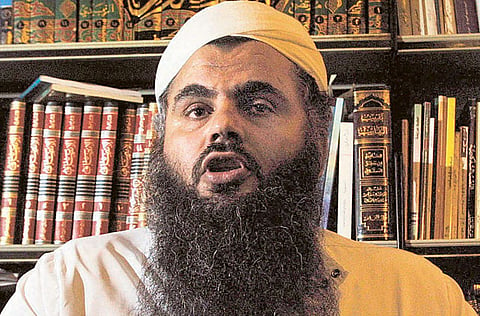
London: The 51-year-old preacher, radical cleric Abu Qatada, will be banned from taking his youngest child to school when he is released from jail, according to police officials.
The government has won a court ruling preventing him from flaunting his freedom at the school gates while ministers battle to find a way of deporting him.
At a cost to taxpayers of £10,000 (Dh57,837) a week, a team of up to 60 police officers and MI5 agents will provide round-the-clock protection for a man described as Osama Bin Laden's ambassador in Europe when he returns to his London home.
Under the terms of his release, Abu Qatada must obey a 22-hour curfew, wear an electronic tag and is banned from using the internet and telephone.
Earlier, bail conditions were agreed for Abu Qatada, signalling his release from an English prison.
The Palestinian-Jordanian cleric has spent more than six years in prison fighting deportation, but a tribunal ruled last week he should be released on bail.
Bail conditions are likely to include a curfew and an electronic anklet.
Abu Qatada, whose real name is Omar Mahmoud Mohammad Othman, has been described in both Spanish and British courts as a leading Al Qaida figure in Europe.
British officials say he poses a serious threat to the country's security, but attempts to deport him to Jordan to face terrorism charges were blocked by the European Court of Human Rights, which ruled last month that there is a risk evidence obtained through torture would be used against him in court.
Prime Minister David Cameron's office said yesterday that Britain still hoped to overcome the European court's objections.
"We are clear we want to remove Abu Qatada at the earliest opportunity. We are looking at all the options," a spokesman for Cameron said, on condition of anonymity in line with policy.
Abu Qatada arrived in Britain in 1993 and was detained in 2002 under anti-terrorism laws that at the time allowed suspected terrorists to be jailed without charge. He has never been charged with a crime in Britain, although authorities have accused him of advising militants and raising money for terrorist attacks.
Although Abu Qatada was released in 2005 when the unpopular law was overturned, he was kept under surveillance and arrested again within months and held pending deportation to Jordan.
‘Disgrace'
He has been convicted in absentia there of terrorist offences related to two alleged bomb plots in 1999 and 2000, and would face a retrial there if deported from Britain.
Reacting on spending taxpayers' money to protest Abu Qatada, Tory lawmaker MP Patrick Mercer, a former infantry officer, said: "This is a disgrace. The money will be spent as much on protecting him as protecting us and adds insult to the injury on the taxpayer pocket."
— With inputs from Daily Mail


