Five months out, France’s presidential race up in the air
More than 30 declared or potential candidates competing to succeed President Macron
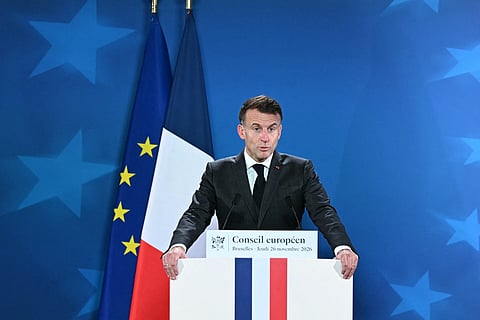
Paris: Far-right leader Marine Le Pen is frontrunner in the race to become the next French president, but analysts say a fragmented field and a volatile electorate make the outcome far less certain than current polls suggest.
Five months before the vote, more than 30 declared or potential candidates are competing to succeed President Emmanuel Macron as the country heads into one of its most consequential votes in an unusually tense social climate.
The public is angry over the rising cost of living and eager for change, with many blaming Macron for the country’s troubles after nearly a decade in power. Protests in October descended into some of the worst rioting in years.
But the government is under pressure from markets and the European Union to rein in spending.
“There is huge potential for volatility over the coming five months,” said Jeremy Cliffe, a senior policy fellow at the European Council on Foreign Relations.
“The range of candidates is in rapid flux. The French economy is fragile and the chances of a market shock are real. Recent protests add another element of unpredictability.”
Testing the waters
Sophie Meunier, director of the EU Program at Princeton, said the campaign had not begun in earnest.
“Several uncertainties could upend the race,” she said.
Le Pen, who ran for president in the 2012, 2017 and 2022 elections, is in her strongest position yet and dominates opinion polls for the first round.
The National Rally (RN) candidate is running despite an embezzlement conviction over a fake jobs scam in European Parliament, after an appeals court in July shortened a ban from office against her. France’s highest court is to decide whether to uphold that verdict early next year.
Opinion polls suggest she could face hard-left candidate Jean-Luc Milenchon of the France Unbowed (LFI) party in the second round.
The crowded field in the centre and on the right has raised fears voters could face a choice between two extremes.
Former prime ministers Edouard Philippe and Gabriel Attal have been campaigning for months, Olympic judo champion Teddy Riner has made a surprise entry into the race and little-known mayor of Cannes David Lisnard has surged in the polls.
There is no unity on the left either. Centre-left candidate Raphael Glucksmann has positioned himself as an alternative to Milenchon, criticising Green leader Marine Tondelier’s willingness to work with the hard-left veteran.
But analysts say candidates are still testing the waters, with future alliances possible.
“A lot of people will drop out,” said Damien Bol, a professor of political science at Sciences Po university.
The uncertainty reflects a broader shift in French politics, which was once dominated by strong parties but has become increasingly candidate-driven.
“A majority of French people just don’t know who to vote for,” said Bol.
“The only kind of support base that is not volatile is actually the support base of Marine Le Pen.”
Change over stability
Erwan Lestrohan of the Odoxa polling organisation said one in two French voters would rather the country’s next president were not one of those currently running.
“The distinctive feature of this presidential election is that no candidate enjoys the support of a majority of French voters,” he said.
Meunier said most French people wanted change rather than stability.
“This is the worst possible environment for a continuity candidate, especially given the absence of an incumbent and the fragmentation of the centrist bloc,” she said.
To win in the current conditions, Le Pen does not necessarily need to expand her support further, she said.
“It may be enough for her opponents to remain divided,” Meunier said.
Milenchon, whose LFI party has backed the recent protests, has also emerged as a strong contender by tapping into anti-establishment sentiment.
“He is offering a confidently left-wing programme that places his candidacy on the side of ‘the people’,” said Cliffe.
Philippe, once billed as the centrist camp’s best chance of defeating Le Pen, has been slipping in the polls, with some describing his campaign as lacklustre.
He was overtaken by Lisnard, who has taken social media by storm, in a Toluna Harris Interactive opinion poll published on Monday.
While pressure has been growing on the centrists to conduct a primary, Philippe has ruled out taking part.
Mathieu Gallard, research director at the Ipsos polling institute, say France’s squabbling centrists could still get their act together, although it was unclear who the consensus candidate might be.
“Voters in the centrist camp are unlikely to enjoy the prospect of a Le Pen-Milenchon runoff.”

