Bayeux tapestry to arrive in London in secret, high-stakes operation
This is the first time the tapestry will be transported to and displayed in the UK
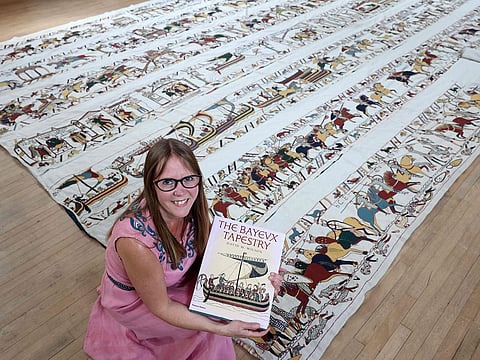
London: The 1,000-year-old Bayeux Tapestry depicting the last successful military invasion of England will arrive in London in the coming days by dead of night and under “police protection”, the UK envoy helping to coordinate the historic transfer told AFP.
But Peter Ricketts, the UK’s Bayeux Tapestry envoy, remained coy about the exact date the “incredibly fragile object” would arrive from its home in northern France for a major exhibition at the British Museum.
“We don’t want any untoward incidents happening. And so that’s why we’re keeping the exact details and date confidential,” said Ricketts, describing the high-security operation around the 11th century work.
“When it’s ready to be exhibited, we want millions of people to see it,” added Ricketts, Britain’s former ambassador to France.
The clandestine arrangements have done little to dampen enthusiasm. Ricketts said he was “not at all surprised” that the British Museum sold a record 100,000 tickets on the first day of sales for the exhibition, set to open on September 10 and run until July 11, 2027.
“Every British child knows the date of 1066, the Battle of Hastings,” when England’s King Harold was defeated by the Norman invader William the Conqueror, depicted in the 68-metre (224-feet) long tapestry, he said.
The battle changed the course of history for England, France and Europe, “but most people don’t know the tapestry, most people haven’t been to Bayeux” to see it, said Ricketts.
Embroidered in wool thread, the tapestry tells its story in words and images, but its origins have remained shrouded in some mystery and much speculation.
This is the first time the tapestry, which usually rests in a museum in Bayeux in northwestern Normandy, will be transported to and displayed in the UK.
For its cross-Channel journey, the tapestry has been “folded up like a curtain” and “put in a very, very high-tech container” with climate and vibration controls to protect the delicate embroidery.
“It will come on a truck, and it will come under the (Channel) tunnel on the shuttle service, and then it will be driven straight to London to the back of the British Museum,” said Ricketts.
The complicated transfer of the tapestry, which was promised by French President Emmanuel Macron in a loan, is the result of more than a year of negotiations for the former ambassador.
What is the Bayeux Tapestry?
An 11th-century masterpiece: The Bayeux Tapestry is nearly 1,000 years old and is one of the world’s most famous surviving medieval artworks.
Not actually a tapestry: Despite its name, it is an embroidered linen cloth stitched with coloured wool rather than a woven tapestry.
Tells the story of 1066: It chronicles the events leading up to and including the Battle of Hastings, when William the Conqueror defeated King Harold II and became King of England.
A remarkable size: Measuring about 68 metres (224 feet) long, it is illustrated with scenes of battles, ships, soldiers, horses and everyday medieval life.
Historical record: Historians regard it as one of the most important visual records of medieval Europe and the Norman Conquest of England.
Home in France: The embroidery has been housed for centuries in the Normandy town of Bayeux, where it is normally displayed in a dedicated museum.
Rare overseas loan: The exhibition at the British Museum marks the first time the Bayeux Tapestry has been displayed in the UK.
Highly valuable and fragile: Estimated to be worth about £800 million ($1.1 billion), it requires specialised climate-controlled transport and conservation because of its extreme age and delicate condition.
‘Indelible memory’
Despite fears voiced by some over transporting the ancient artwork, Ricketts did not waver.
“I saw the experts working together, the conservators, the people who really know about the risks of moving the object,” said Ricketts, who now sits in the UK’s unelected upper chamber the House of Lords.
“If they had said it’s impossible without damage to the tapestry, nobody would have pressed them on that.
“But their approach was always - let’s work out the way to do this safely, and one by one we overcame all the different issues,” added the tapestry envoy.
As for the insurance, which has valued the tapestry at some GBP800 million (nearly $1.1 billion) - backed by the UK Treasury - every effort is being made to ensure that it does not have to be used.
“All our work is to ensure that the tapestry goes back to France - and it will go back to France, I promise, safe and sound,” said Ricketts.
“Of course, if there is damage yes, the British taxpayer is on the hook to pay damages. But that just shows how serious we are about ensuring that it goes back in good condition.”
Once in London, the tapestry will be displayed flat, for the first time, in a specially made glass case in a “choreography with I think 80 different conservators - intensely careful, difficult work”.
The British Museum’s exhibition on Tutankhamun - which drew a record 1.69 million visitors in 1972 - transformed the way visitors viewed ancient Egypt.
“I think the tapestry will have the same effect as that for millions of people,” said the envoy, adding it would “leave an indelible memory”.
“I think this will change people’s mind about thinking about the past.”


