Bank on recovery
Swiss professionalism and innovation hold strong
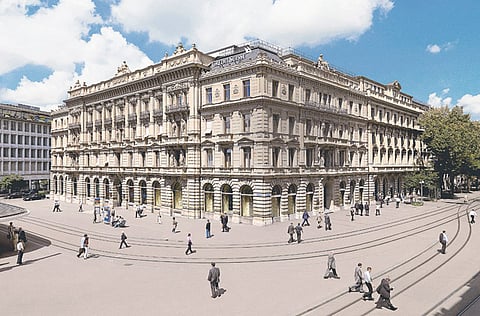
When the world's financial markets eventually stabilise, Swiss bankers will have two very different talesto tell — one from the banksthat ventured into international markets,and the other from the banks that stayedat home. As universal banks, whose activities span the whole gamut of commercial and investment banking, and which are active in all the world's major financial centres, Switzerland's ‘big two' — UBS and Credit Suisse — were well and truly embroiled in the crisis that struck global banking in 2008.
The problems at Credit Suisse paled into insignificance compared with UBS's. Despite reporting losses of 8.2 billion Swiss francs (Dh26.2 billion) in 2008, it rebounded the following year with a healthy profit.
The UBS story
For UBS it was a different story all together. Not only did it rack up 50 billion dollarsof sub-prime losses, it also became entangled in a US government probe into tax avoidance — a case that has opened the Pandora's Box of banking secrecy.
Within the space of two years, UBS sawan annual profit of 11 billion Swiss francs turned into a loss of 21 billion Swiss francs. Not only that, but customers began closing accounts.
The notion that a bank is ‘too big to fail'is one often heard in banking circles. Nowhere was it more appropriate than in the case of UBS. Since it had a balance sheet of more than400 per cent the size of the country's gross domestic product (as against 2 per cent for the largest bank in the US), the Swiss government had little option but to bail the bank out.
With an injection of six billion Swiss francsin return for a 9.3 per cent stake, and setting up a so-called ‘bad bank' into which UBS offloaded $60 billion of toxic assets, the government stabilised the situation.
UBS's spectacular fall from grace not only left the bank's reputation in tatters, but shook the centuries-old Swiss banking system to its core. On the home front, meanwhile, it was remarkably like business as usual.
Switzerland has a myriad of domestically orientated banks, with more than 70 specialist private banks, many with roots going back 300 years, providing primarily wealth-management and advisory services, also >cantonal banks, which focus on the financing of their local economies, and the co-operative Raiffeisen banks, besides numerous regional and savings banks.
These banks largely limit their businessto lending and deposit-taking within clearly defined areas of the country. By focusing on what can be described as ‘old-fashioned' banking — generating their income on the back of thin, but stable margins — they steered clear of the turmoil. Not only were these banks well-served by only doing business where the risks were clearly understood, they also benefited from the fact the Swiss property market, having avoided the real-estate bubble experienced by many economies, remained stable.
Strong recovery
UBS seems to be making a good recovery.First-quarter results for 2010 showed profits returning to near pre-crisis levels at 2.2 billion Swiss francs, up 83 per cent on the prior quarter. The CEO, Oswald J. Grübel, the man responsible for turning UBS around, reported that the group was on track to medium-term goals. Likewise Credit Suisse, who reported earnings of two billion Swiss francs — twice as much as the market had estimated and 150 per cent ahead of the previous quarter. To some extent, these upturns are a recovery-related dividend.
The question outstanding is how Swiss banking will adapt to the new world,wherein banking secrecy could becomea thing of the past.
A certain level of client withdrawals aside, there are encouraging signs. A considerable proportion of funds invested in Swiss banks does not come from countries and regions where tax avoidance would be an issue, such as the Middle East and Russia, and it is therefore attracted to Switzerland for other reasons. For UBS, it is still retained by many of its top corporate clients, and remains a favoured advisor to many governments.
Also, a number of Swiss banks continue to extend their global reach with expansion, notably in the fast-recovering economies of Asia. UBS has maintained its dominant presence in Asia, taking the top slot in performance league tables in the region. It was a particular beneficiary of the growth of China's investment banking requirements, and took over the top slot from Goldman Sachs in the area's equity and M&A league tables. Other Swiss banks — notablySarasin and Julius Baer — are benefitingfrom strong inflows from the region, compensating for outflows.
Switzerland's reputation for innovation and professionalism, together with the essential reliability of its legal system, regulations and politics, continue to underline its attractiveness as an international financial centre. So does the range of investment opportunities for existing clients and new customers. In a most uncertain world these days, it seems there may still be some things that can be relied upon.


