Pakistan, China agree to strengthen cooperation on CPEC and strategic partnership
Sharif invites Chinese companies to invest in water and solar energy projects in Pakistan
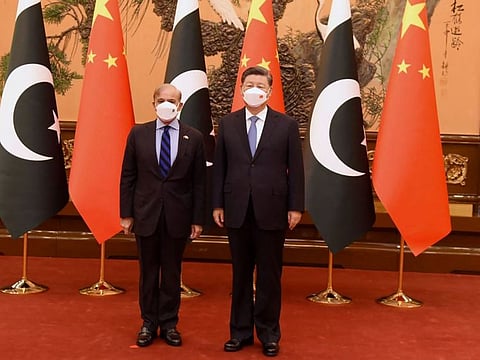
Islamabad: Pakistan’s Prime Minister Shehbaz Sharif and Chinese President Xi Jinping agreed to strengthen strategic partnership and multilateral cooperation in diverse areas, particularly the multi-billion-dollar China Pakistan Economic Corridor (CPEC).
The two leaders discussed cooperation across a range of issues, including defence, trade and investment, agriculture, health, education, green energy, science and technology, and disaster preparedness.
Sharif arrived in Beijing on Tuesday on his maiden two-day official visit to Beijing since assuming office in April. Pakistani prime minister is among the first leaders to visit China after President Xi secured a historic third term in office at the crucial congress of the Communist Party of China. Sharif is heading a high-level delegation, including federal ministers, special assistants as well as the Sindh chief minister.
CPEC and development projects
During the meeting, President Xi Jinping assured China’s continued support for Pakistan’s sustainable economic and strategic initiatives including the ML-1 railway project. Chinese President also announced an additional assistance package of RMB 500 million for flood relief efforts in Pakistan after then unprecedented floods killed over 1,700 in the country since mid-June.
Shehbaz and Xi discussed the $65 billion economic corridor in Pakistan and agreed that CPEC’s high-quality development is important to further strengthen bilateral ties between Pakistan and China. CPEC, a flagship project of Beijing’s Belt and Road infrastructure initiative, is a $65 billion network of roads, railways, highways, energy projects and trading hubs in Pakistan that will connect China’s northwestern region to Pakistan’s ports.
ML-1 railway project
Pakistan and Chinese leaders stressed the importance of joint efforts to launch the ML-1 as an early harvest project under the CPEC framework. The country’s most expensive $10 billion Mainline-1 (ML-1) project aims to upgrade 2,655km of tracks to allow trains to run twice as fast. The project includes the upgradation and doubling of tracks from Karachi to Peshawar and Taxila to Havelian (1,872km), laying new tracks, rehabilitation and construction of bridges, and installation of modern signalling and telecom systems. Pakistan and China also agreed to finalize formalities for the launch of the mass-transit project Karachi Circular Railway.
Delegation-level talks
PM Sharif also held a delegation-level meeting with his Chinese counterpart Li Keqiang where they discussed the progress of CPEC projects. “There is a lot to learn from the Chinese economic miracle” PM Shehbaz earlier said, adding that the trip was aimed at revitalizing the CPEC project to uplift the quality of lives, seeking investments, and increasing bilateral trade. In his meeting with Chinese investors and representatives of Chinese companies, the Pakistani prime minister invited them to invest in clean drinking water and solar power projects in Pakistan.
In a statement, Sharif’s office said he thanked Xi for “China’s invaluable assistance to Pakistan’s relief, rehabilitation and reconstruction efforts in the wake of devastation caused by super floods in the country.”
It said the sides agreed to speed up projects and discussed extending Chinese investment in Afghanistan.
Peace and stability in Afghanistan, which has teetered on the verge of economic collapse since the Taliban seizure of power last year, would ``promote regional security and economic development,” Sharif’s statement said.
"There was complete unanimity of views between the two leaders,” his statement said.


