3.4 million children need urgent support in flood-hit Pakistan
Unicef warns rapid spread of high risk of water-borne, deadly diseases
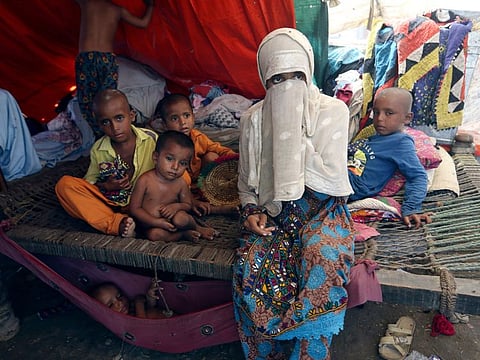
Islamabad: The catastrophic flash floods have devastating consequences for millions of children in Pakistan. At least 3.4 million children are in need of humanitarian support and at increased risk of waterborne diseases, drowning and malnutrition, according to UN children’s agency, Unicef.
“Unicef is appealing for US$37 million to reach approximately 3.4 million children in need of life-saving support,” says the UN agency. “We estimate that 16 million children are impacted and 3.4 million of these children are in need of humanitarian support,” said Unicef Pakistan Representative Abdullah Fadil. “40 per cent of children were already suffering from stunting before the floods hit. Many children are now at heightened risk, without a home, school, or even safe drinking water. There is therefore a risk of many more child deaths. And the situation will only continue to deteriorate as winter is just 8 weeks away in some parts” Fadil said.
Unicef also warned of “a high risk of water-borne, deadly diseases spreading rapidly - diarrhoea, cholera, dengue, malaria” in flood-hit areas. Pakistani health officials have also reported an outbreak of waterborne diseases, diarrhoea, eye infections and skin diseases at relief camps across the country. The World Health Organization (WHO) said that “6.4+ million people are in dire need of humanitarian aid, including 421,000 refugees”. The United Nations Population Fund (UNFPA) estimated that nearly 650,000 pregnant women, including 73,000 expected to deliver in the coming month, need maternal health services in the flood-affected regions.
Urgent needs of flood-affected people
At least 33 million people, including approximately 16 million children, have been affected by unprecedented rains and flash floods in Pakistan. Over 1,200 people including over 400 children have lost their lives, and 6,000 have been injured. Over 1.1 million houses have been either partially or fully destroyed.
Nearly half a million people have been forced to live in relief camps. Although aid began to arrive from around the world, the situation on the ground is alarming, Pakistani volunteers have warned. “The situation is extremely dire, the devastation is vast and has completely broken human lives and infrastructure. People are in desperate need of food, water, tents, mosquito nets and medicines” Hashir Ahmed, a volunteer for Hope in Humanity Foundation told Gulf News.
He has recently visited Sukkur and Khairpur in Sindh, Dera Allahyar, Dera Murad Jamali, and Sobatpur in Balochistan, as well as Taunsa, Rojhan, Rajanpur in South Punjab. “Mosquitoes and the sweltering heat are making the situation worse. People are bathing in floodwater to keep themselves cool. Widespread malaria is now a serious threat,” he said. Many areas that have been cut off from floods are still awaiting help. Hashir said that volunteers are also urgently needed in flood-affected regions and urged the government to immediately devise a mobile and web-based platform for flood volunteers.
Dozens of international flights carrying life-saving emergency supplies and relief goods touched down in Islamabad and Karachi, strengthening the ongoing response to the devastating floods in the country. Pakistan has so far received flood relief goods through nearly 25 flights mostly from UAE, Turkey, and China.
Turkey has so far sent 11 cargo aircraft and two trains loaded with relief goods. China has sent four planeloads of humanitarian aid. On Friday, Qatar Emiri Air Force aircraft arrived at Karachi Airport with relief goods for flood-affected people. The first humanitarian flight from Uzbekistan landed in Islamabad on Thursday night. This week, the United States also announced $30 million worth of aid for the flood victims. Pakistan’s armed forces said on Friday that they have rescued 2,000 stranded people. Pakistan’s navy has also intensified rescue and relief operations.


