Trump pushes India-Middle East-Europe Economic Corridor as Iran war exposes Hormuz risks
Iran war renews push for alternative trade and energy routes through the Gulf
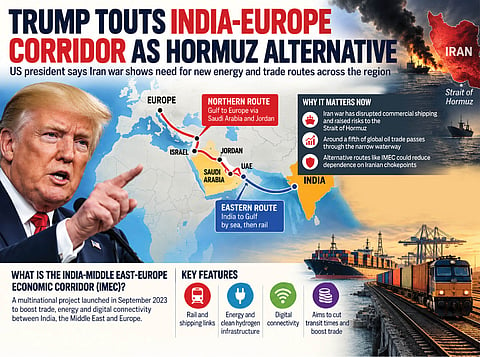
Dubai: A corridor conceived to connect India with Europe through the Gulf is gaining fresh strategic importance as the Iran war exposes the risks of relying on vulnerable maritime chokepoints for global energy and trade.
US President Donald Trump has thrown his weight behind the India-Middle East-Europe Economic Corridor (IMEC), arguing that attacks on commercial shipping have demonstrated the need for alternative routes that reduce dependence on what he called Iranian “checkpoints”.
Addressing Gulf and regional leaders on the sidelines of the UN General Assembly in New York, Trump said his administration “strongly supports” the corridor as well as other ways of moving oil out of the region.
“Iran’s terrorist attacks on commercial shipping in neighbouring countries have shown the need to shift Middle East energy infrastructure away from the Iranian checkpoints,” Trump said, according to the media reports.
He said alternatives could include pipelines and other infrastructure, adding that regional partners were close to overcoming challenges that had troubled the Middle East for years.
The remarks put renewed focus on IMEC at a time when months of conflict have disrupted traditional energy routes and highlighted the vulnerability of the Strait of Hormuz, historically one of the world’s most important oil and gas arteries.
From trade route to strategic alternative
IMEC was unveiled at the G20 summit in New Delhi in September 2023 by India, the United States, the UAE, Saudi Arabia, France, Germany, Italy and the European Union.
The ambitious project envisages an eastern corridor connecting India to the Gulf and a northern corridor linking the Gulf with Europe.
At its heart is a network combining shipping and rail links, supplemented by infrastructure for electricity, digital connectivity and clean hydrogen.
Goods arriving from India by sea would be transferred onto rail networks across the Gulf and onward towards the Mediterranean before continuing to European markets.
The original objective was to make trade between India, the Middle East and Europe faster and more efficient while deepening economic integration across the three regions.
But the Iran war has added another dimension: Resilience.
Disruption around Hormuz has demonstrated how quickly conflict at a single maritime chokepoint can affect oil flows, shipping costs and global energy markets.
Trump’s comments suggest Washington increasingly views alternative infrastructure not simply as a trade project but as part of a broader effort to make regional energy and supply routes less vulnerable to disruption.
UAE at the heart of the route
The UAE occupies a pivotal position in the proposed corridor.
Under the plans, cargo from India would arrive in the Gulf before moving through an integrated rail network towards Saudi Arabia, Jordan and the Mediterranean.
That gives the UAE a potentially important role as the maritime-to-rail gateway between India and the wider IMEC network.
The corridor could eventually carry far more than containers. Plans have included electricity cables, digital connections and infrastructure capable of transporting clean hydrogen.
War exposes the chokepoint problem
Before the war, roughly a fifth of global oil and gas supplies passed through the Strait of Hormuz.
The conflict has sharply demonstrated the risks created when such a large share of global energy trade depends on a narrow waterway exposed to military confrontation.
Those concerns have already pushed alternative routes higher up the regional agenda.
Saudi Arabia has restarted operations on its East-West Pipeline after attacks forced it offline this month, Reuters reported. The pipeline allows Saudi crude to reach the Red Sea port of Yanbu without passing through Hormuz, although exports are initially expected at reduced volumes.
Trump’s renewed backing for IMEC therefore comes as Gulf states and their partners confront a larger question: How to build trade and energy networks capable of continuing to operate when one major shipping route is disrupted.
Ambition still faces reality
For all its strategic promise, IMEC remains far from becoming a fully functioning corridor.
The project requires major cross-border rail, port and logistics infrastructure, along with coordination among countries spanning several regions.
Political tensions and conflict in the Middle East have also complicated progress since the initiative was announced in 2023.
Trump’s intervention does not resolve those obstacles.
But the war has strengthened the argument that lay behind the project: the region needs more than one way to move its goods and energy.
What began as an ambitious India-to-Europe trade corridor is now being discussed against a very different backdrop — one in which alternative routes are increasingly being viewed as a matter of economic and energy security.


