Should every teen romance become a Pocso case? Supreme Court asks
Court says parents often invoke POCSO to protect ‘honour’ after adolescent couples elope
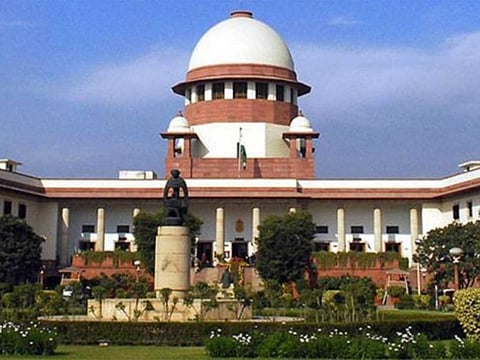
New Delhi: The Supreme Court on Monday questioned whether consensual relationships between teenagers should automatically be treated as offences under the Protection of Children from Sexual Offences (Pocso) Act, observing that parents often invoke the stringent law to preserve family “honour” after adolescent couples elope.
Hearing a suo motu case on the privacy rights and welfare of adolescents, a Bench of Justices B.V. Nagarathna and R. Mahadevan said the law, intended to protect children from sexual abuse and exploitation, was increasingly being invoked in cases involving teenagers in consensual relationships.
“How does the state prevent the elopement of a girl and a boy? Pocso is about sexual assault and exploitation of children. Fifteen to eighteen is a vulnerable age, an age of experimentation. The question is, does it really become a Pocso case?” the Bench observed.
The court, according to NDTV, further noted that many criminal cases arise after parents object to relationships involving teenage daughters.
“Sixteen to eighteen, they develop a relationship and go away. Parents, to protect their honour, fasten criminal liability. We have to acquit,” the judges remarked.
Systematic failures
The observations came during proceedings arising from a case that had prompted a controversial Calcutta High Court judgment advising adolescent girls to “control” their sexual urges instead of getting involved in relationships for “two minutes of pleasure.” The Supreme Court had earlier set aside those remarks.
Senior advocate Madhavi Divan, assisting the court, said the original case involved a minor girl who had eloped with a 25-year-old man. The matter had since reached a conclusion after social workers interacted with the girl, who later chose to remain with the man and had a child with him.
“The individual matter was sorted out. Broadly there was closure,” Divan told the court, adding that a committee appointed during the proceedings had submitted a strong report highlighting systemic failures in the handling of Pocso cases.
When the Bench sought to clarify whether it was a case of kidnapping or elopement, Divan said the girl had willingly left home and wanted to stay with the man.
Child protection
She argued that while the law provides rehabilitation measures for minors, there was also a need for broader reforms aimed at adolescent well-being and child protection.
Divan also highlighted concerns over teenagers being jailed under the Pocso Act, stressing the need for greater awareness and sensitisation at an earlier stage.
“There needs to be sensitisation at a younger level. The government has put in comprehensive suggestions. It needs to be taken to its logical conclusion,” she said.
The Bench observed that such relationships had existed even before Parliament raised the age of consent from 16 to 18 years through amendments introduced in 2012.
“It’s not just after 2012 that it has been happening. It had been happening earlier too, like child marriages. When the age becomes 18, it becomes illegal,” the court observed, adding that any directions issued by it must remain practical.
Appearing for the Centre, the government’s counsel said its recommendations included introducing age-appropriate education on adolescence and Pocso awareness from Class 6 onwards so they could be implemented across states and Union Territories.
Divan also suggested creating a dashboard to monitor Pocso cases nationwide.
The Supreme Court, however, said every High Court already had committees dealing with child rights and observed that state governments were well placed to monitor such cases.
“It is already being monitored by the High Courts. Why do you want the Union to do it?” the Bench asked.
The matter will next be heard on July 17.


