Rare bustard chick gets 50-strong guard after marathon rescue
Rare hatch offers hope for species on brink as teams monitor chick 24/7
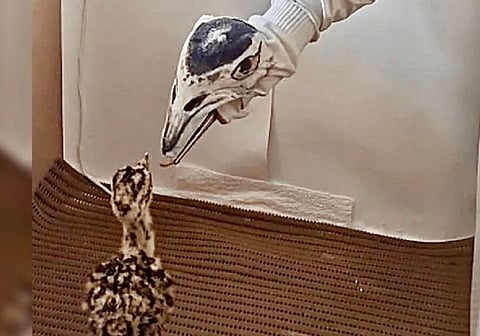
Ahmedabad: A newly hatched chick of the critically endangered Great Indian Bustard is now under the watch of a 50-member team of wildlife staff in Gujarat, marking a rare and fragile milestone in efforts to save one of India’s most threatened birds.
The chick, born after a fertilised egg was transported nearly 800 kilometres in a 19-hour road journey using a handheld incubator, is the first successful hatching in the state in a decade.
Officials say the real challenge begins now.
“The hatching is a rare and momentous occasion for our conservation efforts,” Gujarat forest officer Dheeraj Mittal said. “But the priority is to protect the chick and its mother from predators and disturbance.”
Teams are monitoring the pair around the clock, while nearby villagers have been asked to keep cattle away from the breeding zone to reduce risks.
Great Indian Bustard — at a glance
Status: Critically Endangered
Estimated wild population: ~150
Key threats:
Habitat loss and land-use change
Collisions with power lines
Predators such as feral dogs
Human disturbance
Why it matters:
Among the heaviest flying birds in the world
Indicator species for healthy grassland ecosystems
Conservation efforts:
Captive breeding programmes
Artificial insemination and genetic support
Egg transport and assisted incubation
Planned “soft release” into the wild
Bottom line:
A rare hatch offers hope — but survival in the wild remains the biggest test
A species on the brink
Once common across India’s dry grasslands, the Great Indian Bustard — a tall, long-legged bird with a black crown and sandy-brown body — has suffered a dramatic decline over the past few decades.
Fewer than 150 are believed to remain in the wild.
The species is classified as Critically Endangered, facing multiple threats including habitat loss, feral dogs, and collisions with overhead power lines. Conservationists say the rapid expansion of renewable energy infrastructure in desert regions has added new risks.
India’s Supreme Court had earlier ordered the burial of power lines in key habitats after several bustards were killed, but the government later argued that such measures would hinder clean energy goals.
Today, Rajasthan remains the species’ last stronghold, with small, fragile populations also surviving in parts of Gujarat.
Science steps in
With natural breeding rates low and survival uncertain, India has turned increasingly to science-led conservation.
Captive breeding programmes, led by the Wildlife Institute of India in partnership with state forest departments, are now central to efforts to stabilise the population.
The fertilised egg that led to the Gujarat chick was sourced from such a programme and transported under controlled conditions — a logistical effort that highlights the lengths conservationists must go to.
Artificial insemination has also emerged as a key tool.
Experts say the technique helps overcome the challenges of moving birds between locations and supports genetic diversity in a shrinking population. In some cases, semen is collected and introduced into females to improve fertilisation success — a process still being refined for the species.
Behavioural conditioning is another critical part of the work. Conservationists use dummy models to help birds adapt to breeding conditions, though responses vary widely.
“The species is extremely sensitive,” one expert involved in the programme said, noting that even minor disturbances can affect breeding success.
A long road ahead
In their early months, chicks remain dependent on their mothers, with conservationists closely monitoring growth and development.
Only after achieving sufficient strength and independence are they considered for release into the wild. Even then, the process is gradual.
Under a “soft release” approach, birds are introduced slowly into natural habitats, giving them time to adapt and learn survival skills such as foraging.
Captive numbers have now risen to around 70 birds, offering a measure of hope. But experts caution that breeding success alone will not be enough.
The bigger challenge lies in ensuring these birds can survive in the wild — in landscapes that have changed significantly from those they once roamed.
For now, the focus remains firmly on the tiny chick in Gujarat.
For a species this close to extinction, every new life counts — and every day of survival matters.


