Moily for liberating two-third undertrials in six months
Lawmaker hopes to address the huge backlog of cases pending in courts
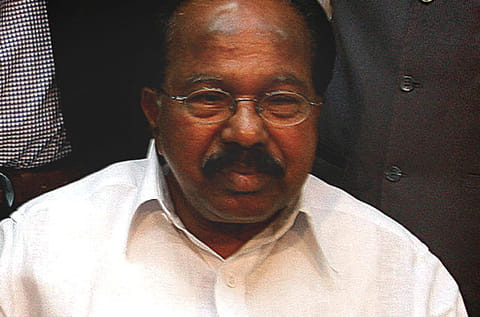
New Delhi: Union Law Minister Moodbidri Veerappa Moily is probably the first to kickstart judicial reforms in the country that has not seen much progress since Independence. Presently, 270 million cases are pending before trial courts, 4 million in high courts and 53,000 cases in the Supreme Court.
Moily's proposals, when implemented, target to reduce the pendency of cases from 15 years to 3 years by December 31, 2011.
Lawyer, writer and politician, Moily is being seen as a champion of women's causes. Not only is he keen on fast-tracking cases related to women, but also pushing for more women judges in high courts and the Supreme Court.
While the number of women high court judges is about six per cent, the Supreme Court has not had a woman judge for nearly four years.
Talking to Gulf News, Moily credits his mother for his literary pursuits and father for becoming worldly wise. "I consider these as gifts from them," he said.
GULF NEWS: For years people have wanted a full-stop to delay in the judicial process. What steps have your ministry proposed?
VEERAPPA MOILY: We have plans to repeal Judges Inquiry Act of 1968, dealing with impeachment of judges of the Supreme Court and the High Court. It deals solely with impeachment procedures and not with other cases of complaints against the judges.
But now we propose to replace it with Judicial Standards and Accountability Bill 2009. Herein, a mechanism to monitor judges will be set in motion, which will lay down procedures to take action against the judiciary for any misconduct or delay. This way, even the perception of corruption will disappear.
You have been quoted as saying "Ruchika Girhotra's case has hurt national psyche." And that "Such a sad story would not be allowed to be repeated." What's your line of action?
Our ministry and the Home Ministry are taking several steps and we have also said that the case should have been put up under section 305 of Indian Penal Code if she was a minor, as punishment is heavy under this section and it is non-bailable.
But the investigating agency focused on section 354, which is bailable. Obviously, there was a mistake in building up the case. In case of a minor, the punishment can be of life sentence or death penalty.
Tell us about you promptly drafting a Bill to set up special courts all over the country for the trial of the accused in cases such as Ruchika's, which has suffered an inordinate delay of 19 years.
The Sexual Offences (Special Courts) Bill has been drafted and sent to the Home Ministry and will be taken to the Cabinet for approval in the next session of Parliament. It will cover sexual offences including assault or criminal force with intent to outrage a woman's modesty and severe punishment for rape.
In addition, we have sought amendment of the Evidence Act, where adequate protection will be given to witnesses. All such cases would also be put on fast track and be over within six months rather than taking 15-20 years.
Why are mostly the highly reported cases put on fast-track?
Although it's not correct, we have taken a decision at the National Consultation on Judicial Reforms to fast-track all cases related to women.
The government and the judiciary will also prioritise and classify cases related to children, the disabled and senior citizens.
Classification is an important component of this programme and a blueprint has been prepared. It is our priority to see that justice is given to everyone at the earliest.
The judges are keen that commercial courts, which are being proposed at every High Court, should have a provision to charge a fee much higher then what is charged from the common man.
Yes, another Bill has already been cleared by the Lok Sabha, and is to be passed by the Rajya Sabha, in the next Parliament Session. The idea is to dispose off the commercial cases within six months. And all cases pertaining to commercial disputes over Rs50 million (Dh4 million) will now go to the commercial division that are soon to be set up in High Courts.
There is a perception due to the World Bank Report that doing business in India is very difficult and there are lots of legal hurdles.
All these notions will be removed and a new picture will emerge so that India becomes the first preferred destination for investment.
How much cooperation are you getting on constitutional amendments from fellow parliamentarians?
Both, the parliamentarians and the public want speedy action. And we are being supported not only by them but also getting cooperation from the judiciary.
In your opinion shouldn't there be a law to introduce ‘damages to be paid' if a person declared innocent has already spent 8-10 years in jail?
We have not yet formulated an Act in this regard and it might take time. But a decision has been taken on rebuilding the whole infrastructure. And the purpose of the National Arrears Grid will be to ascertain and analyse the exact number of arrears in every court in the country.
I know there are a huge number of under-trial prisoners languishing in prisons for want of ability to give surety as they are from poor backgrounds. I am launching a programme on this Republic Day (January 26), which will be over by June 30, whereby at least two-thirds of the under-trials from all over the country will be released.
Another major move by your ministry is videographing of all cases.
We call it e-courts, which means paperless courts. The system is being followed by courts at various levels in the United States, as well as in our Supreme Court, though with limited success.
The Technology Information and Forecasting and Assessment Council of the Department of Science and Technology are in the process of undertaking a project in relation to e-courts.
But don't you think along with all these there is a need to train the judges on disposing of the cases at the earliest?
The Law Ministry will soon set up National Judicial Services on the lines of Indian Administrative Services and Indian Police Services through a competitive examination. And we are in talks with state governments.
The move is to bring in merit and attract young and bright students into the legal profession. The quality of judges has to be improved by means of training and recruiting the right kind of people.
You are known for your literary pursuits. In your latest venture you have chosen Draupadi from the epic Mahabharata as the main character. Apart from her boldness, what fascinating aspects you find in her personality?
She is the most suppressed and exploited character, but at the same time, the entire epic is changed by her. A big war like Kurukshetra takes place because of her, so I consider Draupadi to be the most powerful and courageous woman.
- Moodbidri Veerappa Moily was born on January 12, 1940 in Marpadi Village in Karnataka.
- Graduated from Government College at Hampankatta in Mangalore.
- Bachelor of Law from University Law College, Bengaluru.
- Practised law in High Courts and Supreme Court.
- Drafted and implemented the Karnataka Land Reforms Act - 1974.
- Appointed to various committees, one of which led to the setting up of National Bank for Agriculture and Rural Development.
- Minister for Small Scale Industries in Karnataka - 1974-77.
- Minister for Finance and Planning, Karnataka - 1980-82.
- Leader of Opposition, Karnataka Assembly - 1983-85.
- Minister for Law, Youth Service, Culture, Information, Parliamentary Affairs and Education, Karnataka - 1989- 92.
- Chief Minister of Karnataka - 1992 - 94.
- Chairman, Tax Reforms Commission - 2000-02.
- Chairman, Revenue Reforms Commission - 2002-04.
- Chairman, Oversight Committee for implementation of 27 per cent reservation for backward classes in central educational institutions - 2006-09.
- Federal Minister of Law and Justice - 2009.
- Has authored several books.


