India’s Thirumallai Nayak Palace: An enduring vision
Madurai, fountain of Tamil culture, at heart of it is palace representing ancient status
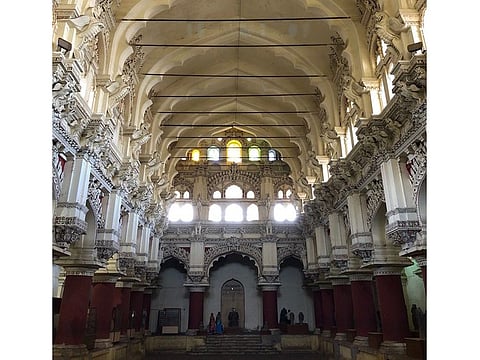
Bengaluru: Madurai is one of India’s oldest cities and has been continuously inhabited for more than 2,500 years, making it easily the oldest urban settlement not just in the state of Tamil Nadu, but also in the whole of South India.
Its fame not only comes from its ancient origin, but also as the fountain of Tamil culture, customs and language.
One of its ancient names is ‘Koodal’, which in Tamil means ‘a congregation of learned men.’ This is where the third Tamil Sangam is said to have taken place, a major foundational event in Tamil linguistic history.
The cultural capital of Tamil Nadu, Madurai is centred around its ancient place of worship, the Meenakshi Temple, which is a major centre of pilgrimage in South India.
Living civilisation
Located on the banks of River Vaigai, Madurai has always been coveted by major empires and kingdoms for the influence and power it held among people.
From Pandyas and Cholas to Nayaks and the Carnatic Sultanate as well as the British Raj, Madurai has seen many rulers, but it is actually the city that held sway over all those who either came with the sword or the pen.
Among all those who made Madurai their home, one king stands out and has left a lasting impression on the soul of the city he loved, Thirumallai Nayak of the Nayak Dynasty.
Thirumallai Nayak, who ruled over much of the Tamil country from 1623 to 1659, was a true visionary and the tallest leader of the Nayak Dynasty.
The great builder and the patron of art and culture that he was, Thirumallai Nayak transformed the city of Madurai into the leading city of South India during his time, attracting scholars and artisans not just from different parts of India but learned and skilled men from Europe and Middle East also found home in the city.
Nayak’s finest project, the Thirumallai Nayak Palace, also known as Madurai Palace, is the greatest example of the diversity of influences that shaped his vision.
The Nayak Dynasty ruled over much of present day Tamil Nadu and some adjoining territories for almost 200 years from 1545 to 1740.
Ageing wonder
Often, we take the ageing wonders of the past as ruins, but they are hardly that. In reality, they are the defiant souls that challenge the vagaries of time and elements.
Monuments are the transient symbols of human vision, which remain alive even if everything else around it collapses.
A monument is not just made of carved ceilings, intricate inlays, giant doors and colonnades or the ornamental stuccos. It’s the life size vision of a dreamer who dared to bring it into reality.
It speaks of his taste, class and ambitions. It is a living embodiment of the architect who left a piece of him behind for the posterity to admire and remember him.
It not only takes us back in time, helping us conjure up the distant past, but it actually gives us a vision of the future that the builder saw.
Such is the story of Thirumallai Nayak Palace - a story of audacious vision, scale and survival.
Though, bereft of much of its original grandeur, the Madurai Palace or what remains of it is an architectural marvel for more reasons than one.
Built in 1636 by the greatest king of Madurai’s Nayak dynasty, Thirumallai Nayak, it is among the oldest surviving palaces in South India. It is also among the earliest monuments in South India with considerable European influences.
Architectural Marvel
Designed by an Italian architect, this monument represents a fine blend of Dravidian, Islamic and Italian styles of architecture.
Restored and renovated periodically since 19th century, first by the British Raj and then by the archeological department of the Tamil Nadu government, only a quarter of the original structure is standing now.
Surprisingly, the downfall of this great palace wasn’t caused by the elements, it was the rather jealous and over-ambitious grandson of Thirumallai Nayak, who tore it down and took away all the jewels and ornaments of the palace to build his own fantasy in another city.
His hubris-filled dream didn’t come to fruition and what we are left with now is only the remnant that is big enough to help us imagine would have been.
Spread over 41,979 square feet, the palace stands on 248 pillars that rise up to 20 metres and have a circumference of four metres each.
Built without a single rafter or girder, this wonder has some stunning stucco works and magnificent arches. As a lover of heritage, it’s easy to lose yourself in this forest of columns and wonder what man is capable of.
Depending on what impulses drive a man, he either becomes a builder or a destroyer!


