India’s CJP protests explained: Why leaders were detained and what happens next
CJP founder Abhijeet Dipke was detained with two leaders as Ajinkya Shinde took over
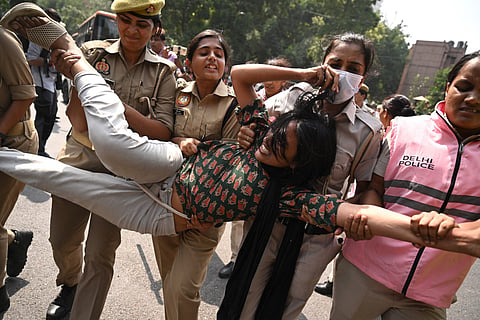
New Delhi witnessed a major security clampdown on Saturday, October 10, as police detained protesters, activists and opposition figures during demonstrations demanding the resignation of Chief Election Commissioner Gyanesh Kumar over a controversial voter-list revision.
The protests were called by the Cockroach Janta Party (CJP), a satirical online movement that has grown into a youth-led campaign on unemployment, alleged examination irregularities and government accountability. The group said its founder, Abhijeet Dipke, and senior leaders Saurav Das and Ashutosh Ranka were detained after their flight from Mumbai landed in Delhi.
Get updated faster and for FREE: Download the Gulf News app now - simply click here.
With its top leadership in custody, the CJP has named national organising in-charge Ajinkya Shinde to lead the movement. Shinde has urged supporters to continue marching towards Jantar Mantar, warning that wherever police stop them could become a protest site.
The police operation extended beyond CJP members, with opposition leaders and other activists also reported detained during separate demonstrations. Authorities tightened security across the capital, restricted access to the planned protest area and closed Metro stations.
The confrontation centres on the Election Commission of India’s Special Intensive Revision (SIR) of electoral rolls. The commission says the exercise is intended to ensure accurate voter lists, while critics fear eligible citizens could be excluded.
Here is what happened, who was detained, what they said and why the dispute has escalated.
What happened in Delhi on October 10?
CJP founder and two senior leaders detained: The group said Abhijeet Dipke, Saurav Das and Ashutosh Ranka were detained after their flight from Mumbai landed in Delhi. CJP alleged that police boarded the aircraft before the passengers could disembark.
Leaders’ whereabouts initially unclear: The CJP said the three were taken to an undisclosed location and alleged they were unable to contact lawyers. These were claims made by the group.
Ajinkya Shinde takes over: The CJP confirmed that Shinde would lead the movement until the detained leaders were released. The handover had been planned in advance.
Conflicting detention figures: Delhi Police sources put the number of people detained across the capital at around 1,000. CJP leader Ajinkya Shinde separately claimed at a news conference that more than 15,000 protesters had been detained. The figures differ significantly and should not be treated as a single confirmed total.
Opposition leaders reported detained: Former West Bengal chief minister Mamata Banerjee, former Delhi chief minister Arvind Kejriwal and former Kerala chief minister Pinarayi Vijayan were among opposition figures reported detained during separate demonstrations.
Activists and other public figures held: Student activist Neha Bora and economist Jean Drèze were reported detained. The CJP also claimed that YouTuber Dhruv Rathee had been detained from his home in Gurugram.
Security measures intensified: Authorities deployed thousands of police personnel, closed 46 Metro stations, increased security at Delhi’s entry points and established temporary detention centres. Mobile internet services were also reportedly suspended around the protest area.
Clashes reported: Police reported stone-pelting near Connaught Place during efforts to disperse demonstrators. A police officer was reportedly injured, although accounts of the confrontation and its circumstances varied.
Dipke informed of a family death: Delhi Police informed the detained CJP founder that his grandmother had died in Santuk Pimpri village in Maharashtra’s Hingoli district. Police offered assistance to help him travel for the funeral on humanitarian grounds.
Photos: Scenes from the CJP protests
A look at the protests, police detentions, barricades and security measures in India’s capital.
Why were protesters gathering at Jantar Mantar?
The CJP called the demonstration to demand the resignation of Chief Election Commissioner Gyanesh Kumar and an end to the ECI’s Special Intensive Revision of electoral rolls.
The group and opposition parties have questioned whether the revision is being conducted fairly and whether it could affect eligible voters. They have also accused the election authorities of favouring Prime Minister Narendra Modi’s ruling Bharatiya Janata Party (BJP), allegations rejected by the ECI and BJP.
Police said permission had not been granted for the planned CJP gathering at Jantar Mantar. Officers moved to prevent protesters from assembling at the designated site, while the CJP urged supporters to continue demonstrating wherever police stopped them.
The dispute quickly developed into a wider confrontation over the right to protest, the detention of political figures and concerns about the fairness of India’s electoral process.
Who has been detained, and what did they say?
Abhijeet Dipke, CJP founder
Dipke was detained along with Saurav Das and Ashutosh Ranka after their flight from Mumbai landed in Delhi. According to the CJP, police boarded the aircraft before the passengers had disembarked.
The group initially said the three leaders had been taken to an undisclosed location and that their whereabouts were unclear. It also alleged that they were denied access to lawyers and contact with others.
Before his detention, Dipke recorded a video naming Shinde as his successor if the senior leadership was detained.
“After us, Ajinkya will lead this movement,” he said in the video, which was released after the arrests.
Dipke was later informed of his grandmother’s death. Police offered assistance to help him return to Maharashtra for the funeral.
Ajinkya Shinde, the new protest leader
Shinde took over the CJP’s leadership after the detention of Dipke and the other senior figures. The group said the succession plan had been prepared in advance.
In a video posted on Instagram, Shinde called on supporters to continue marching towards Jantar Mantar.
“If Delhi Police tries to stop us, wherever they stop us will become our Jantar Mantar,” he said.
At a news conference, Shinde claimed that more than 15,000 protesters had been detained, a figure substantially higher than the around 1,000 detentions cited by Delhi Police sources.
Shinde, 35, is from Latur in Maharashtra and holds a BTech degree from Dr Babasaheb Ambedkar Technological University. He was appointed the CJP’s national organising in-charge in August 2026 and has been involved in its Mumbai operations, the “School Thik Karo” campaign and protests at Shivaji Park.
He has also been named in an FIR alongside Dipke, Das, Ranka, Pranav Ahire and more than 400 supporters, according to reports supplied for this explainer.
Shinde’s reported past links to the Aam Aadmi Party have also drawn attention. His social media profiles were previously described in reports as identifying him as a former convener of the AAP youth wing in Maharashtra and a former co-in-charge for Goa. These reported past associations do not establish that he remains an AAP member.
Saurav Das and Ashutosh Ranka
Das and Ranka were detained alongside Dipke after their flight arrived in Delhi. The CJP said the three were taken away by police and initially could not be contacted.
The group alleged that the leaders were taken to an undisclosed location and that access to lawyers was restricted. Police said the planned gathering at Jantar Mantar had not been authorised.
Mamata Banerjee, Arvind Kejriwal and Pinarayi Vijayan
Former West Bengal chief minister Mamata Banerjee, former Delhi chief minister Arvind Kejriwal and former Kerala chief minister Pinarayi Vijayan were also reported detained during separate demonstrations.
Their detentions added to the political tensions surrounding the day’s protests, which had brought together CJP supporters, opposition figures and campaigners challenging the voter-list revision.
Neha Bora and Jean Dreze
Student activist Neha Bora was reported detained and urged supporters to “hold the line” at Safdarjung flyover.
Economist Jean Dreze was also reported detained at the protest site. Their detentions added to concerns raised by campaigners about the handling of demonstrations and the scope of the police operation.
Dhruv Rathee
The CJP claimed that YouTuber Dhruv Rathee had been detained from his home in Gurugram. The claim was made by the group and should be distinguished from independently confirmed details about the detentions.
Who is Abhijeet Dipke, and how did the CJP begin?
Dipke, 30, launched the Cockroach Janta Party online in May 2026. The movement began as satire before developing into a youth-led campaign focused on unemployment, alleged examination irregularities and government accountability.
The idea followed remarks attributed to Chief Justice of India Surya Kant comparing some unemployed young people to cockroaches. The judge said the remarks had been taken out of context and referred to people obtaining work using fake degrees.
Dipke turned the remark into an online campaign, asking what would happen if all the “cockroaches” came together. The name became a satirical identity for the group, which used social media to attract supporters and organise protests.
The CJP is not a registered political party. Dipke had previously been associated with the opposition AAP.
The movement’s first major campaign focused on alleged irregularities in a medical entrance examination. Its July protests were followed by the resignation of then Education Minister Dharmendra Pradhan.
The group’s latest campaign targets the ECI’s voter-list revision and Kumar, whom it wants to resign.
What is the Special Intensive Revision (SIR)?
The Special Intensive Revision is a large-scale exercise to verify and update India’s electoral rolls. It involves door-to-door checks and the preparation of revised voter lists, rather than relying only on routine updates.
The exercise began in Bihar in June 2025 and has since expanded to other states and union territories.
The ECI says SIR is intended to remove deceased voters, duplicate entries and people who are ineligible or fraudulently registered. It has also cited the need to prevent foreign illegal immigrants from voting.
However, critics say the process could exclude eligible voters, particularly people from marginalised and minority communities who may face difficulties producing the required documentation or verifying their details.
Indian media reports citing ECI data said more than 133 million names had been excluded from draft voter lists. The figure refers to exclusions from draft rolls and does not, by itself, establish how many eligible voters may have been wrongly removed.
The central dispute is whether SIR is improving the accuracy of electoral rolls or risks disenfranchising citizens who are entitled to vote.
Why are protesters demanding Gyanesh Kumar’s resignation?
The CJP and opposition parties accuse the ECI of conducting the revision unfairly and potentially benefiting the BJP. They argue that the process requires greater transparency and safeguards to ensure eligible voters are not removed.
The controversy intensified after The Indian Express reported that key decisions related to the revision may have been taken without the approval of two of the three election commissioners.
The ECI disputed the allegations, maintaining that its decisions were unanimous and legally valid.
The protests have therefore become about more than a technical update to voter lists. They have raised broader questions about electoral fairness, the independence of institutions and the right of citizens to challenge decisions affecting their voting rights.
Why has the police response drawn criticism?
Authorities introduced extensive security measures ahead of the planned demonstration, citing the need to maintain law and order.
Police barricaded parts of central Delhi, tightened security around Jantar Mantar and increased checks at entry points to the capital. Janpath Market was reported to be unusually quiet and affected by barricades. Authorities also closed 46 Metro stations and reportedly suspended mobile internet services around the protest area.
Police created operational zones and temporary detention facilities as officers attempted to prevent demonstrators from assembling at the planned site. Some journalists from Scroll and Newslaundry were also briefly detained, according to reports.
Amnesty International criticised what it called “lockdown-like restrictions”, arguing that peaceful protesters should be able to demand accountability without intimidation or arbitrary detention.
Congress leader Shashi Tharoor questioned the restrictions, saying a government confident in the fairness of elections should welcome scrutiny and provide answers.
Delhi Police said permission had not been granted for the CJP gathering at Jantar Mantar. The force said its responsibility was to allow people to raise concerns peacefully while maintaining public order and ensuring that the city continued to function.
Police reported stone-pelting near Connaught Place during efforts to disperse protesters. Accounts of the confrontation varied, and allegations made by protesters and police should be considered separately.
What have the government and BJP said?
BJP spokesperson Sambit Patra dismissed the CJP’s protest efforts as an attempt to spread “anarchy”. He said the developments did not reflect the wider situation in India and described the country as calm and progressing under good governance.
The BJP has defended the government’s position, while the ECI maintains that the voter-list revision is lawful and necessary to ensure accurate electoral rolls.
The authorities’ position is that the revision is an electoral-administration exercise, while protesters argue that its implementation could affect voting rights and requires greater accountability.
The confrontation has become a political challenge for the government as opposition parties continue to raise questions about voter eligibility and electoral fairness.
What did Sonam Wangchuk and other critics say?
Climate activist Sonam Wangchuk said he would consider another hunger strike or a peace march if detained protesters were not released within 24 hours.
Wangchuk had undertaken a 26-day hunger strike during the July CJP protests and was hospitalised on the 20th day. He described the latest situation as resembling an “undeclared Emergency” and said he hoped dialogue could resolve the confrontation.
Amnesty International’s criticism of the “lockdown-like restrictions” and Tharoor’s call for the government to answer questions added to pressure over the police response.
Analyst Nilanjan Mukhopadhyay told AFP that Modi appeared “at his weakest politically and individually”, suggesting the controversy could become a bigger challenge for the government.
What happens next?
The CJP has urged supporters to continue demonstrating wherever police stop them, while Shinde has taken over leadership following Dipke’s detention. The group says the movement will continue until its demands are addressed.
Wangchuk has said he would consider further peaceful action, including a hunger strike or march, if detainees were not released within 24 hours.
The immediate questions are whether the detained CJP leaders and other protesters will be released, whether demonstrations will continue at or near Jantar Mantar, and how authorities will respond to further gatherings.
The larger dispute over SIR remains unresolved. The ECI says the exercise is necessary to maintain accurate voter lists; critics fear eligible citizens could be excluded and question whether the process is being conducted fairly.
For now, the protests have brought electoral-roll revision, the handling of dissent and the right to peaceful assembly into a wider national debate.
With inputs from Agencies


