India’s Supreme Court gives student protesters a clean slate, CJP calls off Delhi march
Court protects future of young protesters as CJP calls off planned September 5 march
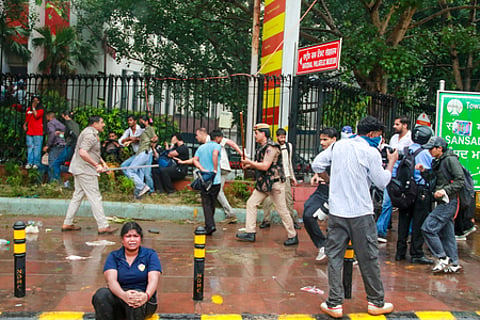
Dubai: India’s Supreme Court on Tuesday quashed criminal cases arising from July’s nationwide student protests, saying the future prospects of young demonstrators should not be damaged, in a sweeping order that prompted protest leaders to call off a planned September 5 march in New Delhi.
Invoking its extraordinary powers under Article 142 of the Constitution, a bench headed by Chief Justice of India Surya Kant ordered that FIRs linked to protests held between July 20 and 25 be closed across India and that no fresh cases be registered over those events.
The order followed an assurance from the Centre that cases against protesters would be withdrawn and no new FIRs filed in connection with the demonstrations, IANS reported.
“Keeping in view the future prospects of the young protesters who came to participate in a peaceful protest to raise their voice in support of certain demands, we deem it appropriate to invoke our powers under Article 142,” the court said.
The ruling covers cases not only in Delhi, Bihar, Assam, West Bengal and Maharashtra — whose authorities had sought their withdrawal — but in every state and Union Territory.
One major exception
The court, however, carved out an exception for 2,873 people at the Jantar Mantar protests who Delhi Police said had serious criminal antecedents.
Police were permitted to pursue a single FIR against them, strictly limited to allegations involving bodily harm and destruction of property.
NDTV reported that the Centre’s assurances followed commitments made to leaders of the Cockroach Janata Party (CJP) on July 25 after the protests.
What the Supreme Court ordered
July 20-25 FIRs: Cases arising from the student protests to be closed nationwide
No new cases: States and Union Territories cannot register fresh FIRs over those protest events
2,873 exception: Delhi Police can pursue one FIR against people with serious criminal antecedents
Limited allegations: That FIR must concern bodily harm or destruction of property
September 5 march: CJP withdrew its planned Delhi protest after the ruling
Compensation: Centre given three months to formulate a pan-India policy
Article 142: Supreme Court used its extraordinary constitutional power to deliver “complete justice”
Not a precedent: Court said the decision was specific to the circumstances of this case
Solicitor General Tushar Mehta told the court that the Centre and the governments of Bihar, Assam, West Bengal and Maharashtra had filed applications seeking to quash cases arising from the protests.
During the hearing, the bench stressed the importance of resolving the dispute through dialogue and trust.
When the court suggested the issue could be resolved if the two sides trusted each other, Mehta said they had approached it “constructively and positively”, adding: “We are not enemies.”
September 5 march dropped
The decision immediately defused another potentially large confrontation in the capital.
CJP co-convener Saurav Das told the court that, following the government’s assurances and the Supreme Court’s intervention, the group was withdrawing its call for a September 5 protest.
The CJP had announced a march from India Gate to New Delhi Police Headquarters, accusing the government of failing to honour promises made following the July demonstrations.
A day earlier, the Supreme Court had declined to stop the proposed march, saying there were no compelling grounds to presume it would create a law-and-order problem.
Compensation policy ordered
Tuesday’s ruling went beyond the criminal cases.
The Centre also reiterated its commitment to compensate families of students who died by suicide in connection with academic issues, including the NEET-UG 2026 examination.
The Supreme Court directed the government to formulate a pan-India compensation policy within three months, in consultation with state governments, IANS reported.
The mechanism is intended to provide a uniform framework that states and implementing authorities can follow.
The court nevertheless stressed that its use of Article 142 arose from the unusual circumstances of the case and should not be treated as a binding precedent.
Its intervention effectively delivers the protesters two of their key demands: an end to criminal proceedings arising from the July demonstrations and a timetable for a nationwide compensation mechanism.
For thousands of students, however, the most immediate consequence is simpler: Participation in the July protests will no longer leave them facing a criminal case that could follow them into their future.


