India: Lok Sabha passes Waqf (Amendment) Bill after marathon debate
Opposing the Bill, Owaisi dramatically tears a copy of it in the House
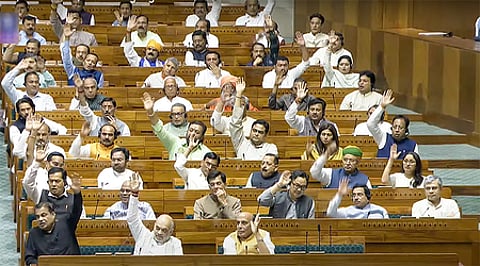
New Delhi: The Waqf (Amendment) Bill 2025 remained a major point of contention in the Lok Sabha on Wednesday as it was tabled for discussion. Following a marathon debate lasting nearly 12 hours, the Bill was passed in the early hours of Thursday with a majority of 288 votes against 232.
Union Home Minister Amit Shah, intervening in the debate, strongly criticized the previous UPA government for its 2013 amendments to Waqf laws. He described them as politically motivated and rushed before the 2014 elections, highlighting the transfer of "123 VVIP properties" in Delhi’s Lutyens zone to Waqf authorities as a consequence.
Shah argued that had these amendments not been made, the current Bill would not have been necessary.
Defending the Bill, Union Parliamentary Affairs Minister Kiren Rijiju dismissed accusations of targeting the Muslim community.
He pointed out that the previous government had established separate Waqf boards for Sunni, Shiite and other sects, whereas the current administration proposed a unified board to promote unity.
Addressing concerns about non-Muslim involvement in religious matters, Rijiju clarified that Waqf and the Waqf Board are distinct entities.
On the role of the district collector, he stated: "The collector oversees revenue and administration; he is the district’s welfare officer. If we cannot trust him, whom shall we trust?"
Rijiju also responded to AIMIM chief Asaduddin Owaisi’s claims that the Bill insults Muslims, emphasizing that similar measures for Hindus already exist and that the amendments aim to ensure accountability and protect land rights for all citizens.
Opposing the Bill, Owaisi dramatically tore a copy of it in the House. Meanwhile, Jagdambika Pal, Chairman of the Joint Parliamentary Committee (JPC) on the Bill, assured that it would bring significant benefits to the Muslim community, dismissing allegations that it was being pushed for electoral gains.
Ulterior motives
Amid widespread criticism, Syed Naseruddin Chishty, Chairman of the All India Sufi Sajjadanashin Council, refuted claims that religious properties would be seized under the Bill. He urged people not to believe such misinformation, stating that the legislation merely introduces stricter regulations to prevent misuse of Waqf properties.
The Opposition strongly opposed the Bill. Congress MP Gaurav Gogoi labeled it an "attack" on Parliament and the Constitution, alleging that the government had ulterior motives targeting the Muslim community. Samajwadi Party President Akhilesh Yadav questioned the clarity of the Bill, while senior Congress leader Rashid Alvi vowed that his party would revise the Waqf law if it returns to power in 2029.
The National Commission for Minorities (NCM) chairman, Iqbal Singh Lalpura, backed the Bill, stating that it serves the larger interest of the community and poses no harm to Muslims.
In Jammu and Kashmir, all political parties except the BJP opposed the Bill, with Chief Minister Omar Abdullah declaring it unacceptable. Congress spokesperson Pawan Khera called the Bill "anti-Muslim" and "anti-constitutional," claiming it undermines the principles of equality, federalism, and minority rights.
Congress MP K.C. Venugopal accused the government of using the Bill to foster division along religious lines.
Despite heated debates and political pushback, the Bill was passed, marking a significant moment in the ongoing discourse over Waqf legislation in India.


