BBC’s ‘voice of India’ Mark Tully passes away at 90
From war zones to everyday life, the broadcaster gave the world a rare window into India
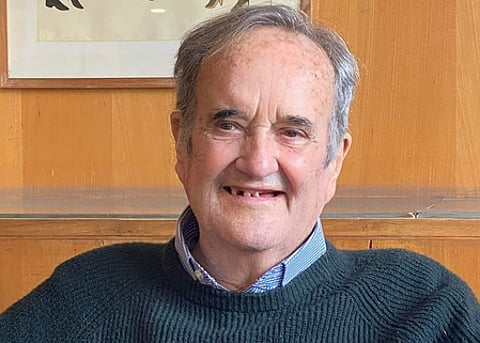
Dubai: Sir Mark Tully, the broadcaster and journalist who for decades shaped the BBC’s coverage of India and South Asia, has died at the age of 90.
With his distinctive warm voice and deep understanding of the country, Tully became one of the most respected foreign correspondents of his generation, admired by audiences in Britain and across the world.
Born in Calcutta in 1935 during the British Raj, Tully grew up in India before being sent to Britain for schooling after World War Two. He later studied history and theology at Cambridge, briefly considering life as a clergyman before turning to journalism.
He joined the BBC in 1965 and was posted to India, initially in an administrative role but soon emerging as a reporter with a unique style and deep insight into Indian society. Over time, he became fluent in Hindi — a rare achievement among foreign correspondents — earning affection across the country, where many referred to him as “Tully sahib”.
Tully went on to serve for more than 20 years as the BBC’s bureau chief in Delhi, overseeing coverage not just of India but of South Asia as a whole. His reporting spanned some of the region’s most dramatic moments, including wars, famines, political upheavals, the Bhopal gas disaster and the storming of the Sikh Golden Temple.
He was present in Ayodhya in 1992 when a mob demolished the Babri mosque, an event that triggered some of the worst communal violence in decades. During the chaos, he was threatened by hardliners and held in a locked room for hours before being rescued by local officials.
Though deeply attached to India, Tully was expelled briefly during Indira Gandhi’s Emergency in 1975 but returned 18 months later and remained based in Delhi for the rest of his life.
Who was Mark Tully?
British journalist and broadcaster
Long-time BBC correspondent in India and South Asia
Served over 20 years as BBC bureau chief in Delhi
Known as the BBC’s “voice of India”
Born in Calcutta in 1935 during British rule
Fluent in Hindi and deeply connected to Indian society
Covered wars, riots, assassinations and major disasters
Witnessed the 1992 Babri mosque demolition in Ayodhya
Expelled briefly during India’s Emergency in 1975
Presented BBC Radio 4’s Something Understood
Author of several acclaimed books on India
Awarded Padma Shri and Padma Bhushan
Knighted in Britain in 2002
Later became an Overseas Citizen of India
In the early 1990s, he publicly criticised the BBC’s management for running the organisation through what he described as a culture of fear, eventually resigning in 1994.
However, he continued to broadcast on BBC Radio 4, notably presenting the programme Something Understood, which explored spirituality and human experience.
Tully was honoured by both India and Britain. He received the Padma Shri and Padma Bhushan — two of India’s highest civilian awards — and was knighted in the UK in 2002 for his services to journalism.
An accomplished author, he wrote several books on India, including No Full Stops in India, India in Slow Motion, and The Heart of India.
Though he retained British citizenship, he later became an Overseas Citizen of India, describing himself as belonging to both nations.
Tributes have poured in from journalists, academics and public figures, many praising him as a bridge between cultures and a towering voice in journalism.


