China nails first reusable rocket booster landing in dazzling sea catch
Long March 10B sea landing makes China third to master reusable orbital boosters
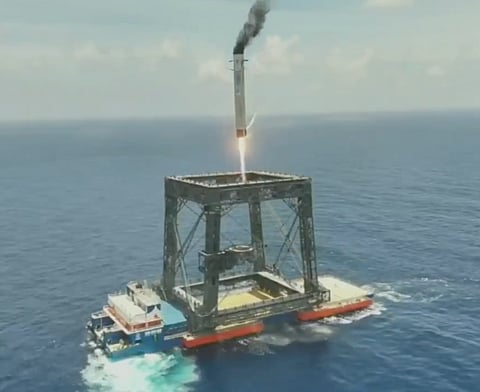
China on Friday successfully launched the Long March 10B rocket on its maiden flight and achieved the nation’s first controlled recovery of an orbital-class rocket booster, a major step forward in its ambitions to develop reusable space launch technology.
Get updated faster and for FREE: Download the Gulf News app now - simply click here
The rocket lifted off at approximately 12:15 pm local time (0415 GMT, 8.15 am Gulf) from the Wenchang Commercial Space Launch Site in Hainan province.
The first stage was recovered about six minutes after separation using an innovative net or cable system on an offshore platform in the South China Sea, state media and the China Aerospace Science and Technology Corporation (CASC) reported.
The upper stage successfully delivered its payload — understood to support satellite constellation development — into the planned orbit.
Third in the world
Friday’s mission marks the third time globally that an orbital-class reusable booster has been recovered, following systems developed by SpaceX and Blue Origin.
It comes after earlier Chinese attempts at booster recovery by other rockets ended in failure last December.
The Long March 10B is a partially reusable, cargo-focused variant derived from the Long March 10 series, which is being developed to support China’s crewed lunar programme.
Officials have described the rocket as using a five-meter-diameter first stage powered by YF-100K engines and employing a wire/net recovery approach rather than traditional landing legs to reduce weight. CASC hailed the flight as a “complete success” and a breakthrough in reusability that will help lower launch costs and increase launch cadence.
Experts cited by Chinese media called it China entering the “rocket recovery era.”No immediate details were released on the number of future reuses planned for the recovered booster or the exact payload manifested on the debut flight.
The achievement comes as China accelerates development of multiple reusable rocket families to rival commercial leaders in the West.
Post-flight analysis
Video of the dramatic vertical descent and net capture has gone viral on Chinese social media and platforms including X, drawing widespread international attention.
CASC said post-flight analysis of the recovered hardware is underway.
Additional Long March 10 series flights are expected in the coming months as China prepares for more ambitious lunar and low-Earth orbit missions.


